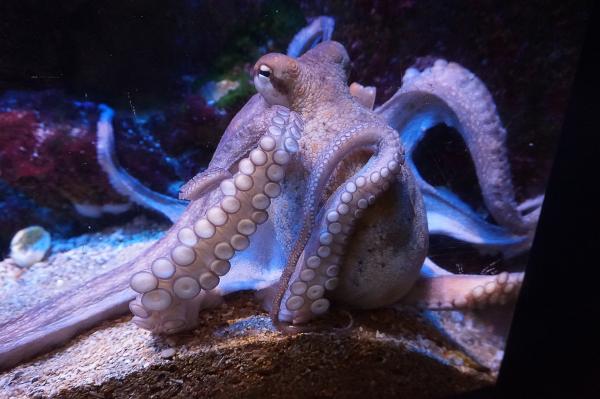
The octopus is undoubtedly one of the most fascinating marine animals in the world. Their complex physical characteristics, great intelligence, and behavioral eccentricities have aroused the interest of marine biologists, school students, and pretty much anyone who has even a casual interest in the animal kingdom. The fascination elicited by the octopus relates to almost every aspect, but we can generally break them up into two groups: behavior and physical characteristics.
For our AnimalWised readers, we know there is an appetite for octopus facts that are both interesting on their own and helpful in revealing our relationship to animals in general. That's why these 20 amazing octopus facts also reveal the crazy, funny, and weird nature of these incredible mollusks.
Amazing facts about octopus behavior
The behavior of the octopus leads us to some of the most fascinating facts about this amazing creature. It is true the animal's behavior and morphology are greatly linked, but how they are able to interact with their environment and learn about it has continually opened up minds about the perceived limitations of animal consciousness. Our fun facts about octopus behavior are:
- The octopus, although not particularly long-lived and expressing a solitary lifestyle, is able to learn from other members of its species. This was shown in a 1992 study where octopuses were shown another octopus performing a task requiring an object to be picked up. When it came time to be their turn, the observer octopus in repeated tests picked up the same object as they had been shown to do[1].
- Octopuses not only learn by observing, but they have an innate problem-solving ability. This is observed in a 2016 experiment where different octopuses were given a complex task that required them to push or pull to retrieve food from an L-shaped box. The study showed that the octopus exhibits “behavioral flexibility by quickly adapting to a change in a task”[2].
- The marine mollusk can also learn by operant conditioning. This is a process whereby the octopus learns from both receiving positive rewards and experiencing negative consequences for their actions.
- Their cognitive capacity is demonstrated by carrying out different behaviors depending on the stimulus present and how it affects their survival. They do this via a process of exploration and habituation. Initially, they explore their environment, then get used to the stimuli in said environment and learn what is and what is not safe. Their drive is not dependent solely on hunger, and at least one study suggests that they may engage in a form of ‘play’[3].
- Another interesting octopus fact is that they are capable of transporting materials to build their own shelters, even if they have difficulty moving and doing so may temporarily put their survival at risk. In this way, they create the opportunity to survive longer.
- Octopuses apply significantly different pressure when manipulating different utensils. They do the same when attacking prey or when they are defending themselves against predators. For example, they know to hold on more tightly to a fish that is trying to swim away than a tool they may pick up for carrying purposes. The use of tools is in itself an amazing fact about octopuses, something not every marine biologist may have believed. A study in 2009 showed octopuses picking up coconut shells, washing them in water jets, and then carrying them for use later[4].
- They recognize and can differentiate their own amputated tentacles from those of members of the same species. According to one study, 94% of the octopus studied neither ate nor discarded their tentacle. Instead, they transported them back to their shelter by carrying them in their beak. This indicates a level of self-awareness that is quite rare in the animal kingdom.
- As a means of survival, the octopus can imitate poisonous species in their environment. This is possible thanks to their long-term memory capacity. Memory reflects on their defensive behavior as they can learn from past experiences. They remember which species pose threats and mimic their appearance to deter potential predators.
- The octopus has pre-synaptic facilitation of serotonin, a neurotransmitter which can influence mood, emotion, and even result in depressive states in a wide range of animals, including humans. It is for this reason that the The Cambridge Statement on Consciousness was created. This was a momentous moment in biology where neuroscientists made a statement supporting the views that animals have been underestimated by the scientific community in their consciousness levels.
- The organization of the octopus' motor skills and intelligence levels it possesses have been fundamental in the construction of large-capacity robots. This is mainly due to their complex biological systems, which inspire robotic design and artificial intelligence research.

Amazing facts about octopus biology
We continue our amazing octopus facts by looking at the physicality of the animal. They have unique bodies which allow for some crazy maneuvers, even making escape attempts from aquariums. However, this is only the start of it. Read more cool octopus facts here:
- Octopuses can walk, swim, and cling to any surface thanks to their powerfully strong suction cups. For this, they need three hearts, one which works exclusively to power their bulbous head, the other two to pump blood to the rest of their body. It was by using this great strength that Inky the octopus was able to escape from his tank at a New Zealand aquarium and climb down a 50 m drainpipe to freedom in the ocean[5].
- Despite their incredible suction strength, an octopus cannot become entangled with itself thanks to a substance secreted on their skin which prevents this from happening. This adaptability allows them to move gracefully in their complex underwater environments.
- Like chameleons and various other color-changing animals, the octopus can change the pigment of its skin to better hide in its environment. They do this by using specialized cells known as chromatophores which house different colored pigments. Not only can they change color, but they can adapt to the different patterns and textures found in their environment. This ability enhances their camouflage and communication within their habitats.
- If a tentacle is amputated for any reason, the octopus is able to regenerate the limb. This is similar to other marine creatures such as the starfish. This regenerative ability is crucial for survival, allowing them to recover from injuries that would be debilitating to other creatures.
- Another interesting tentacle fact is that they are extremely flexible and have almost infinite movement capacity. To ensure proper control, the octopus moves their tentacles in preset patterns, almost like a tank. This reduces the tentacle's movement, allowing greater control of the body and better ensuring safety. Their dexterity is unmatched in the animal kingdom, allowing for precise manipulation of objects.
- The octopus is colorblind. They have particular difficulty in discriminating between red, green, and, sometimes, blue shades. Despite this, they still manage to camouflage effectively, suggesting other sensory mechanisms help them perceive their surroundings.
- An octopus has about 500 million neurons. This is about the equivalent of a dog and about 6 times more than that of a mouse. Of these, about 350 million neurons are in their 8 arms. They use these to process a vast array of sensory information, something that has led some researchers to believe the tentacles may have a ‘mind of their own’[5]. This neuronal distribution allows for complex problem-solving and environmental interaction.
- Each tentacle also has about 40 million chemical receptors. This is why each individually is considered a sensory organ. These receptors play a crucial role in their foraging and mating behaviors, providing detailed chemical information about their environment.
- As the octopus lacks bones, the octopus uses muscles to structure their body. Muscles relax and contract according to their movement needs. Their motor control and boneless structure also allow them the ability to pass through apertures much smaller than many people would expect. They can even jump out of pools and catch prey on the surface of the land, using their tentacles to walk back into the water[4]. This ability highlights their adaptability and resourcefulness in diverse environments.
- There is a close relationship between the olfactory receptors of an octopus brain and its reproductive system. This is because they are able to identify the chemical residue that floats in the water left by other octopuses. Using this system, they can track mates. The suction cups on their tentacles are able to pick up the scent, providing them with essential information for reproduction.

If you have found these amazing octopus facts useful, maybe you will be interested in looking at these other incredible animal facts about marine animals like dolphins and some Arctic animals. We also have fact sheets about land-dwelling members of the animal community such as the sloth. Or get the best of both worlds with this information and facts about the platypus.
If you want to read similar articles to 20 Amazing Octopus Facts, we recommend you visit our Facts about the animal kingdom category.
1. Graziano, F., & Scotto, P. (1992). Observational Learning in Octopus Vulgaris. Science, 256 (5056), 545-547.
https://www.researchgate.net/publication/6052505_Observational_Learning_in_Octopus_vulgaris
2. Richter, J. N., Hochner, B., & Kuba, M. J. (2016). Pull or Push? Octopuses Solve a Puzzle Problem. Plos One, 11 (3): e0152048.
https://doi.org/10.1371/journal.pone.0152048
3. kuba, M. J., Byrne, R. A., & Meisel, D. V. (2006). Exploration and Habituation in Intact Free Moving Octopus vulgaris. International Journal of Comparative Psychology, 19(4), 426-438.
https://animalstudiesrepository.org/cgi/viewcontent.cgi?article=1056&context=acwp_asie
4. Finn, J. K., Tregenza, T., & Norman, M. D. (2009). Defensive Tool Use in a Coconut-Carrying Octopus. Current Biology, 19 (23).
https://doi.org/10.1016/j.cub.2009.10.052
5. Roy, E. A. (2016). The Great Escape: Inky the Octopus Legs it to Freedom from Aquarium. Retrieved November 5, 2019, from
https://www.theguardian.com/world/2016/apr/13/the-great-escape-inky-the-octop
1. Nesher, N., Levy, G., Grasso, F. W., & Hochner, B. (2014) Self-Recognition Mechanism between Skin and Suckers Prevents Octopus Arms from Interfering with Each Other. Current Biology, 24 (11).
https://www.ncbi.nlm.nih.gov/pubmed/24835454
2. Hooper, S. 2(2006) Motor Control: The Importance of Stiffness. Current Biology, 16 (8).
https://www.sciencedirect.com/science/article/pii/S0960982206013431
3. Albertin, C. B., et al. (2015). The octopus genome and the evolution of cephalopod neural and morphological novelties. Nature, 524, 220-224.
https://www.nature.com/articles/nature14668
4. Hochner, B. (2012). An Embodied View of Octopus Neurobiology. Current Biology, 22 (20).
https://www.sciencedirect.com/science/article/pii/S0960982212010640
5. Zarrella, I., et al. (2015). Learning and memory in Octopus vulgaris: a case of biological plasticity. Current Opinion in Neurobiology, 35, 74-79.
https://www.sciencedirect.com/science/article/abs/pii/S0959438815001063
6. Science Daily. (2019). How Octopus Arms Make Decisions. Retrieved November 5, 2019, from
https://www.sciencedaily.com/releases/2019/06/190625102420.htm