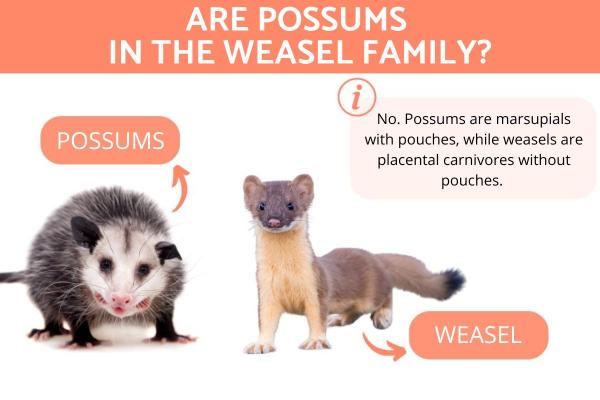
Often mistaken for one another due to their small size and nocturnal habits, possums and weasels represent distinct branches within the mammalian family tree. Possums are marsupials, while weasels are placental mammals. This fundamental difference reflects distinct reproductive strategies and evolutionary lineages.
This article from thedailyECO aims to clarify misconceptions about possums and weasels, emphasizing their distinct classifications and ecological roles by highlighting their unique characteristics.
Are possums in the weasel family?
No, opossums are not in the weasel family. They belong to a completely different group of mammals called marsupials, specifically, Didelphimorphia order and the Didelphidae family. They are characterized by having pouches for carrying their young. Weasels, on the other hand, are members of the Carnivora order, specifically the Mustelidae family. This family includes animals like weasels, stoats, badgers, otters, martens, and wolverines.
While both opossums and weasels are small, furry mammals with similar roles in their ecosystems, their evolutionary paths and biological characteristics are quite distinct. People who are unfamiliar with both species often confuse one for the other. In the following sections, we will delve into the primary characteristics and distinctions between these two species. It's fascinating to consider how these animals independently adapted to fill similar ecological niches despite their divergent ancestries.
Discover if possums pose any danger to humans in our next article.

Differences between possum and weasel
While opossums and weasels might share a fleeting resemblance at first glance, delving deeper reveals their unique evolutionary paths and biological characteristics. Possums diverged from other mammals about 130 million years ago, following a unique evolutionary path leading to marsupial traits like pouches and short gestation periods. Weasels, on the other hand, belong to a much larger group of placental mammals that emerged around 80 million years ago, giving birth to more developed young after longer pregnancies.
This evolutionary branching results in distinct behavioral and physical characteristics:
- Pouch: opossums are known for their pouch, where they carry and nurture their young after a short gestation period. Weasels lack pouches and give birth to more developed young after a longer pregnancy.
- Distribution: opossums are native to the Americas, while weasels have a wider global distribution across Asia, Africa, Europe, and North America. This widespread distribution allows weasels to occupy a variety of habitats and climates.
- Habitat: opossums can be both terrestrial and arboreal, whereas weasels are primarily ground-dwelling. This arboreal capability gives possums an advantage in escaping predators.
- Size: size can vary within each species, but as a general trend, opossums typically appear slightly larger than weasels. Opossums usually range from 17 to 100 cm (6.7 to 39.4 inches) in length and weigh between 10 grams to 2 kg (0.02 to 4.4 pounds), while weasels typically measure from 16 to 60 cm (6.3 to 23.6 inches) in length and weigh between 25 grams to 2 kg (0.06 to 4.4 pounds).
- Diet: opossums are omnivorous, consuming insects, small animals, fruits, and carrion. Weasels are primarily carnivorous, though some species eat fruits and vegetables as well. This varied diet helps possums adapt to different environments and available resources.
- Head: opossums have elongated snouts, while weasels have rounded faces.
- Tail: opossums have prehensile tails, allowing them to grasp branches, unlike the non-prehensile tails of weasels. This feature aids possums in climbing and balancing.
- Activity: opossums are primarily nocturnal or crepuscular, while weasels can be active during both day and night depending on the species. This nocturnal behavior in possums helps them avoid many predators.
- Social behavior: opossums are typically solitary animals, while some weasel species, like ferrets, live in social groups. This social behavior in certain weasels can aid in hunting and protection.
- Venom: while rare, some weasel species like the North American short-tailed weasel possess venom glands that can paralyze small prey. Opossums lack any form of venom. This venomous ability in weasels is a fascinating adaptation for capturing prey.
- Defense: possums are known for "playing dead," while weasels rely on speed and agility. Possums' "playing dead" involves mimicking the appearance and smell of a sick or dead animal to deter predators.
Unravel the fascinating world of marsupials! Dive deeper with our next article, where you'll encounter the diversity of these pouched wonders.

Examples of possums and weasels
Now that we've highlighted the most significant differences between these two animals, let's explore some specific examples of each so you can easily differentiate them in the future. By understanding these examples, it becomes easier to appreciate the diversity within each group.
Opossums:
- Common Opossum (Didelphis marsupialis): found from Mexico to Argentina, this species is classified as "least concern." It features yellow or orange and black or gray fur. This opossum is highly adaptable, thriving in both urban and rural environments.
- Virginia Opossum (Didelphis virginiana): native to North and Central America, it is also classified as "least concern." Its fur is gray, and it exhibits adaptability to various habitats, including urban areas where it often forages for food.
- Mouse Opossum (Cryptonanus chacoensis): occurring in Brazil, Argentina, and Paraguay, it is classified as "least concern." This species has brownish fur overall, with grayish or whitish ventral areas. It is one of the smallest, weighing barely 15 grams, yet plays a crucial role in the ecosystem as an insect predator.
- Bare-tailed Woolly Opossum (Caluromys philander): native to South America, including countries like Bolivia, Brazil, Guyana, and Suriname, it is categorized as "least concern." Known for its soft, brown fur, it primarily inhabits forested areas.
- Water Opossum (Chironectes minimus): ranging from Mexico to Argentina, it is also classified as "least concern." This semi-aquatic species boasts dense, water-repellent fur and webbed feet for swimming, making it unique among opossums.
Weasels:
- Mountain Weasel (Mustela altaica): native to Asia, including countries like China, India, and Russia, it is classified as "near threatened." Exhibits brown fur with white facial and body spots, living primarily in mountainous regions and preying on rodents. The mountain weasel's adaptability to cold climates is noteworthy.
- Lesser or Common Weasel (Mustela nivalis): widely distributed across America, Asia, and Europe, it is categorized as "least concern." Known as the smallest weasel species, it has short legs and brown fur, with a reputation for being a voracious hunter. Its small size allows it to pursue prey into burrows.
- Short-tailed Weasel or Stoat (Mustela erminea): native to the Americas, Asia, and parts of Europe, it is also classified as "least concern." Recognized for its long tail and hunting prowess, its fur changes from brown in summer to white in winter, a perfect camouflage in snowy environments.
- Japanese Weasel (Mustela itatsi): endemic to Japan, it is classified as "near threatened" and inhabits mountain forests. It features brown fur and plays a significant role in controlling pest populations.
- Amazon Weasel (Mustela africana): despite its scientific name, this species is native to South America, residing in Brazil, Bolivia, Peru, and Ecuador. Classified as "least concern," it sports a dark brown coat and primarily inhabits tropical forests, where it contributes to the balance of the local ecosystem.
Explore the unique biology and behavior of opossums in our next read.

If you want to read similar articles to Are Possums in the Weasel Family?, we recommend you visit our Facts about the animal kingdom category.
- Myers, P. (2001). Didelphimorphia . Animal Diversity Web. Available at: https://animaldiversity.org/accounts/Didelphimorphia/
- Myers, P., R. Espinosa, CS Parr, T. Jones, GS Hammond, and TA Dewey. (2024). The Animal Diversity Web. Available at: https://animaldiversity.org.
- IUCN (2024). The IUCN Red List of Threatened Species . Version 2023-1. Available at: https://www.iucnredlist.org.