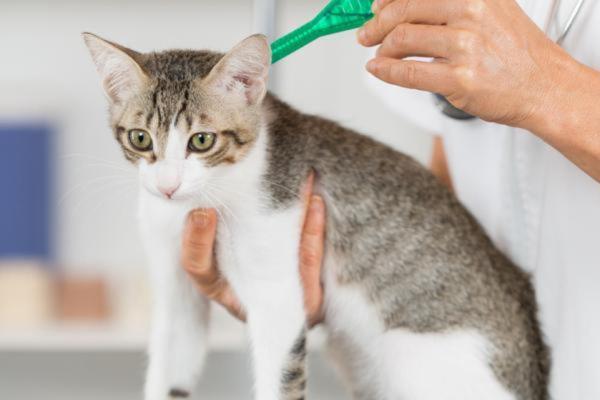
Broadline is a veterinary drug for the treatment of cats with a mixed infestation of internal and external parasites or at risk of such infestation. In other words, it is an all-in-one parasite treatment for cats that kills fleas, ticks, roundworms, and tapeworms. It is applied topically, directly on the skin in one spot, using a topical applicator that ensures accurate dosing. Broadline can be used every time for routine flea control or as part of a regular deworming program.
The following AnimalWised article explains what Broadline is for cats, how to administer it, and the possible side effects and contraindications.
What is Broadline?
Broadline is an external and internal antiparasitic commonly used in cats, i.e., it is effective against both internal and external parasites. It consists of a drug formulated in a spot-on solution for topical application, containing four active ingredients from the group of insecticides and acaricides. These are fipronil and (S)-methoprene, combined with eprinomectin as an endocide and praziquantel as a cestocide, which also acts against worms. Let us take a close look at how each of these ingredients works:
- Fipronil: kills adult fleas because it blocks the channels in their nerve cells, disrupting the transmission of nerve signals, leading to hyperstimulation and death.
- (S)-Methoprene: controls eggs, larvae and pupae, disrupting the flea life cycle at every stage.
- Eprinomectin: disrupts the channels in the nerve and muscle cells of roundworms that allow charged chloride particles (ions) to pass, causing their paralysis and death.
- Praziquantel: acts on the cell membranes of tapeworms, leading to the death of the parasite.
Fipronil and (S)-methoprene are distributed through the skin and stored in the oils of the skin and hair coat for long-lasting action against fleas and ticks. Eprinomectin and praziquantel are absorbed through the skin to effectively control roundworms, hookworms, and tapeworms.
In addition to its core ingredients, Broadline contains solvents and stabilizers to ensure the stability and efficacy of the active components. This formulation allows for an even distribution across the cat's skin, maximizing its protective benefits. Moreover, Broadline's unique composition helps avoid resistance build-up, which is a growing concern in parasite management.
What is Broadline for cats used for?
Broadline for cats is a flea and tick control product for cats that also kills roundworms, hookworms, and tapeworms in one topical applicator. Let us take a closer look at the various internal and external parasites Broadline can protect your cat from:
- Fleas: when people think of fleas, they often think of adult fleas, but adult fleas only account for about 5% of the problem. Cats pick up new fleas that develop from larvae, pupae, and eggs in their environment, including carpets, furniture, and bedding in the home. Broadline controls flea bite hypersensitivity by flea control and kills newly acquired fleas within 8-24 hours. It prevents flea eggs from hatching and can be used to treat and control tick infestations, bite lice, roundworms, hookworms, and tapeworms.
- Roundworms: these parasites are common, especially in young cats, and cause poor growth and diarrhea. The eggs can survive in the environment for years. These parasites also pose a zoonotic risk, especially to children.
- Hookworms: they can cause anemia or digestive issues in your cat. Infection occurs by ingestion of the larvae or by penetration of the skin. Hookworms are also a zoonotic parasite for humans.
- Tapeworms: these parasites are transmitted by ingestion of infected fleas or rodents. Tapeworms are a potential zoonotic disease for children if they ingest infected fleas. Tapeworm infestation may recur if control of intermediate hosts such as fleas, mice, etc. is not carried out.
- Lungworms: cats become infected by eating prey such as birds, rodents, and lizards. Cats that have access to outdoor areas are at higher risk. Lungworms can cause mild coughing to severe respiratory problems and even death.
Broadline not only targets existing infestations but also helps prevent future ones by breaking the life cycles of these parasites. For instance, flea larvae and eggs in the environment are targeted by the insect growth regulators in Broadline, minimizing the risk of re-infestation. Additionally, the product's broad-spectrum efficacy ensures that multiple parasite types are controlled with a single application, simplifying the parasite management process for cat owners.
For more information on other common parasites in cats, see this other article on intestinal parasites in cats, symptoms, and treatment.
Broadline application for cats
Broadline for cats is available in two volumes:
- 0.3mL: to treat cats from 0.8 – 2.4 kg
- 0.9mL: to treat cats from 2.5 – 7.4 kg
To apply Broadline, gently pull back the plunger, remove the cap, and place the tip of the applicator on the skin. Apply directly to the skin at a point in the midline of the neck between the base of the skull and the shoulder blades.
This product should be applied as follows:
- Do not inject, administer orally or by any other route.
- Avoid contact with the cat's eyes or mouth.
- Apply it to a skin area where the cat cannot lick it off: the neck, between the shoulders.
- Avoid the animals licking each other after the treatment.
- Wear gloves when handling the veterinary medicine. Wash hands immediately after application.
- Handling of treated animals should be restricted until the application site is dry. Children should not be allowed to play with treated animals during this time.
- Do not use on dogs.
- For long-haired breeds, be especially careful to apply directly to the skin and not to the hair, as this may reduce effectiveness.
Broadline can be used as part of a seasonal deworming program or routinely every 4-6 weeks to control external and internal parasites. In the absence of available data, do not repeat treatment at intervals of less than 2 weeks.
It should be noted that maintaining a consistent treatment schedule is crucial for optimal effectiveness. Skipping doses or inconsistent application can reduce the efficacy of Broadline, allowing parasites to survive and potentially develop resistance. This is especially important in multi-cat households, where treating all cats simultaneously helps prevent cross-infestation.
You may be interested in this other article on home remedies for deworming cats.

Side effects of Broadline for cats
Broadline is a very safe product. It can even be used in cats as young as eight weeks of age. However, as with any medication, some side effects may occur.
At the application site, there may be temporary matting of the hair and skin reactions such as itching and hair loss.
If the cat swallows the medication, you can expect vomiting and/or short-term nervous system effects. These include: disorientation, disinterest in the environment, and dilation of the pupils.
All of these signs resolve spontaneously within 24 hours.
In rare cases, some cats may exhibit more pronounced reactions such as temporary lethargy or changes in appetite. If these symptoms persist beyond 24 hours, it is advisable to consult a veterinarian to rule out any underlying issues. Proper application and adherence to dosage recommendations can minimize the risk of adverse effects.

Contraindications of Broadline for cats
As with any drug, there are a number of contraindications to using Broadline that must be taken into consideration:
- Do not use in sick or convalescent cats.
- Do not use if hypersensitivity to any of the active ingredients is known.
- Do not use in pregnant or lactating cats because safety has not been established.
- Do not use in other animal species.
Additionally, it is essential to store Broadline properly, away from direct sunlight and out of reach of children and pets. Misuse or improper storage can compromise the product's effectiveness and safety. Always follow the prescribed guidelines and consult a veterinarian if you have any doubts about its suitability for your cat.
You may be interested in this other article about how I know if my cat is sick.
This article is purely informative. AnimalWised does not have the authority to prescribe any veterinary treatment or create a diagnosis. We invite you to take your pet to the veterinarian if they are suffering from any condition or pain.
If you want to read similar articles to Broadline for Cats, we recommend you visit our Medicine category.
- Cimavet. Technical sheet of Broadline spot-on solution for cats. Available at: https://cimavet.aemps.es/cimavet/pdfs/es/ft/EU%402%4013%40157%40004/FT_EU-2-13-157-004.pdf