Snails are very interesting animals that can be kept at home and cared for as a pet. Due to the fact that snails aren't the most popular pets, you may be asking yourself how to care of a pet snail.
Continue reading this AnimalWised article to learn about creating the right habitat for your pet snail, as well as what diet to feed them and more! This way you will be well-informed with our guide on caring for a snail as a pet.
Snail Characteristics
If you're interested in caring for a garden snail in your home, you will first need to know a little more about them. Their main characteristics in the wild and their basic needs.
There are many types of snails, both land and marine. In this article we will speak specifically about garden snails, also known as gastropod molluscs. These snails have a lung and breathe air. In the wild, they live in damp or wet areas. When it comes to their physical appearance, snails are small. They have a hard shell and a slimy body. Their strong and muscular foot allows them to crawl through hard surfaces by using mucus.
These animals are herbivorous and feed on different types of vegetables that they gnaw on by using their radula. In their radula, they have around 40,000 tiny, backward-curved teeth. As the snail advances, it rubs them against the upper jaw, which is also serrated. With this mechanism the grinding of food is achieved. Food particles are processed thanks to the chemical action of the secretions excreted by the salivary glands in the oral cavity.
Their most outstanding feature is their calcium carbonate shell, which is made up of three layers that result from the secretion of specific glands. When the snail feels in danger, resting or the conditions of the outside world are unfavorable, they retract inside their shell and close the so-called mucous seal. This hardens and forms a solid film that keeps the snail protected and moist. Snails usually use their shell's protection when the temperature is too cold or too warm.
The entire body of the snail is covered with mucus. This is produced by epidermal glands and a large mucous gland that empties below the oral opening. The mucus serves to reduce friction, so that the snail manages to glide smoothly on any type of surface, including the roughest ones.
Finally, another of the most easily recognizable characteristics of the snail is its particular retractable eyes located at the tips of two long tentacles. Likewise, the vision of this animal is very reduced, so it does not distinguish more than masses and light.
Interestingly, snails have a remarkable ability to adapt to different environments, which has contributed to their survival for millions of years. They exhibit a behavior known as estivation during extreme weather conditions, where they become inactive to conserve moisture and energy. This adaptation highlights their resilience and ability to thrive in various habitats.
The snail as a pet
Humans have been engaged in snail farming for centuries. It is known by the name of heliciculture. Snails are considered an edible animal, which has been consumed since the time of the Romans. They were farmed for this reason and, in addition, they attributed to certain medicinal properties.
Nowadays, snails have become a family pet. They are taken cared for in their own terrariums. Some families even add marine snails into their family aquariums. It's a nice opportunity for children to learn about the ecosystem. They often enjoy observing these little animals and providing for them.
Pet snails are easy to care for as they have very basic needs. Continue reading this article to learn how to prepare their terrarium, what to feed them and more.
Snails also have a calming presence, making them a great choice for people who enjoy quiet and low-maintenance pets. Their slow-paced nature encourages mindfulness and relaxation, which can be beneficial in today’s fast-paced world. Additionally, caring for snails can teach responsibility and patience, especially for young children who are just starting to learn about pet ownership.

How to care for a snail
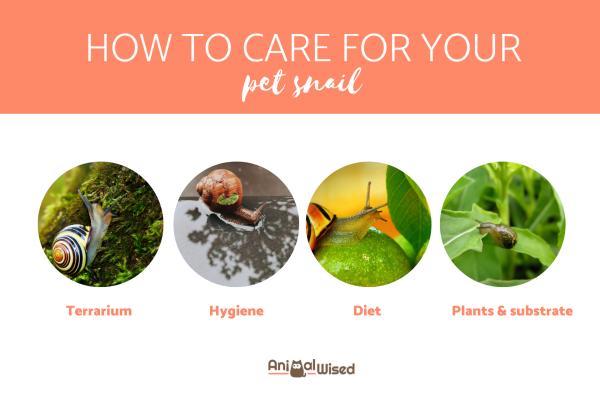
When it comes to caring for snails, they are very easy to care for as long as you provide them with their basic needs. These include the right habitat (terrarium, substrate and plants) diet and hygiene.
Ideal environment for snails
First things first, the terrarium. Try to choose a large terrarium so your snail has plenty of space to explore and walk around. We don't want them to feel trapped, just safe. We must also be careful that there is enough circulation so that our snail has enough oxygen.
Next, we're going to choose the correct substrate. The substrate has to be about 2 inches deep. Opt for an all-purpose, peat-free potting soil that you can get in any local gardening store. Make sure the soil has a pH above 7, as in the long run lower pH soil can damage your snail's shell. Regularly monitoring the pH level is crucial, as fluctuations can affect the overall health of your pet snail.
When it comes to decorating your snail's habitat, you can include plants. Some great options are moss, ivy and fern. Avoid placing potted plants that may be toxic to snails and plants that need lots of sun as you will need to place the terrarium in the shade.
Other decorations you can include are rocks, branches or a broken flower pot (where your snail can find refuge if there's too much sun). However, we recommend you don't include a pool for garden snails as they do not need it and can even drown in it.
Lastly, we must remember not to place the terrarium in direct sunlight as it can hurt our snail and even lead to their death. Warm and temperate temperatures are ideal for snails. Ensuring the terrarium is placed in a stable environment helps prevent dramatic temperature changes that could stress or harm the snail.
Snail diet
When caring for a pet snail, the first thing you will want to know is what type of land snail you're caring for. In general, snails are mostly herbivorous animals, so their diet consists of plant remains, pieces of fruit, soil and even bits of chalk in stones. These stones, such as limestone, are rich in calcium. This is an important component for a snail to be able to strengthen their shell and protect themselves from hazards.
Despite this, there are some types of land snails that are carnivorous and that even feed on smaller snails. These types of snails have a tongue that can bore holes into the shells of other snails, allowing them to reach the soft flesh inside. To learn more about different types of snails and their diet, we encourage you to read our article on a snail's diet.
Other than including a rich substrate and a variety of rocks for your snail, you can provide them with fruits and vegetables, such as: lettuce, mashed banana, chard, broccoli, carrot, etc. Once they have finished eating, remember to remove the remains of the food you have provided to keep their terrarium clean. Regular cleaning helps prevent the growth of mold and bacteria, contributing to the snail’s overall health.
Lastly, provide them with a shallow bowl of water. It should be shallow enough that they cannot drown inside it. For example, you can use the top of a water bottle and add some water for them to drink. Regularly change the water to ensure it remains clean and free of contaminants.
Hygiene
This is another important factor when caring for a pet snail. You will want to clean their terrarium once in a while. Try to eliminate their feces that you find on a daily basis. If you see that your snail has gotten extremely dirty, you can softly scrub their shell with a tooth brush and some water. You can also provide them with a shallow pool of water that they can walk through without drowning.
When picking your snail up to clean their terrarium, remember to never pull them up by their shell. It's best to place your hand in their way and even offer a treat. This way, they will climb onto your hand. This gentle method minimizes the risk of damaging their delicate bodies and builds trust between you and your pet.
Mating and eggs
Lastly, you will want to be informed on snail mating and their eggs. Many people wonder how snails reproduce. Garden snails are hermaphrodites, which means that they have both reproductive organs. Nevertheless, they still need another snail to mate. Once a snail lays their eggs, they will bury them in the soil and they will hatch after two weeks (depending on weather conditions). The first food the newborns will eat is their own eggs. From then, their care will be the same as for adult snails. After two years of age, they will begin to reproduce. Keep in mind that garden snails live for 3-5 years.
Understanding the reproduction process of snails can help in managing their population within your terrarium. If you do not wish to have more snails, it may be necessary to separate individuals to prevent overpopulation. Additionally, knowing the signs of egg-laying can help you prepare the terrarium for the arrival of new snails, ensuring they have a safe environment to thrive from the start.
If you want to read similar articles to Caring for Snails as Pets Guide, we recommend you visit our Basic care category.