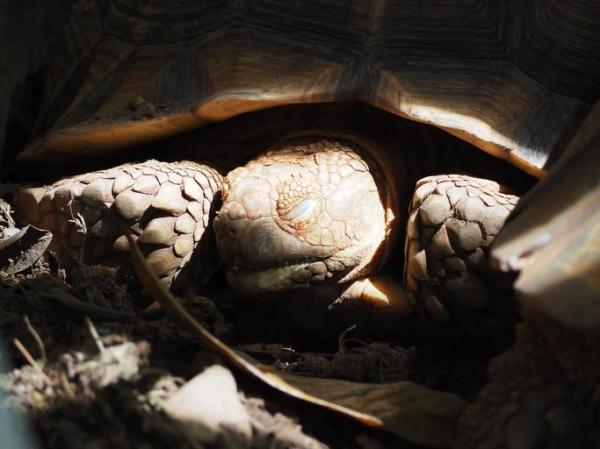
Dormancy is more than just sleeping. It is a period when an organism slows down its physical activity until it has essentially stopped. It can even seem as if some animals are not alive because their metabolism has nearly stopped, and they may appear not to be breathing. This allows the animal to conserve energy in climates that do not allow individuals to thrive and cause food resources to become scarce.
Turtles are one of the few animals that have almost become synonymous with hibernation. When keeping turtles as pets, we need to know that a large chunk of the year might be spent without any interaction. But, do all turtles hibernate? AnimalWised sheds light on the subject and reveals the surprising answer.
Do turtles hibernate?
When we ask whether all turtles hibernate, there is the implication that at least some turtles do so. Strictly speaking, turtles do not hibernate. Hibernation is a type of dormancy carried out only by endotherms, meaning animals that thermoregulate through their metabolism. These are loosely defined as warm-blooded animals.
All turtles are ectothermic reptiles, often referred to as cold-blooded. This means they regulate their body temperature largely via external sources, mainly the sun when in nature. Ectotherms can go into a period of dormancy, but it is known as brumation, not hibernation. The process is very similar, and many people simply refer to reptile dormancy as hibernation instead of using the technically correct term, brumation. Regardless, the term hibernation is often used interchangeably, as the behaviors are very similar despite the metabolic differences.
Brumation and hibernation are natural processes during which the animal minimizes the functionality of its organs. This means its heart and respiratory rates drop to near-undetectable levels. It also stops eating, drinking, and excreting.
Turtles that brumate do so in response to the outside temperature. This is why species native to cold climates are the ones that brumate during the winter months. This usually occurs when temperatures drop below 10 ºC. During this state of dormancy, the turtles survive by feeding off their own fat reserves. They can consume up to 1% of their total body weight each month of brumation. The timing and duration of this period vary between species and depend on conditions in their habitat. Changes in temperature and daylight can act as seasonal cues, so the process does not begin at exactly the same time for every turtle.
If you are still unsure why turtles hibernate, we can make it plain. Turtles struggle to survive very cold temperatures where resources are scarce, so dormancy allows them a way to stay alive at an extremely low metabolic rate. Feeding during the summer months allows them to store up fat reserves and makes this feasible. An additional reason is that it helps ensure the proliferation of the species via reproduction. It sexually stimulates the males and synchronizes ovulation in the females.
Do all turtles hibernate?
No, not all turtles enter brumation or achieve dormancy. If you are adopting a turtle as a pet, it is vital that you learn about its species beforehand. Only then will you know whether or not it brumates during the winter. Turtles under the age of 3 generally do not brumate, depending on the species. Some painted baby turtles in the wild take part in a process known as overwintering. This is where the hatchlings survive off the fat reserves with which they are born. They can survive so well that they will still live even when more than half of their internal body water freezes[1].
Sick turtles should also not brumate. If you see that your turtle has damage to its shell, irritated eyes, or is under its ideal weight, it is best not to let it brumate. Take it to a specialized veterinarian so they can advise you further. A health check before dormancy can help identify problems that might otherwise be difficult to notice once the turtle has become inactive.
The following are some turtle species that are known to brumate:
- Herman's tortoise (Testudo hermanni)
- Greek tortoise (Testudo graeca)
- Russian tortoise (Testudo horsfieldi)
- Turtles of the genus Gopherus
- Spotted turtle (Clemmys guttata)
- Wood turtle (Clemmys insculpta)
- Red-eared slider turtle (Trachemys scripta elegans)
A tortoise is a type of turtle that lives on land, and the majority are herbivorous. Some land turtles are not considered tortoises, however. Essentially, all tortoises are turtles, but not all turtles are tortoises. Other turtles live partly on land and partly in water. Some freshwater turtles brumate, but no sea turtles do. Whether a particular turtle needs a dormant period depends on its species and natural habitat, so these examples should not be taken as a rule for every individual.

What to do when turtles hibernate?
If you have a pet turtle that brumates in the wild, you will need to bear the following information in mind:
Before hibernating
You must feed the turtle very well during the summer. It is recommended that, 6 weeks before brumation is due to begin, you increase the amount of foods containing carbohydrates and vitamins in your turtle's diet. You can offer sprouts such as alfalfa, fruits such as figs, melon, or apples, and vegetables like pumpkin and carrots. When the time for brumation approaches, about 2 or 3 weeks beforehand, you will need to slowly reduce its food intake. This will help the turtle to begin fasting and empty its bowels, reducing the chances of getting sick during dormancy. As feeding needs vary between species, check that this preparation is appropriate for your turtle rather than following a general schedule without guidance.
Although you will reduce food intake, you should have plenty of water available. Turtles can retain water in their bladder rather than immediately losing it through urination.
This may sound obvious, but it is very important that turtles only brumate during the cold winter months, not during summer. When they brumate, they are protecting themselves against cold temperatures, not warm ones. They will not brumate in summer due to the heat, and if you leave them without resources during this time, they are unlikely to survive.
During turtle hibernation
In the case of terrestrial species (land turtles) that brumate, it is important that they have an area of moist, loose soil where they can dig. If you are going to let a turtle brumate in the home, a small box with some wet soil should be enough to create an ideal environment. The exact conditions, however, will be particular to the species and should mimic its habitat in the wild. This includes the ambient temperature, so you cannot keep them somewhere warm. The enclosure should also be secure and allow the turtle to remain undisturbed throughout this period.
During brumation, we need to avoid disturbing the turtle. However, we should make periodic checks to ensure that all is OK. Check its weight before and during brumation (weigh the entire box to avoid disturbing it). You should also assess its general condition by looking at its eyes, nostrils, and extremities. Keep a simple record of these checks so that any changes in weight or condition are easier to identify.
If you detect signs of dehydration such as dry skin, sunken eyes, or weight loss, you should let your turtle soak in some water for 2 hours. The temperature of this water should never exceed 24 ºC. If the turtle is brumating outside, it may wake up on warmer days. When this happens, give it some fresh water to drink, but never any food. Giving it food can create conditions in which it gets sick. If you are concerned about its condition, contact a veterinarian rather than repeatedly disturbing it.
After the hibernation period, how do you wake the turtle?
When the brumation period ends, you must wake the turtle by exposing it to the sun. This way, it will synthesize vitamin D and balance its calcium metabolism. You should also rehydrate it by giving it fresh water. It will have lost some water during brumation and will also need to reactivate its urinary system. It is advisable to offer food such as tomato or cucumber, as these are rich in water and will help your pet rehydrate and reactivate its digestive system. Let the turtle warm up gradually and monitor its appetite and activity as it returns to its normal routine.
Do turtles hibernate inside or outside the shell?
As we stated above, turtles bury themselves during the brumation process. When they do this, they hide in their shells. However, do not worry if they wake up and move; it is natural for them to leave their shells when the temperature rises a little. This is especially true if they brumate outside, where it is not possible to control the weather. If they move briefly, avoid handling them unless there is a clear reason to do so, since frequent disturbance can interfere with their rest.
Remember that brumation is a natural process in some species. Our involvement is only a way to help support them through this process and ensure their quality of life.

What if he is not going to hibernate?
All turtles under three years old or sick should not brumate. Instead, you will need to keep a terrarium to emulate the natural conditions of a summer climate. Prepare a space with artificial light that should be on for a minimum of 15 hours a day. Feed the turtle as usual. Provide suitable warmth and a regular day-and-night routine so the turtle can remain active and continue eating.
When brumation is essential to the ovulation process, other factors such as humidity, temperature, and a mate will play an important role. You can control these factors by keeping them in a terrarium, but again this will depend on the specific turtle species. Maintaining conditions that match the needs of that species is important; a terrarium should not be treated as a substitute for species-specific care.
If you want to read similar articles to Do All Turtles Hibernate?, we recommend you visit our Extra care category.
1. Gibbons, W. (2004). How Do Baby Turtles Survive Cold Winters? Retrieved September 18, 2019 from
http://archive-srel.uga.edu/outreach/ecoviews/ecoview040118.htm
- Hatchling turtles survive freezing during winter hibernation (Proceedings of the National Academy of Sciences)
- Winter and Ambassador Animals (University of Illinois College of Veterinary Medicine)