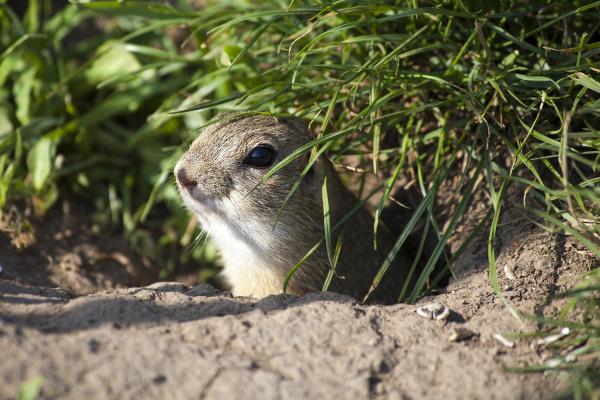
Normally, we think of squirrels as very active animals and skilled climbers. Some species are even able to glide from one tree to another. However, as is usually the case, these behaviors are closely related to their environment and the habitat in which they live. Squirrels are widespread throughout the world and can be found on almost every continent. Therefore, it is not surprising that squirrels living in places with extreme temperatures have had to adapt their behaviors to survive the coldest months.
This AnimalWised article is about whether squirrels hibernate and how they cope with extreme temperatures.
What is hibernation?
In order to survive in ecosystems subject to extreme fluctuations in temperature, animals have developed numerous mechanisms. One of these strategies is hibernation, which is carried out by certain mammals. Hibernation is a state of minimal activity and a metabolic depression. During hibernation, the body temperature drops, respiration, and heart rate slow, and metabolism slows down.
Animals usually hibernate in places with long, cold winters. Food is very scarce during these months, so they must enter this state of lethargy and inactivity to conserve their energy and survive without food intake.
Do squirrels hibernate?
Most squirrels do not hibernate, at least not in the traditional sense. Instead, they stockpile food for the cold season and spend the winter cozy in their nests. However, there are some species that have some behaviors that could be considered hibernation, since their temperature drops and their metabolism slows down.
Interestingly, these adaptations not only ensure their survival but also play a crucial role in maintaining the ecological balance. By understanding hibernation better, we gain insights into the broader biological processes that impact various ecosystems.
Which squirrel species hibernate?
Squirrels are members of the family Sciuridae, a family that includes small or medium-sized rodents. The squirrel family includes tree squirrels, ground squirrels (including chipmunks and prairie dogs), and flying squirrels. The species that hibernate all belong in the ground squirrel family. We will examine the main characteristics of each of these species in this section, such as where they live and how long they hibernate.
Here are some examples:
- Arctic ground squirrel (Urocitellus parryii): is native to northeastern Canada and British Columbia, and is also found in Russia and Alaska. Incidentally, these squirrels are called "parka" squirrels in Alaska, probably because their fur is well suited for clothing and parka ruffles. They are active only 3-5 months of the year, the rest of the time they are forced to hibernate. Females begin hibernation in early August, while males begin it in September. Hibernation lasts between 215 and 240 days, although females are usually in this state longer. Despite being the last to leave this state, the young hibernate for the shortest period of time.
- Mexican ground squirrel (Ictidomys mexicanus): is native to Mexico and the United States. Although much of its original habitat has been destroyed by humans, it has adapted well to human civilization and can be easily spotted in urban areas. Most Mexican ground squirrels hibernate, but there are cases where this is not the case. In this species, it has been reported that males begin and end hibernation before females and that juveniles begin this process several months after adults. Males begin hibernation around late July and mid-August, while it continues until September for females. Exits from hibernation can be discontinuous and occur from February, but more often from March.
- European ground squirrel (Spermophilus citellus): it is native to several regions, including Austria, Bulgaria, the Czech Republic, Greece, Hungary, Moldova, Macedonia, Romania, Serbia, Slovakia, Turkey, and Ukraine. The European ground squirrel hibernates between autumn and March, the duration of which depends on the climate. In preparation, they lay down reserves of brown fat in late summer. This species spends about 6 months in hibernation, beginning about August. Although some squirrels may reemerge in March, this typically occurs in April when temperatures rise above 0ºC.
- Perote ground squirrel (Xeros permophilus perotensis): it is endemic to Mexico and currently threatened with extinction. Perote's ground squirrels have two annual cycles, an active phase (March-November) and a hibernation phase (December-February). However, there may be overlap in March and November.
- Daurian ground squirrel (Spermophilus dauricus): is native to China, Mongolia, and Russia. It is a colonial species that digs relatively simple burrows that usually have only two entrance holes. This Asian squirrel hibernates for about 3 months, beginning in late November and ending in early March.
- Russet ground squirrel (Spermophilus major): also known as the hibernating large ground squirrel and the large-toothed souslik. It is native to western Central Asia, where its natural habitat is temperate grasslands. Hibernation lasts about six and a half to eight and a half months. The time of emergence depends on spring conditions and can vary by up to twenty-five days. This species of squirrel has a short active period in the year, which can hardly exceed 50 to 110 days. This means that hibernation can last up to 250-300 days a year. Males begin hibernation in mid-June, but both females and juveniles begin hibernation in late August or early September.
- Thirteen-lined ground squirrel (Ictidomys tridecemlineatus): is native to the grasslands and prairies of Canada and the United States. In late summer, this squirrel puts on a thick layer of fat and stores some food in its burrow. In October, it retreats to its nest (some adults retreat much earlier), curls up into a stiff ball, and reduces its breathing from 100 to 200 breaths per minute to one breath every five minutes. It hatches in March or early April.
- Spotted ground squirrel or speckled ground squirrel (Xerospermophilus spilosoma): Lives in Mexico and the United States. The spotted ground squirrel is a burrowing mammal and creates tunnels to store its food and find shelter and hibernation quarters. The spotted ground squirrel may also exhibit insectivore-like habits in late summer, feeding primarily on grasshopper larvae.
Understanding these species' hibernation behaviors not only highlights their adaptability but also underscores the importance of conserving their habitats. Protecting these environments ensures the survival of these fascinating creatures and maintains the biodiversity essential for healthy ecosystems.
If you want to learn more about other squirrel species and their habitats, do not miss this other article about where do squirrels live.

How do squirrels hibernate?
Now that you know squirrels hibernate and what kinds of squirrels do it, let's find out how they prepare for hibernation and how they endure it.
The first aspect of squirrels' preparation for hibernation has to do with building up body fat reserves. Since they do not eat food during the resting phase, they consume a lot of food during the active phase to maintain their body fat. This fat acts as an energy reserve, ensuring that they can survive the long months without needing to forage in the harsh winter weather.
The next aspect to consider is the burrow, which consists of a suitable underground space that is kept during the months of inactivity. Squirrels can be very aggressive when it comes to their hibernation spaces because they are essential for their survival. As we already know, the squirrels that hibernate are terrestrial animals, that is, they bury themselves in the ground. They dig burrows that are up to 1 meter or more deep, where they not only spend this period of inactivity but also seek shelter from predators, rest, and reproduce. Generally, these rodents live in family groups, so hibernation takes place in a group.
On the other hand, the onset of hibernation does not occur abruptly; squirrels, like other animals that hibernate, may make small attempts in which they lower their body temperature a little and then raise it again. Later, when they really begin the process, squirrels lower their body temperature with a minimal difference from the outside temperature, which may be 1 ºC or less. Also, their respiratory rate slows from 200 inhalations to only about 4 or 5 per minute, and their heart rate slows from 150 to 5 per minute.
During hibernation, squirrels have various episodes in which their body temperature rises and their metabolism is activated in some way. This is probably to ensure that certain systems, such as the brain, are functioning. After a day or two of activation, they return to their hibernation.
This cyclical pattern of activation and dormancy is crucial, as it prevents the complete shutdown of essential bodily functions. The periodic increase in metabolic rate ensures that vital organs, like the brain, remain operational, preventing damage that could occur if they were to remain completely inactive for extended periods.

How do squirrels that do not hibernate survive?
As we mentioned earlier, only some species of squirrels hibernate. But then, how do the squirrels that do not hibernate survive the winter?
These animals are areothermic, meaning that their body temperature remains fairly constant throughout the year, unlike some mammals; they do not hibernate.
In winter, squirrels spend less time foraging outside their burrows, and it is more common for multiple squirrels to share a burrow. This behavior allows more animals to seek shelter and keep each other warm.
Caching, also called hoarding, is a behavior in which food is stockpiled for later. Squirrels usually do this by placing their food in a shallow hole and covering it up. Many of the seeds they leave behind will germinate and become shrubs, trees, etc., since they don't remember all of these "stores." The stores they do remember will serve as food when resources become scarce in the winter.
Squirrels also prepare for winter by storing fat in their bodies. Throughout the fall, they maximize food intake and body mass. In winter, when food is hard to come by, these reserves will help the animals survive.
They also tend to spend more time sleeping to conserve their energy.
Additionally, squirrels have developed remarkable strategies for finding food during winter. Their keen sense of smell allows them to locate caches of nuts and seeds buried under snow and leaves. This ability to efficiently locate stored food is critical for their survival during periods when fresh resources are scarce.
Squirrels are wild animals that should not be kept as pets. However, if you ever find yourself in the situation where you have a baby squirrel that has been separated from its mother, there are some things you can do to care for it until it is big enough to leave.

If you want to read similar articles to Do Squirrels Hibernate in the Winter?, we recommend you visit our Facts about the animal kingdom category.
Lisa E.Schwanz, (2006). Annual Cycle of Activity, Reproduction, and Body Mass in Mexican Ground Squirrels ( Spermophilus mexicanus ), Journal of Mammalogy , Volume 87, Issue 6. Available at: https://doi.org/10.1644/06-MAMM-A-009R2. one
- Hickman C, Roberts L, Parson A (2000). Comprehensive Principles of Zoology . McGraw Hill Inter-American: Spain.
- Myers, P., R. Espinosa, CS Parr, T. Jones, GS Hammond, and TA Dewey. (2022). Animal Diversity website. Available at: https://animaldiversity.org/search/?q=Vulpes&feature=INFORMATION
- IUCN (2022). IUCN Red List of Threatened Species. Version 2021-3. Available at: https://www.iucnredlist.org