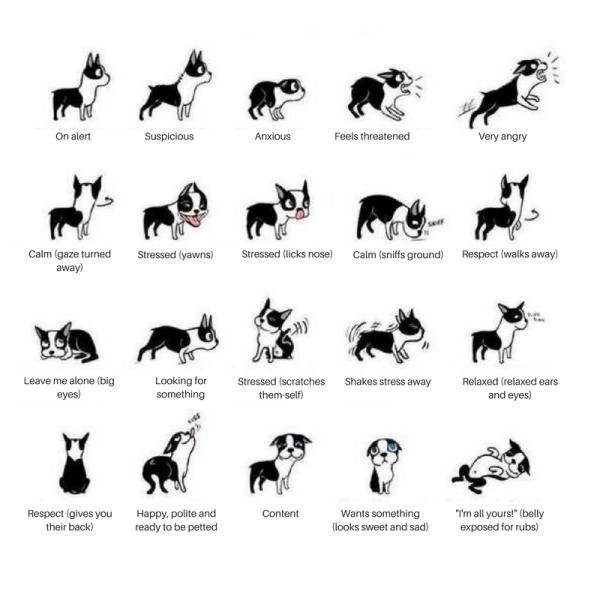
Learning to communicate with your dog is essential for a balanced and happy coexistence. Often a lack of understanding between dog and owner can lead to unwanted behavior, due to poor non-verbal communication. Luckily, you can improve your relationship with them whilst you attempt to figure out what they are trying to tell you!
In this AnimalWised article we will help you understand how to read a dog's body language and their calming signals. Read on to learn how to better understand your dog and decipher their messages.
Do all dogs know body language and calming signals?
Dogs begin to learn to communicate from birth to 3 months. During this period, they start to communicate with their mother and the rest of the puppies and this "language" lasts them a lifetime.
The most important period for the recognition of language is during the phase of puppy socialization, i.e. the period from 3 weeks to 3 months of life. Premature separation of the puppy from his mother and the rest of the litter can have serious consequences. Such as, the lack of a behavioral model when with fellow dogs. However, there may be many other side effects like: not being able to handle the bite force, the development of phobias and fears, or the tendency to suffer from stress.
Therefore, not all dogs are able to understand and recognize the signs that we will list below. Although usually this is in specific cases of prematurely weaned dogs or dogs who have suffered isolation. This is a common problem in pups that come from kennels.
In addition to these factors, environmental stimuli during the early stages of life can significantly affect a dog's ability to learn and use body language effectively. For instance, dogs raised in highly stimulating environments tend to develop better social skills. This highlights the importance of providing a balanced environment for puppies to thrive socially.

How do you communicate with your dog?
Before delving into the body language of dogs and their calming signals, it is essential to know how to communicate with your dog:
- Always use a low tone of voice so that your pet does not confuse your words with a punishment. Also, you must remember that they have very sensitive hearing, so there is no need to raise your voice.
- Try to match words with gestures. This way your dog will understand you better and will be easier for them to understand you in loud environments.
- Use positive reinforcement to communicate with the dog. Various studies show that dogs learn best with this technique than with punishment methods.
- Make eye contact when communicating with them.
- Always respect your dog, especially if you see that they do not feel at ease. Change the environment, situation or use a different method of positive reinforcement to motivate them.
- Again, do not use punishments to communicate with the dog. If they do not understand you, repeat the action but never scold them.
Furthermore, consistency in your commands and gestures is crucial. Dogs thrive on routine and predictability, so maintaining a consistent pattern of communication helps them understand and respond better. Additionally, patience is key; every dog learns at their own pace.

1. Yawning
The yawn as a calming signal, is usually accompanied by other signals such as lifting the ears, and tilting their head. This behavior should not be confused with the typical yawn when dogs wake up. The signal indicates discomfort or confusion as to what you're asking.
In some cases, yawning can also be a way for dogs to relieve stress or anxiety. It should be noted that, much like humans, dogs yawn when they are feeling nervous or when they are in new environments that might make them uneasy.

2. Licking
This is one of the most common calming signals. Except when they have been drinking water, dogs will lick their nose to indicate that they don't want any stress or problems. They usually do this with their head down or sideways. This means they are asking for a break from training or want some space from you.
Licking can also be a sign of submission. In situations where a dog feels threatened or exposed, licking may serve as a non-aggressive way to communicate peace and a desire to avoid conflict. Understanding this can help in managing their interactions with other animals or unfamiliar humans.

3. Licking a person
In general, if a dog licks you, they are showing affection. However, if the dog licks someone who is agitated or excited this could be a symptom of stress. By licking that person, they are trying to relieve their stress because they know this is a welcome gesture.
If the dog licks you from nerves and not for love, you can recognize this behavior thanks to other calming signs. Signs such as lifted ears, head tilts and anxious movements.
Additionally, dogs often lick as a way to gather information about their environment. This behavior is particularly common in puppies as they explore their surroundings. It is a natural form of communication and exploration that continues into adulthood.

4. Turning their head away
It is likely that at times when you are trying to get closer to your dog, they can turn their head away from you. This gesture indicates discomfort and indicates that they want their space. In this case you can observe other signs like shortness of breath, lifted ears and licking their face. If they emit this signal in front of other dogs, it may indicate that they want to be quiet and not have any issues.
Turning away can also be an indication of submission, acting as a way to show respect and avoid confrontation. Dogs use this behavior in social settings to maintain harmony and prevent conflicts with other dogs.

5. Nudging your nose
This is a very positive sign that shows the dog seeks our attention and affection. This behavior arises when the dog is a puppy, because it is the same gesture used when they want their mother's breasts.
Moreover, nose nudging can be a way for dogs to communicate their needs, such as hunger or the desire to play. Recognizing and responding to these cues can strengthen the bond between you and your pet.

6. Eyes half open
This calming signal indicates that your dog feels safe and at ease. It also originated when they were a puppy too, when they felt safe with their mother. This is a very positive sign.
In many cases, a dog resting with eyes half open signifies trust in their surroundings. It is a state of relaxation where the dog feels secure enough to let their guard down, indicating a deep level of comfort and trust in their environment.

7. Sniffing the ground
If your dog sniffs the ground before approaching another dog, you can be happy. This is a quiet signal that characterizes a polite dog that does not wish to cause problems nor have their space invaded.
Sniffing is a fundamental part of canine communication, offering them a wealth of information about their surroundings. It serves as a calming mechanism and is often employed by dogs to ease tension or diffuse potentially stressful situations.

8. Walking in circles
When two dogs encounter one another and begin walking in circles, they are exhibiting the correct and polite canine greeting.
This behavior allows dogs to assess each other in a non-threatening manner. Walking in circles can be seen as a mutual exchange of information, helping to establish whether the interaction will be friendly or if caution is needed.

9. Stretching
Stretching in dogs can have several meanings:
- It is common to see a dog in this position when they are asked to play with another dog. In this case, the gesture shows a positive and vibrant attitude and they will often wag their tail. It shows that the dog is well trained.
- If the stretch is accompanied by other calming signals, like licking their nose, wagging their tail and tilting their head, the dog is asking for space and wants to be left alone.
Additionally, stretching can indicate that a dog is trying to relieve tension or stiffness after a period of rest. It is a natural behavior that helps maintain flexibility and muscle health.

10. Remaining still and alert
Remaining still and alert is common when you bring a dog to a new park or a new place where they do not know the other dogs. In this kind of situation they will stays still and let the others sniff them. It is a calming signal that shows that the dog is well trained: they quietly let the others get to know him.
Remember that if a dog stays still while you're telling them off or punishing them, they are not showing submission. They feel helpless because they don't know how to react or where to hide from you. This situation is dangerous and negative for the dog and their training. Do not scold your dog harshly or use violence.
This stillness is a protective mechanism, allowing the dog to assess the situation without provoking a reaction from others. It demonstrates the dog's ability to adapt to new environments and manage their stress levels effectively.

11. Shaking
This sign shows that your dog is stressed and they are trying to release their tension through shaking. Generally this is accompanied by other calming signals or the dog will start running.
Shaking can also occur after a bath or when a dog is wet, as a natural response to remove excess water from their coat. Recognizing the context in which shaking occurs can help differentiate between stress-related and normal behavior.

12. Lying with their belly up
In this case, a dog will stretch showing their submission to another dog, for fear or other reasons. They are indicating civility and kindness and showing they don't want to have any issues with a fellow dog.
Remember that if they lie down on their back and shows no signs of submission, just peace and tranquility, they trust you. And they just want cuddles and belly rubs!
This position can also reflect a dog's desire for social interaction and bonding. When a dog feels comfortable enough to expose their belly, it signifies a high level of trust and affection towards their companions.

13. Peeing
If a dog pees, they are marking their territory. But, if they do this alongside other dogs, they are getting to know each other. A dog's sense of smell is highly developed and one of the ways in which these animals are able to know what surrounds them.
In addition to marking territory, peeing can serve as a stress-relief mechanism in anxious situations. This is particularly common in new environments where the dog is trying to establish familiarity and comfort.

Other calming signals
Importantly, there are a number of calming signals in dogs, which sometimes we can struggle to identify. Here they all are:
- Raising one of their front legs
- Raising one of their hind legs
- Looking at you with one eye
- Lying down
- Hunched or curved body
- Lifting their ears
- Nudging you
- "Smiling"
- Looking at the ground
- Moving away
- Turning their head
- A relaxed mouth / mouth slightly open
- A relaxed tail
- Slight tail movements
Each of these signals plays a crucial role in a dog's communication repertoire, allowing them to navigate social interactions smoothly and effectively. Understanding these signals can enhance your ability to respond to your dog's needs and emotions appropriately.
Position of fear or aggression
It is very important to recognize the signs of fear in dogs because they help us to interpret their emotions and behave in an appropriate manner. Refer to the image below to see the positions that show fear in dogs.
- In Figure 1, the dog has a lot of fear. They have their tail between their legs, they are licking, they have their ears lifted and they have a curved body.
- Also in Figure 2 shows the afraid dog is on the defensive. They are showing their teeth, have stiffened limbs and their hair is bristled. We must be careful because a dog that shows aggressive-defensive behavior can react suddenly and in an exaggerated way. They may harm you. This happens especially when the dog feels surrounded or endangered. In such situations, moreover, the dog may bark or incessantly growl, cry and moan.
Recognizing these signs early can prevent potential conflicts and allow for timely intervention. Providing a safe and reassuring environment can help alleviate fear and aggression in dogs.

Position of defense and offensive aggression
Now we'll show you the positions of a confident dog, very different from the former image.
- In Figure 1, the dog is confident, steady and quiet. They have a relaxed tail, relaxed ears and their posture does not indicate fear.
- In Figure 2, however, you can see the typical posture of a dog with offensive aggression. In this way, the dog tries to ward off other animals, people or annoying objects. They have bristled hair, a curled nose, stiff legs and are showing their teeth. Usually they have a raised tail, and can bark briefly with a high-pitched tone that expresses annoyance or frustration at the situation.
Understanding these positions can aid in assessing a dog's intentions and mood. It should be noted that recognizing these signs can be pivotal in ensuring safe interactions, especially in multi-dog households or public spaces.

Compulsive behaviors
Repeated movements with no purpose are usually a mechanism to relieve stress in a certain situation. They are repetitive, prolonged and can cause you to be agitated. If left untreated, the condition tends to become chronic and more difficult to eliminate. It can be caused by a disease, a behavioral problem or both. An example of a stereotype in dogs is to see them chasing their tail compulsively.
If you want to read more similar articles, please visit our Basic Education category.
You may also be interested in: Cat body language.
Compulsive behaviors require careful observation and management. Consulting with a veterinarian or a professional dog trainer can provide insights into underlying causes and offer strategies to address and mitigate these behaviors effectively.

If you want to read similar articles to Dog Body Language and Calming Signals, we recommend you visit our Facts about the animal kingdom category.