
The list of endangered dolphin species is threatening to grow longer. Although some efforts at conservation are underway, the challenges these marine mammals face continue to mount. While some of these are naturally occurring in their ecosystem, some of the most significant threats to dolphin populations as a whole are the result of human interference in their ecosystems. This is as a due to many factors such as commercial fishing, pollution, climate change and others. For these reasons, certain dolphin species are in danger of becoming extinct.
At AnimalWised, we provide this 6+ endangered dolphin species list so you can find out which dolphins are most in threat of extinction. We also provide information on the causes of this dolphin population decline.
How many dolphins are there in the world?
There are currently 42 living species of dolphins known to zoology. These include both oceanic dolphins and types of river dolphins (freshwater dolphins). Dolphins are types of aquatic mammals, meaning they share certain characteristics with land mammals such as:
- They have a highly developed brain: like other types of mammals, dolphins have a complex nervous system. They have a high capacity for learning and memory. What sets them apart from other animals is how dolphins sleep. They have unihemispheric sleep, meaning they turn off one brain hemisphere to rest while the other remains active. Thanks to this, the dolphins can remain alert to the environment that surrounds them, they can breathe and continue swimming. This is a similar process to how whales sleep without drowning. It's fascinating how this adaptation allows them to avoid predators and navigate their complex aquatic world efficiently.
- Pulmonary respiration: dolphins breathe through lungs. They can take in air from the top of their head via a type of spiracle commonly known as a blowhole. This is connected to the trachea, a connection which is shorter than in terrestrial mammals. Gas exchange occurs in the alveoli of the bronchioles. These are not lobed as in most other mammals. Breathing is voluntary and not reflexive, meaning they have to choose to breathe. This voluntary control over breathing is essential for their survival during dives and while resting.
- They are born with hair: one of the important characteristics of mammals is the presence of hair on the entire body or in certain regions. Adult dolphins do not have hair as it would be inconvenient for aquatic life. However, dolphins are born with a fine hairy layer that sheds as the animal grows. This vestigial hair is a reminder of their evolutionary past.
- They are viviparous animals: dolphins develop in the womb where there is a placental connection between the baby and the mother. After birth, the baby dolphin will be totally dependent on their mother, who will have to help them to surface for breathing. In addition, they will be fed with breast milk during the first months of life. This strong maternal bond is crucial for the calf's survival and learning.

Types of dolphins
Dolphins are a relatively heterogeneous group of animals. They have common characteristics that allow them to live in the water. In addition to these adaptations, we can see morphological differences between the various species, most of which are visible to the naked eye. These differences may include variations in size, coloration, and dorsal fin shapes.
There are two main types of dolphins, although they all belong to the same parvorder known as Odontoceti. The common name for this parvorder is toothed whales. This is because these animals are characterized by having a multitude of teeth in a row, all equal to each other. The presence of these teeth reveals a carnivorous diet. Odontoceti includes not only dolphins but also orcas and sperm whales.
The group of oceanic dolphins is made up of the following species:
- Commerson's dolphin (Cephalorhynchus commersonii)
- Chilean dolphin (Cephalorhynchus eutropia)
- Heaviside's dolphin (Cephalorhynchus heavisidii)
- Hector's dolphin (Cephalorhynchus hectori)
- Common dolphin (Delphinus capensis)
- Pygmy killer whale (Feresa attenuata)
- Short-finned pilot whale (Globicephala macrorhynchus)
- Long-finned pilot whale (Globicephala melas)
- Risso's dolphin (Grampus griseus)
- Fraser's dolphin (Lagenodelphis hosei)
- Atlantic white-sided dolphin (Lagenorhynchus acutus)
- White-beaked dolphin (Lagenorhynchus albirostris)
- Peale's dolphin (Lagenorhynchus australis)
- Hourglass dolphin (Lagenorhynchus cruciger)
- Pacific white-sided dolphin (Lagenorhynchus obliquidens)
- Dusky dolphin (Lagenorhynchus obscurus)
- Northern right whale dolphin (Lissodelphis borealis)
- Southern right whale dolphin (Lissodelphis peronii)
- Irrawaddy dolphin (Orcaella brevirostris)
- Australian snubfin dolphin (Orcaella heinsohni)
- Killer whale (Orcinus orca)
- Melon-headed dolphin (Peponocephala electra)
- False killer whale (Pseudorca crassidens)
- Tucuxi (Sotalia fluviatilis)
- Guiana dolphin (Sotalia guianensis)
- Indo-Pacific humpback dolphin (Sousa chinensis)
- Atlantic humpbacked dolphin (Sousa teuszii)
- Pantropical spotted dolphin (Stenella attenuata)
- Clymene dolphin (Stenella clymene)
- Striped dolphin (Stenella coeruleoalba)
- Atlantic spotted dolphin (Stenella frontalis)
- Spinner dolphin (Stenella longirostris)
- Rough-toothed dolphin (Steno bredanensis)
- Indo-Pacific bottlenose dolphin (Tursiops aduncus)
- Burrunan dolphin (Tursiops australis)
- Common bottlenose dolphin (Tursiops truncatus)
River dolphins are divided into seven species and classified within the superfamilies Platanistoidea and Inioidea:
- Amazon pink dolphin (Inia geoffrensis)
- Bolivian river dolphin (Inia boliviensis)
- Araguaian river dolphin (Inia araguaiaensis)
- Baiji (Lipotes vexillifer)
- La Plata dolphin (Pontoporia blainvillei)
- Ganges river dolphin (Platanista gangetica)
- Indus river dolphin (Platanista minor)
These animals are characterized by being practically blind and having a long and thin snout. Their limited vision is counteracted by the great ability of echolocation that these animals have. This echolocation ability allows them to navigate murky waters where visibility is poor.
Learn more about the animals which use echolocation.
Endangered Dolphin Species
The list of endangered dolphins is likely much longer than the one we show. The problem is that there is hardly any data on these animals, they are difficult to see and study in their natural habitats. Moreover, many of these species inhabit remote or inaccessible regions, making comprehensive population assessments challenging. Conservationists continue to strive for better data collection methods to improve our understanding and protection of these creatures.
1. Hector's Dolphin
Hector's dolphin (Cephalorhynchus hectori) is considered by the IUCN as an endangered animal. Additionally, some populations of this species are critically endangered. These small dolphins are native to the coastal waters of New Zealand and are under threat from fishing nets and habitat degradation.

2. Irawadi dolphin
Sometimes known as the Irawadi river dolphin (Orcaella brevirostris), this endangered dolphin species is actually an oceanic dolphin (as you can see by the short nose in the photo), but it lives very close to the coast and can frequently go up into an estuary. This species faces threats from habitat loss, pollution, and accidental capture in fishing gear.

3. Amazon river dolphin
The Amazon river dolphin (Inia geoffrensis) not only inhabits this river, but also many of its tributaries. Like many species of the Amazon jungle, this dolphin is also in danger of extinction. Deforestation, pollution, and dam construction are significant threats to its survival. Conservation efforts are focusing on habitat protection and pollution control.

4. Ganges river dolphin
The Ganges river dolphin (Platanista gangética) is considered endangered in the Ganges river area, especially due to the pollution present from various industries. It seems to be present in other rivers, although these are often equally polluted. Additionally, water extraction for irrigation and industrial activities threatens its habitat.
Learn more about dolphin characteristics with our related article.

5. Indus river dolphin
The Indus river dolphin (Platanista minor) is considered an endangered species, for the same reasons as other river dolphins. Water pollution, habitat fragmentation due to dams, and reduced water flow are significant concerns. Conservationists are working to mitigate these threats through policy changes and public awareness campaigns.

6. Baiji
It is not known for certain, but it is very likely that the Baiji (Lipotes vexillifer) is completely extinct. Even so, the IUCN considers it a critically endangered species. The photo below shows one of the last known specimens seen alive. Once inhabiting the Yangtze River in China, the Baiji faced threats from pollution, boat traffic, and habitat destruction.

Why are dolphins in danger of extinction?
According to the recent research, it is likely the above endangered dolphin species list will be extinct in the next few years. The main problem for oceanic dolphins is gillnets. Dolphins get caught in this type of net very easily. For this reason, its use is prohibited in some countries, but is still common practice in many others. Additionally, bycatch in commercial fishing operations poses a significant threat.
These nets can also cause the loss of their swimming limbs. Entanglement with these nets is certain death for these animals. In addition, ocean pollution and overfishing negatively affect dolphin populations contributes to the dolphins losing some of their main sources of food. Moreover, climate change impacts oceanic food webs, further stressing dolphin populations.
The causes of extinction for river dolphins are largely due to the construction of dams. In the regions where these animals live, more than 100 dams have been built in recent decades. The establishment of certain companies on the banks of the rivers has also contaminated them in such a way that their recovery is already impossible or, at least, very improbable. Efforts to balance human development with environmental conservation are ongoing but challenging.
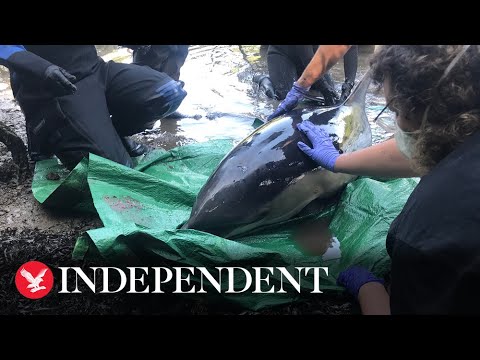
What to do if I find a stranded dolphin?
For reasons that are still not yet understood, more and more dolphins are stranded on the coast of various countries. Most of these animals are already stranded when they are practically dead, but many others still have a chance to survive. Stranding events can be caused by a variety of factors, including disorientation due to noise pollution or illness.
In regions where dolphins regularly beach, there are specialized recovery centers where you can call if you come across one. These centers do not exist in all countries. For this reason, we must call emergency animal rescue services. While we await these services, we will need to keep the animal hydrated by continually pouring seawater on its skin. This helps prevent the dolphin's skin from drying out and maintains its body temperature.
We should never try to return a stranded dolphin to the sea. This must be determined by a specialized veterinarian. We must also prevent people from crowding around. These animals are not used to being touched, so we could increase their stress and accelerate death. Only have enough people to keep the animal hydrated while specialized services arrive.
To finish we provide video of a successful rescue of a stranded dolphin:
If you want to read similar articles to Endangered Dolphin Species List, we recommend you visit our Endangered animals category.
- Reeves, R.R., Dawson, S.M., Jefferson, T.A., Karczmarski, L., Laidre, K., O’Corry-Crowe, G., Rojas-Bracho, L., Secchi, E.R., Slooten, E., Smith, B.D., Wang, J.Y. & Zhou, K. (2013). Cephalorhynchus hectori. The IUCN Red List of Threatened Species: e.T4162A44199757.
- Minton, G., Smith, B.D., Braulik, G.T., Kreb, D., Sutaria, D. & Reeves, R. (2017). Orcaella brevirostris (errata version published in 2018). The IUCN Red List of Threatened Species: e.T15419A123790805.
- da Silva, V., Trujillo, F., Martin, A., Zerbini, A.N., Crespo, E., Aliaga-Rossel, E. & Reeves, R. (2018). Inia geoffrensis. The IUCN Red List of Threatened Species: e.T10831A50358152.
- Smith, B.D., Wang, D., Braulik, G.T., Reeves, R., Zhou, K., Barlow, J. & Pitman, R.L. (2017). Lipotes vexillifer. The IUCN Red List of Threatened Species: e.T12119A50362206.
- Smith, B.D., Braulik, G.T. & Sinha, R. (2012). Platanista gangetica ssp. gangetic The IUCN Red List of Threatened Species: e.T41756A17627639.