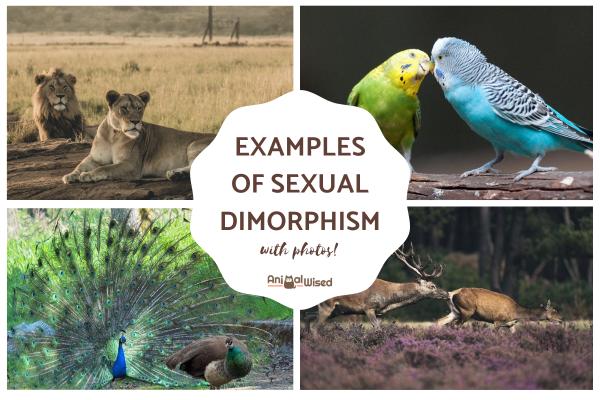
Procreation through sexual reproduction implies the necessary presence of two different sexes. The competition for resources, the risk of predation, and the energy expenditure of finding and courting a mate have led many animal species to evolve adaptations to facilitate this process.
In this AnimalWised article, we will define sexual dimorphism, explain what causes this condition, and provide examples of sexual dimorphism with photos. Continue reading to learn more!
What is sexual dimorphism?
Sexual dimorphism occurs when the two sexes of the same species exhibit different characteristics beyond their sexual organs. This may include size, weight, color, markings, or even behavioral and cognitive differences. This condition occurs in many animals, including humans, and even in some plants. The differences can be subtle or exaggerated.
The evolution of this concept was influenced by scientists such as Charles Darwin, who advanced the theory of sexual selection. This theory is related to sexual dimorphism as Darwin considered that most sexual dimorphism resulted from sexual selection. For example, females might choose to mate with highly ornamented males, such as peacocks. Similarly, males may develop certain characteristics useful for fighting other males to access females, as seen in deer, where males are larger and possess antlers for combat.
Unfortunately, in some cases, sexual dimorphism may expose the animal to predators due to their brighter colors or more striking appearance. The opposite of sexual dimorphism is monomorphism.
What causes sexual dimorphism in animals?
The main cause of sexual dimorphism is genetics, usually expressed by sex chromosomes. In many cases of sexual dimorphism in vertebrate animals, females have two X chromosomes while males have an X and a Y chromosome. In many invertebrate species, females may possess only one sex chromosome while males possess two.
Another significant factor is hormones. Each sex is differentiated by varying concentrations of certain hormones. Additionally, during the embryonic development of certain species, a high concentration of testosterone in the brain may lead to the development of female characteristics.
Nutrition is another key factor for the proper development of secondary sexual characteristics that contribute to dimorphism. An unhealthy and poorly fed animal may exhibit reduced dimorphism, making it less likely to attract the opposite sex.
Moreover, the season of the year and the mating season can induce dimorphism in certain species that do not exhibit sexual dimorphism at other times. This is observed in some birds, such as the Hawaii akepa (Loxops coccineus).
Examples of sexual dimorphism in animals
To understand the different types of sexual dimorphism, the easiest way is to observe their courtship behaviors and lifestyle.
Examples of sexual dimorphism in polygynous animals
In many cases, sexual dimorphism can be attributed to competition for mating opportunities. This is evident in polygynous animals (groups of females with one or a few males). In such cases, males must compete to mate with females, leading to them being bigger, more robust, and stronger than females. They often possess an organ that serves as a defense or offense. Examples of such animals include:
- Deer
- Elephants
- Antelopes
- Chimpanzees
- Gorillas
- Peacocks
- Grouse
- Wild boar
Additional examples of sexual dimorphism
In some cases, sexual dimorphism is essential for survival strategies. For instance, consider species where males and females need to be easily distinguishable from each other.

Examples of sexual dimorphism in animals to differentiate each other
In certain species, dimorphism exists to help females and males of the same species be distinguished from each other. This is observed in parakeets. The sexual dimorphism in these birds manifests in their beak, specifically in an area called the "cere." The cere differs in coloration between the sexes, with males having a blue cere and females having a brown one. If a female's cere is painted blue, she may be attacked by males, and if a male's cere is painted brown, he might be courted as a female.
Additionally, in some species, these distinctions play a crucial role in mating rituals, ensuring that individuals correctly identify potential mates and competitors.

Examples of sexual dimorphism in animals for sexual performance
Sexual performance is another area where sexual dimorphism is evident. For example, male toads and frogs that engage in amplexus (a form of mating embrace) have stronger and more developed arms. They may also possess spines on their hands to better grip the female during mating.
Dimorphism can also serve as a courtship element. The birds of paradise provide a vivid example. These birds, free from natural predators in their native habitats, have evolved to have striking plumage and elongated tail or head feathers. Not only does this attract females, but it also signals the male's health and genetic fitness, increasing the likelihood of producing healthy offspring.
In many species, these ornamental traits are crucial in female choice, demonstrating the role of sexual selection in driving the evolution of dimorphism.

Examples of sexual dimorphism in animals where females are larger
In some species, such as raptors like eagles, owls, or hawks, females are larger than males, sometimes significantly so. This size difference is beneficial because the female often spends more time in the nest incubating eggs. Being larger helps her defend the nest and the offspring. Moreover, these females are usually more aggressive and territorial than males.
In the arthropod group, females frequently surpass males in size, as seen in spiders, praying mantises, flies, mosquitoes, and others. Similarly, in many amphibians and reptiles, females are notably larger than their male counterparts.
This size advantage often plays a critical role in reproductive success, where larger females may produce more or healthier offspring.

Other examples of sexual dimorphism in animals
There are intriguing cases like hyenas, where females, before giving birth, are almost indistinguishable from males. They have a clitoris that resembles the male's penis, and their labia appear similar to a scrotal sac. After birth, the presence of nipples helps distinguish them. Furthermore, females are significantly larger than males, a trait necessary because hyenas are cannibalistic, and any male could potentially prey on newborn cubs. To prevent this, the female's greater size and strength are essential.
This fascinating example highlights how dimorphism can evolve as a strategy to protect offspring and ensure species survival in harsh environments.

Sexual dimorphism in humans
Human beings also exhibit sexual dimorphism, although some studies suggest that there is no severe feminization or masculinization. They propose that cultural standards and beauty norms contribute to our perceptions of sexual differentiation.
At puberty, men and women begin to develop their sexual organs, which are visually distinct from each other. Hair growth occurs in the armpits, pubic region, face, legs, and other parts of the body. Genetically, men typically have more body and facial hair, although this varies among individuals. Both men and women may have hair on the upper lip.
A unique trait in women is the development of the mammary glands, regulated by genetics and hormones, though not all women experience the same degree of development.
Understanding human sexual dimorphism offers insight into the complex interplay of biology and culture that shapes human identity and development.
If you want to read similar articles to Examples of Sexual Dimorphism in Animals, we recommend you visit our Facts about the animal kingdom category.
- Carranza, JUAN (1994). Mating systems and sexual selection . Ethology: introduction to the science of behavior, 363-406.
- Hedrick, AV, & Temeles, EJ (1989). The evolution of sexual dimorphism in animals: hypotheses and tests . Trends in Ecology & Evolution, 4 (5), 136-138.
- Hiraldo, F., Álvarez, F., & Valverde, JA (1974). Biometry and sexual dimorphism in the gallinule (Porphyrio porphyrio) . Doñana Acta Vertebrata, 1, 103-108.
- Shine, R. (1989). Ecological causes for the evolution of sexual dimorphism: a review of the evidence . The Quarterly Review of Biology, 64 (4), 419-461.
- TDC (2008). Sexual dimorphism and communication between mammals . Mundo Pecuario, 4 (2), 72-75.
- Kottler, M. (1980). Darwin, Wallace, and the Origin of Sexual Dimorphism. Proceedings of the American Philosophical Society, 124(3), 203-226. Retrieved June 17, 2020, from www.jstor.org/stable/986370