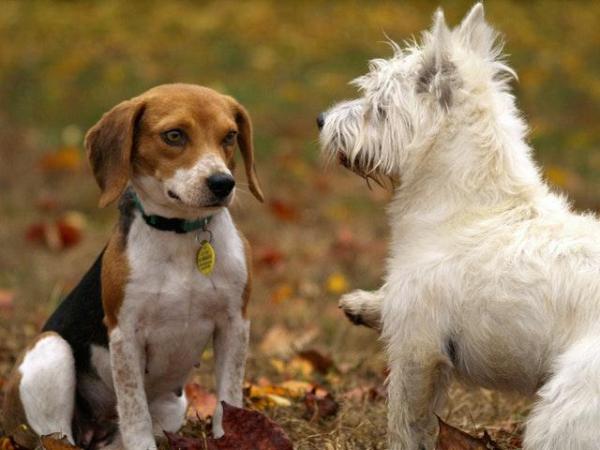
Communication is the foundation of any relationship. For a dog, this includes the relationship they have with us and with any other animal. We know much of what we do about canine communication thanks to studying how dogs interact with each other. However, it is often too easy to make assumptions on this behavior which are not correct. Intraspecies communication and interspecies are not the same thing, mainly because they do not have the same faculties to understand each other.
In this AnimalWised article, we ask how do dogs communicate? We understand how dogs communicate with each other and how we have learned to communicate with them over the long process of domestication.
Canine language
We can simplify communication as a transmitter sending out information to a receiver. Usually, it is done so with the expectation of a reply, but this is not always the case. Sometimes, the signals they are sending out are designed for anyone in their vicinity. This is crucial in the wild, especially when they have to be cautious of predators.
Many animals in the wild will have various forms of both communication between the same species (intraspecies) and communication with other species (interspecies). While we humans may think we are special, and we do have our own unique methods of intraspecies communication, we do not have much capacity in terms of interspecies communication. Although dogs cannot use words as we can, they are able to transmit information to each other through sight, hearing, and smell.
For instance, visual cues play a significant role in canine communication. Dogs often use body language, such as tail wagging or ear positioning, to convey emotions and intentions to others around them. These non-verbal signals are essential for expressing feelings and establishing social hierarchies within a pack.
How do dogs understand each other?
There is an erroneous belief that dogs will understand each other correctly due to natural canine instinct alone. While there is an innate component which relies on instinct, a dog's education and learning throughout their development is essential in being able to communicate. Without it, dogs would not be able to understand each other correctly, resulting in conflicts and negative experiences.
For this reason, it may be unsurprising to know that the majority of dogs with behavioral issues have them, at least in part, due to poor socialization. If they do not know how to adequately interact with other dogs, they will be unlikely to forge healthy relationships with them.
The reality is that much of canine communication is learned when the dog is a puppy. The key socialization stage happens between the ages of 3 and 14 weeks. However, from the very beginning, puppies are soaking up information and learn from their siblings, not just their mother. In the wild, there would also be other members of the pack who could let them learn.
The instinctual communication of puppies can be seen in their crying for attention, nuzzling nipples to be fed, and other interactions. However, these are only the building blocks upon which they need to develop their understanding of the world. One behavior of a dog which has had a poor socialization period is vocalizing too much, a leftover of never having developed past their earlier behavioral patterns. With an inability to effectively communicate, insecurities and misunderstandings may arise.
A significant problem with poorly socialized dogs is aggression. When a puppy is young, they will play with their siblings or other dogs. Play-fighting is important as it helps to control their hunting instinct. Dogs learn bite inhibition and appropriate behavior through play. If they don't learn this lesson, they may attack other dogs. Even if they think they are playing, they haven't learned boundaries and will be more likely to overstep them. Equally, they may also not understand the behavior of other dogs and become overly fearful of otherwise normal actions.
Additionally, dogs that have experienced trauma or neglect may have difficulty interpreting social cues from other dogs. This can lead to confusion and anxiety in social settings, further exacerbating behavioral problems.

Visual communication in dogs - body language
Visual communication encompasses the gestures, postures, movements, and expressions dogs use to express a state of mind or intention. The most common body language in dogs expresses:
- Relaxation: if the dog is calm, its ears will likely be erect, but not pointing forward. They will keep their mouths open slightly and their tails lowered.
- Being alert or attentive: when the dog tries to fixate on something, they direct their body towards it. Their ears will likely be forward facing and eyes wide open. They may move their tail slightly and keep their body slightly arched forward in a state of readiness.
- Playfulness: when a dog wants to invite another to play, it is common to observe them making a ‘bow’. This is a movement whereby they keep their tail wagging up in the air, but the rest of their body slopes down with their legs out in front of them. Their mouths are open and it may be accompanied by excited barking. This is a way to show they are not being threatening, but want to engage in play.
- Offensive aggressiveness: this type of aggression occurs when the dog is threatening another or wanting to attack. The main characteristics we can detect are a bristled coat, dilated pupils, erect tail, snarling lips, showing teeth, and dilated pupils.
- Defensive aggressiveness: on the contrary, this type of aggressiveness is shown by the dog when it feels insecure in any given situation. In this case, the dog's coat will still likely be bristled, but their tail will be between their legs and their ears back. They will still have dilated pupils due to fear, but their mouth will probably be completely open. This is so they can defend themselves against biting or scratching from another animal.
- Fear: this emotion is easily distinguishable in dogs. It is characterized by the fact that the dog places their tail between their paws, their ears are flat against their skull and their head is bent down. In general, the whole body will be inclined downwards. In extreme fear, the dog may bark, whimper, whine, or even urinate.
Understanding these visual cues is essential for dog owners, as they can help prevent misunderstandings and potential conflicts between dogs. By recognizing the signals, owners can intervene appropriately and ensure a safe and harmonious environment for their pets.
- Calm signals: calming signs or signals are a wide range of gestures and actions which the dog uses to intimate good intentions towards another. They may want to appease the other party in case they are aware they feel uncomfortable, upset, or are in a conflict situation. When another dog is adopting an aggressive stance against them, calming signals are used to show they are not a threat. They do this by adopting a submissive stance of their own. Calming signals include yawning, looking away, sniffing the ground, sitting down, and moving slowly. There are about 30 in total that we know of and you can read about them in our article on canine calming signals.
- Submission posture: as we have commented, when a dog wants to show that they are harmless if threatened by another dog, the submissive position may be taken. In this position, the dog lays down, exposes their belly and throat, and proves themselves defenseless. Their ears will be kept back against the skull and they will avoid eye contact.
These calming signals and submissive postures are vital tools in a dog's communication arsenal, helping to de-escalate potentially tense situations and foster peaceful interactions with other dogs. By understanding these signals, dog owners can better support their pets in social settings.

Auditory communication in dogs
While dogs cannot speak words as we can, they still use vocalization to communicate with each other. We need to look at the different context of each sound to help us understand what it is they are saying. In this way, it is complementary to their body language. They are not two separate behaviors.
- Barking: this is the best-known vocalization of a dog and can be applied in a wide range of contexts. A dog may bark when angry, when excited, when trying to get the attention of another, when someone is in their territory, or even because they are bored. If a dog won't stop barking or they bark at strange times, you need to contextualize the situation. Look at where they are barking, at whom, and what has happened during the period.
- Growling: while a growl is often a precursor to a bark, it also has different contexts. It may be a threat or a warning, especially to something they feel threatened by. However, it can be used in playful contexts on occasion. Determining which is one of the reasons it is so important to understand their body language also.
- Whining: the most common reason a dog whines is because they are asking for help. This is similar to how puppies will whine for their mother. They are feeling insecure and want some attention. They may whine or cry when you go out because they develop separation anxiety. Whining behavior can often be stopped by providing food, comfort, or affection to reassure them.
- Screaming: dogs can scream when they are in severe pain or acutely frightened. For example, if you accidentally step on their tail, it is natural for them to scream and walk away quickly.
- Howling: this vocalization does not occur in all dogs. With domestication, some breeds have gotten out of the habit of howling. It is an instinctive behavior that is closely associated with the dog's close cousin, the wolf. Some dogs that look like wolves are more likely to howl. Howling is usually used to locate or alert other members of their family. However, if a dog has stress or other problems, it may howl out of anxiety. Some howl simply to alert their guardians that they want something.
- Sighing: after a situation in which a dog has been under a lot of tension or stress, they may sigh to relax. Similarly, the dog may also sigh in disappointment when they eagerly await something, but don't get it. For example, they could be very excited with the expectation that you are going to give them a treat and sigh when they don't get it.
- Panting: when a dog is very tired or is very hot, it is normal to open their mouth and begin to pant. This regulates body temperature. However, they can also use it to relieve stress.
By carefully observing and interpreting these auditory signals, dog owners can gain valuable insights into their pet's emotional state and needs, ensuring a happier and more harmonious relationship.
Olfactory communication in dogs
A dog's sense of smell is so acute, it can be difficult for us to understand how they use it in communication. However, we need to bear in mind how important and relevant smell is in canine communication. Knowing how dogs communicate through smell means understanding how their bodies work. Through smell, dogs can transmit all kinds of information, including:
- Sex
- Age
- Social status
- Disease
- Reproductive status (whether or not the female is in heat, for example)
This kind of communication is possible due to pheromones. These are substances made of volatile chemicals produced in various glands in parts of the body. These include the facial, perianal, and urogenital areas, as well as on the feet and breasts.
Pheromones are picked up by the dog using the Jacobson's organ, located in the nasal cavity. The scent enters the air in droplets and then goes into this organ. Information is then sent to the dog's brain.
Additionally, there are different means of the dog getting this information. It can happen both directly or indirectly. When dogs smell each other's butts, the reason is more than just a greeting. Dogs have anal glands located on their rear. When another dog approaches them, they press this gland with their nose. The gland then secretes a substance which provides the above information.
Dogs will also scoot their rear on the ground to leave this smell. It is similar to when they mark territory with their urine. The smell remains in the environment for a long time and alerts other dogs of their presence. Even saliva and other secretions will tell dogs a lot about each other.
The olfactory communication skills of dogs are not only fascinating but also serve crucial functions in their social lives. It allows them to establish boundaries, identify potential mates, and even detect changes in the health status of other animals. This exceptional sense of smell is one of the many reasons dogs are often employed in search and rescue operations or used to detect medical conditions in humans.

How do dogs communicate with humans?
Families with one or more dogs as members will need to know how dogs communicate with them and how we can answer. It will not surprise dog guardians to know that dogs are conscientious animals. They will want to communicate with us and tell us all kinds of information. They are also sponges and will absorb much learning throughout their lives.
From a young age, dogs associate their actions with consequences. When interacting with human beings, dogs will develop complex relationships specific to the given situation. They will learn how to express their feelings, something more complicated than simply begging for food or asking for a walk. They learn this through cause and effect. For example, if a dog licks your hand and you give them a treat, it is understandable they will expect to be fed when this happens again.
Each dog has a unique way of communicating with their human. What they want to communicate is also specific to the individual. They will also use body language similar to how they behave with other dogs. For example, they may adopt the submissive position or be aggressive. However, they also do things such as lift their paw on top of us or sleep on our feet. These are generally quite unique to canine and human interaction.
Dogs often use vocalizations to communicate with humans, such as barking to alert us to strangers or whining to seek attention. Understanding these signals can help strengthen the bond between humans and their canine companions.
If you want to read similar articles to How Do Dogs Communicate?, we recommend you visit our Facts about the animal kingdom category.
- Communication in Dogs (Animals)
- Canine communication (Journal of the American Veterinary Medical Association)
- AVSAB Position Statement on Puppy Socialization (American Veterinary Society of Animal Behavior)
- Bentosela, M. E., Mustaca, A. (2007). Communication between domestic dogs (canis familiaris) and man. Latin American Journal of Psychology, 39(2), 375-387.
- Putrino, N., Jakovcevic, A., Carpintero, S., D´Orazio, M., & Bentosela, M. (2014). Are there associations between sociability, learning and communication between dogs and people? Psychology Magazine.
- Yllera Fernández, M. M., Camiña García, M., Cantalapiedra Álvarez, J. (2016). Behavior and sense organs of animals. Ibader Monographs - Livestock Series 2. Ibader: University de Santiago de Compostela. Lugo.