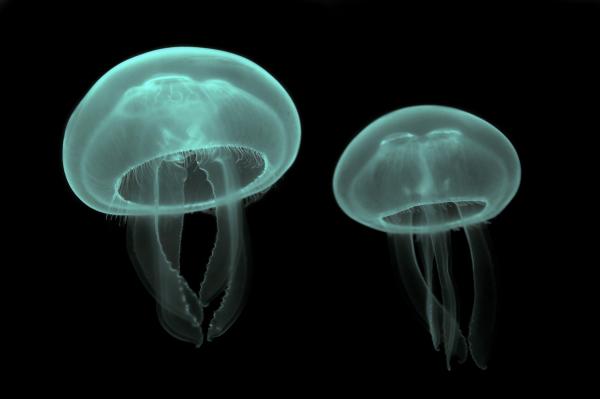
Jellyfish are dome-shaped, gelatinous invertebrates. Many of us have encountered this fascinating animal, either through jellyfish stings or by observing them in the ocean. Jellyfish are not actually fish; they are plankton. Despite their popularity, these intriguing creatures remain somewhat mysterious.
Have you ever wondered how jellyfish reproduce? Interestingly enough, the reproduction of jellyfish does not occur inside a female jellyfish's body, as it does in mammals. If you want to discover how jellyfish reproduce, keep reading this AnimalWised article!
Jellyfish characteristics
Jellyfish belong to the "Cnidaria" phylum, which includes approximately 10,000 species, of which only 20 are freshwater, while the rest are marine. Jellyfish exhibit radial primary symmetry, meaning their bodies can be divided into similar halves along their longitudinal axis.
The body of a jellyfish is organized as a blind sac with a single opening that serves as both the entry for food and exit for waste. Jellyfish have a digestive cavity called a "gastrovascular cavity", which digests food and distributes nutrients and oxygen to the rest of the body.
Jellyfish don't have a brain or a heart; instead, they are known for having highly developed sensory organs located in their bell. These senses allow jellyfish to detect changes in their environment and coordinate their movements. Within their bell, you can find their visual organs (ocelli) and balance organs (statocysts). Jellyfish can be predatory or filter feeders. Filter feeding involves them sifting the surrounding water to trap small food particles for nourishment.
Jellyfish also possess specialized cells known as "cnidocytes". Among these, the most common type is the nematocyst, which jellyfish use to sting for both hunting and defense. These stinging nematocysts are located in their tentacles. Another hunting mechanism involves an explosive cell called a Ptychocyst, which has a sticky surface that jellyfish use to capture prey.
Another significant characteristic of jellyfish is their two corporal forms: the polyp form, which is generally benthic (living anchored to the seabed) and colonial, and the planktonic form, where they float freely in the water, usually becoming solitary. Some species only exhibit the polyp form, while others transition through both forms.

How do Jellyfish feed?
Jellyfish, due to their planktonic lifestyle, are predatory animals. Their tentacles contain nematocysts, which are cells comprising an internal capsule (cnidocyst) filled with a stinging liquid and a filament. These cells are triggered by a contact-sensitive cilium (cnidocilium).
When a fish ventures too close to a jellyfish or lightly touches one of its tentacles, these nematocysts are activated. They are then expelled from their capsules and penetrate the prey's skin, immobilizing it. Once the prey is completely immobilized, the jellyfish guides it with its tentacles toward its mouth, leading it into the digestive cavity.
Jellyfish feeding habits are not only fascinating but also crucial for maintaining marine ecosystems. By preying on smaller organisms, they help regulate the population of various marine species, ensuring a balanced ecological environment.
The reproduction of jellyfish and polyps
To understand how these animals reproduce, we must first recognize the environments jellyfish inhabit. All cnidarians live in either salt or freshwater aquatic environments. In such habitats, internal fertilization (the union of the ovum and sperm) is uncommon. Therefore, cnidarians engage in external fertilization, meaning that females and males release eggs and sperm outside of their bodies. In hermaphroditic species, a single individual releases both eggs and sperm.
As we mentioned earlier, some species only have the polyp form, while others experience both forms. Most jellyfish species are hermaphrodites. Other species are dioic with separated sexes, though they are not easily distinguished.
During a jellyfish reproduction cycle, jellyfish undergo both a sexual and asexual phase. Initially, males release gametes (sperm) through their mouths into the surrounding water, where they swim to the female and enter her central cavity, ultimately reaching her eggs.
However, fertilization depends on the species. In some female species, eggs are retained in brood pouches and are fertilized by swimming through the male's sperm. Once fertilized, the eggs hatch into larvae that, upon release from the female, anchor themselves to the ocean floor. This asexual larva eventually develops into a polyp and releases more polyps, often resulting in a polyp colony. This polyp colony then produces young jellyfish, known as Ephyra.
This process illustrates the transformation from the grounded polyp form to a free-swimming jellyfish, i.e., the evolution from the benthic to planktonic form. Understanding this complex lifecycle provides insights into the adaptability and resilience of jellyfish in various marine environments.

Interesting jellyfish facts
As you may have seen, the reproduction in jellyfish is undoubtedly spectacular. This group of animals is full of surprises. For example:
- Jellyfish don't have bones, brains, or hearts.
- The box jellyfish is one of the most dangerous animals in the world, capable of stopping a person's heartbeat in two minutes.
- Some jellyfish are bioluminescent, meaning they can glow in the dark.
- Jellyfish consist of 95% water and only 5% solid material.
- Jellyfish can clone themselves through their remarkable ability to regenerate.
- A jellyfish's stinger can move faster than a bullet shot from a gun.
- Some jellyfish are considered immortal. The Turritopsis Nutricula jellyfish can reverse its aging process, effectively renewing itself. For more intriguing information, take a look at this article about which animals live the longest.
- Jellyfish have existed for over 500 million years, making them one of the oldest living creatures on Earth.
- Despite their simple structure, jellyfish have complex interactions with other marine life, playing key roles in their ecosystems.

If you want to read similar articles to How Do Jellyfish Reproduce?, we recommend you visit our Facts about the animal kingdom category.