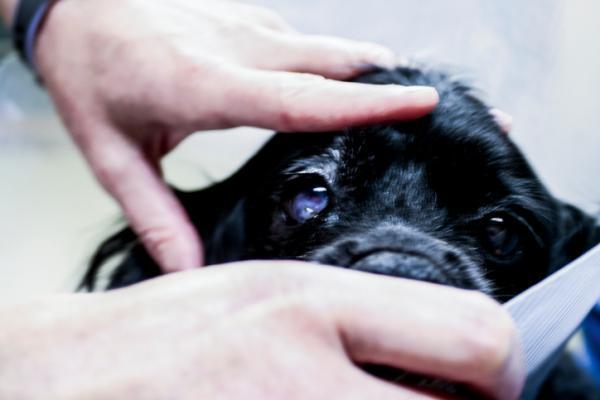
Keratitis in dogs is an ocular disorder that appears as corneal inflammation in dogs, often caused by several different things. The eyes of all animals are incredibly sensitive organs and are susceptible to conditions that often require treatment. If left untreated, some of these conditions can result in blindness in dogs.
Have you noticed discharge coming from your dog’s eyes? Are your dog’s eyes cloudy? There are many different types of keratitis in dogs, and treatment differs for each. For more about the types, symptoms, causes and treatment of keratitis in dogs, keep reading here.
Keratitis in dogs: what is it?
Keratitis refers to corneal inflammation in dogs. The cornea is the transparent, protective front layer of the eye. Tears, secreted by the lacrimal glands, of which there are two in each eye, moisten the cornea and prevent it from drying out. All of this helps protect the eye.
Common keratitis in dogs symptoms include:
- Pain.
- Pawing at the eye.
- Excessive tearing.
- Photophobia.
- A visible third eyelid.
- Cloudy-looking eyes.
- Eye scratching.
- Ocular discharge.
- Inflamed or reddened eyes.
Squinting or keeping the eye closed can also be a warning sign. Since eye conditions can worsen quickly, prompt veterinary assessment is important, especially if the eye is painful or cloudy. It’s important to know that these symptoms will always vary depending on the type of keratitis your dog is suffering from. All types of keratitis need to be treated accordingly. If not treated, it can result in partial or total blindness. For more about eye problems in dogs, take a look at our article where we look at, ‘‘Why does my dog scratch its eyes?’’
Keep reading to find out more about the most common types of keratitis in dogs.
Keratoconjunctivitis sicca: dry eye in dogs
Keratoconjunctivitis sicca is a type of keratitis in dogs that affects the lacrimal glands. Dry eye in dogs results in insufficient tear production, which causes the cornea to dry out. This then produces a thick, mucous or mucopurulent discharge, which can be confused with conjunctivitis. The difference between keratoconjunctivitis sicca and conjunctivitis is that with dry eye, the cornea will appear opaque and, over time, can become ulcerated and result in blindness.
There are several causes of dry eye in dogs, such as immune-mediated diseases. Many cases of dry eye in dogs, however, are idiopathic. This means that their origin is unknown. Some breeds are more prone to dry eye than others. These breeds include bulldogs, Cocker Spaniels and West Highland terriers. In addition, dry eye may appear as a result of other diseases, such as Addison’s disease or canine distemper. Dogs may squint, blink frequently or rub their eyes, and signs can worsen gradually. If discharge persists, an eye examination is important; do not use human eye drops unless a veterinarian recommends them.
Dry eye in dogs: diagnosis
To diagnose this disorder, a veterinarian will need to perform a Schirmer’s test to measure your dog’s tear volume. Treatment may include artificial tears, cyclosporine and antibiotics. In some cases, corticosteroids or surgery may be prescribed.

Ulcerative keratitis in dogs
Ulcerative keratitis in dogs is a very painful corneal inflammation that can develop when conditions such as dry eye or injury damage the corneal surface. Ulcerative keratitis in dogs symptoms include a cloudy, white or opaque cornea. Ulcerative keratitis in dogs treatment requires drugs to reduce pain and antibiotics. A veterinarian may use a special stain to check for corneal damage and assess the depth of an ulcer.
For more, we recommend taking a look at our article where we discuss cloudy eyes in dogs: causes.

Infectious keratitis in dogs
Infectious keratitis in dogs occurs when ulcerative keratitis or dry keratitis becomes complicated by a bacterial infection. Infectious keratitis can be caused by: fungi, bacteria or parasites. In addition to pain, purulent discharge and eyelid inflammation can occur. The difference between infectious keratitis and conjunctivitis, which also produces purulent discharge, is that keratitis also includes ocular pain. Because the cause can vary, an examination helps a veterinarian choose the appropriate treatment.
This type of keratitis in dogs treatment, like those already mentioned, requires antibiotic treatment prescribed by a veterinarian and appropriate to the specific case. This infection can sometimes be caused by fungi, resulting in fungal keratitis. This, however, is not very common.

Interstitial keratitis in dogs: blue eye
Interstitial keratitis in dogs is also referred to as blue eye in dogs. This type of keratitis turns the cornea a bluish hue. Blue eye in dogs is caused by the infectious hepatitis virus, and symptoms appear about ten days after the dog has come into contact with the virus. If you notice that your dog has cloudy or bluish eyes, make sure you consult your veterinarian immediately. A prompt examination can help identify the cause of the cloudiness and rule out other eye problems.
Although recovery from interstitial keratitis is possible, in some cases, the cloudiness of the eye may not completely clear.

Pigmentary keratitis in dogs
Although chronic superficial keratitis (corneal pannus) and pigmentary keratitis are different, it is common for them to occur together. Vascular keratitis occurs when blood vessels and connective tissue grow into the eye, a process known as neovascularization. This causes the cornea to lose its transparency. In pigmented keratitis in dogs, melanin pigment is deposited deep within the cornea[2].
Both types of keratitis may appear as a consequence of continued corneal irritation, such as entropion (eyelids turned inward) or lagophthalmos (the inability to close the eyes completely). Once these conditions are treated and the irritation is eliminated, the keratitis has a chance of being cured.
This specific, painless type of pigmentary keratitis, also known as canine pannus, commonly appears in breeds such as German shepherds, Border collies or huskies. Pigmentary keratitis in pugs is also becoming increasingly common. Although some forms of keratitis in dogs are curable, vascular and pigmentary keratitis that are not related to corneal irritation are progressive and incurable. This means that treatment for pigmentary keratitis in dogs focuses on controlling its progress. Corticosteroids and cyclosporine may be prescribed by a veterinarian when treating these types of keratitis[1]. Regular veterinary checkups help monitor changes and adjust treatment when needed.

This article is purely informative. AnimalWised does not have the authority to prescribe any veterinary treatment or create a diagnosis. We invite you to take your pet to the veterinarian if they are suffering from any condition or pain.
If you want to read similar articles to Keratitis In Dogs - Causes, Diagnosis and Treatment, we recommend you visit our Eye problems category.
1 https://onlinelibrary.wiley.com/doi/abs/10.1111/j.1748-5827.1979.tb07019.x
2 https://europepmc.org/abstract/med/8050943
- Disorders of the Cornea in Dogs (Merck Veterinary Manual)