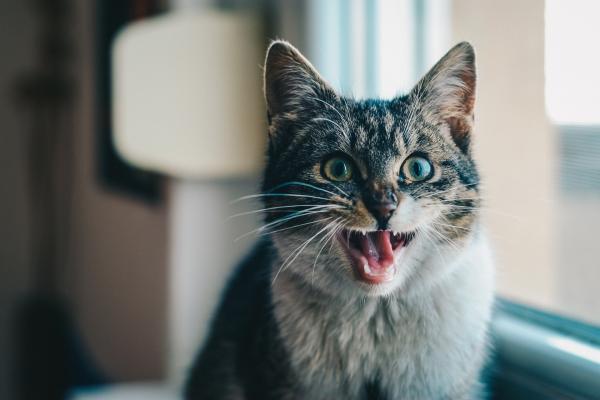
If we see our cat coughing and wheezing, our mind can jump to many conclusions. The intensity and frequency of the choking sounds from our cat will determine how panicked we may be, but it's important to know something is causing them. Whether this is something we need to be worried about will depend on the other symptoms the cat exhibits. We also need to think carefully about what our cat may have been doing before getting into this coughing, choking or wheezing situation.
A cat hacking or making gagging noises has various possible causes, some of which can lead to serious problems if left unattended. AnimalWised looks into why your cat keeps making choking noises to help you know if you have an emergency on your hands (and what to do about it).
Is your cat hacking, choking or gagging?
Vocalization is an important aspect of our cat's interaction with their human companions. In fact, cats will generally only meow at humans and not their fellow felines. However, among the sounds cats make toward their human pals, coughing, choking or wheezing are abnormal. Knowing what is an abnormal sound in your cat involves getting to know them and understanding their healthy vocal expressions. Each cat is unique in this regard, but getting to know your cat well is part of the rewarding experience of living with a pet.
The type of sound the cat makes will help determine the cause of the problem. You will need to see how severe it is, whether it sounds dry or wet and whether it is accompanied by any substances. With a cat hacking, it is usually a sound that indicates choking, but the cause of the choking might vary. A cough might sound like hacking, but it doesn't necessarily mean a foreign object is present. Gagging can be a sign of choking, which is usually an immediate problem and can lead to asphyxiation without proper intervention.
You need to think about whether they have eaten anything recently, as this can provide a clue to the cause of choking or coughing. You should also consider if there is anything you have left out which may have been consumed accidentally. In general, look for any change or factor in their environment or behavior which may help diagnose the problem. Unless the problem is obviously not an immediate danger, you should take your cat to the vet to determine the cause of the hacking or choking. If possible, note when the noises started and how often they occur; a short video can help the vet understand what you have observed.

My cat acts like something is stuck in her mouth
When a cat makes a hacking or choking noise, it is possible there is something stuck in their mouth or throat. What this might be is related to what they have consumed. How they behave will help give us clues as to what might be stuck. The two main choking hazards are:
Hairballs
Anything which gets stuck in the gastrointestinal system is known as a bezoar. Hairballs are a type of bezoar which occur when a cat ingests hair while grooming themselves. Most cats shed throughout the year, but molt significantly twice annually. During these times, it is possible the cat will ingest more hair than usual, leading to hairballs. As the hair collects in the gastrointestinal system, it will form a wet mass mixed with phlegm.
When coughing up a hairball, the sound will be less like hacking and more like regurgitation. When the hairball is expelled, it will sound like the cat is vomiting rather than coughing. You will also see the cat sticking their tongue out as they try to bring up the hairball. They may drool a little before the hairball appears. Once the hairball has been produced, any choking noises should stop. Some hairballs will take longer than others to appear. If your cat keeps retching without producing a hairball, or seems weak or distressed, contact a vet rather than assuming the problem is only a hairball.
If you want to prevent hairballs, it is important to groom your cat regularly. Many domestic cats will need help, particularly longhair breeds which do not have another cat in the house. Malt paste may also be used to help aid digestion of hair or ease regurgitation. Hairballs are normal for a cat, but if they have ingested too much hair it can lead to a trichobezoar. These can get stuck further down the digestive tract and can be dangerous. They are rare and probably won't be accompanied by choking.
Foreign objects
While a hairball might be temporarily uncomfortable, it will usually not cause harm to the cat. If your cat is coughing and wheezing, but no hairball is present, it may be due to a foreign object. These are a different matter. If the cat ingests something they shouldn't have, the result may be a choking hazard. If the foreign object is small enough, it may pass through their digestive system. If it is too large to pass, it can get stuck in the throat or mouth.
If your cat has something stuck in their throat, then you may see them look like they are yawning a lot. They are probably trying to get the object out rather than being tired. They may also grind their teeth a little to dislodge the object. Persistent gagging, pawing at the mouth or difficulty swallowing can also indicate a problem and should be checked by a vet.
If the object is in the mouth, then you may be able to see it. The cat may be able to expel it themselves unless it is stuck or they are too weak to do so. If it is stuck at the back of the throat (top of the esophagus), air may still be able to pass. The cat may be agitated, but they are not necessarily in immediate danger. If the object is blocking their airway, it needs to be dislodged immediately. Avoid pushing a visible object farther into the mouth or throat while trying to remove it.

What to do if your cat is choking on something
An emergency situation is happening if your cat is choking on something which is blocking their airway. The first thing you should do is open their mouth and see if there is anything visible which you can remove. If you can see an object and it is loose and easy to reach, carefully remove it. Do not reach blindly into the throat, as this could push an object farther in or result in a bite. If you can see the obstruction but are unable to reach it, contact an emergency vet immediately rather than trying to use tweezers without guidance. If breathing is severely affected, do not delay seeking emergency veterinary care.
When you are sure they are choking but cannot see the obstruction, you may need to perform the Heimlich manoeuvre on the cat. Call an emergency vet for guidance if possible, and use this only for a suspected airway blockage:
- Hold the cat with their back against your chest and make a fist with one of your hands.
- Place the fist under the cat's rib cage and hold it with the other hand so that your arms are around their body.
- Pull in and upwards in sharp motions, using care not to apply excessive force.
- Repeat these abdominal thrusts until you hear the object being removed.
- Look into their mouth after two or three abdominal thrusts to see if you can remove the object yourself, but do not reach blindly.
- Repeat until the obstruction is dislodged or veterinary help takes over.
If you have had to do the Heimlich manoeuvre on your cat, you will need to take them to the vet afterwards, even if they seem better. This is so that the vet can check whether all of the obstruction has been removed and whether any damage has occurred during the experience.
The types of obstruction are often food related, as cats don't often try to eat things which do not look appetizing to them. If they have been given cooked poultry, the cooked chicken bones might get stuck in the cat's mouth. Fish bones can similarly cause choking hazards. Small bones may cause the cat to make hacking noises as they try to dislodge them. Even if their airway is not blocked, a bone may still injure the mouth or throat, so contact a vet if the cat continues to gag or appears uncomfortable.
You will need to take the cat to the vet if the obstruction is not an emergency situation. There they will diagnose the problem. You should tell them everything you can about the circumstances to help with this diagnosis. If the object is near the top of the throat, they may use an endoscopy to confirm its presence and remove it with the grips at the end of the endoscope.
If the obstruction is further down, the vet will need to perform an X-ray and/or ultrasound to determine what the object is and how to treat it. If the object can pass through the rest of the gastrointestinal tract but cannot be removed from the mouth, a vet may try to push it into the stomach. If not, surgery may be required. If it is not obvious what the obstruction is, do not remove it yourself. It could be a long piece of string or something with a sharp edge. If this is the case, pulling it out manually may cause internal tissue damage.

My cat keeps coughing, but nothing comes up
If your cat keeps making choking noises, but you are sure there is no hairball or foreign object, the cough may be due to one of the following causes:
- Asthma: cats with asthma may make noises which sound very similar to choking or coughing. Feline asthma is one of the most common respiratory diseases in cats[1], affecting about 1% of the population. When an asthma attack occurs in a cat, their lungs will become inflamed, constricting them and making it much harder to breathe. Mild asthma attacks in cats might lead to slight coughing, but an acute attack will require you to take them to a veterinary hospital. You should not smoke around your cat in general, but particularly around a cat with asthma. Dust, smoke and other airborne irritants can also trigger or worsen respiratory signs, so it is helpful to keep the cat's environment as free of these as possible.
- Congestive heart failure: if a cat suffers from heart problems, then coughing may be a symptom. This will likely mean coughing happens over a longer period of time. If the heart condition worsens, coughing may occur alongside other symptoms such as weakness or difficulty breathing, which require prompt veterinary attention. Some reports find that drugs such as spironolactone can be used to treat cardiomyopathy (heart disease) in cats[2]. Annual or biannual veterinary checkups should be carried out to check vital signs and heart function. Filariasis is a disease affecting the heart caused by the parasite known as heartworm. It is zoonotic, meaning the parasite can also affect humans, although people do not catch it directly from an infected cat[3].
- Infection: if your cat has been infected by a disease or infested by a parasite, choking sounds may be a symptom. The type of infection will produce particular symptoms, but those which lead to respiratory inflammation often cause coughing or retching sounds. Lungworm is a particularly nasty parasite which can cause coughing in a cat. A recent report notes that although “visualization of the nematode [lungworm]... in fecal and respiratory (bronchial mucus or pleural fluid) samples” has been used as the main type of diagnosis, more sophisticated diagnostic tests are being developed[4]. Treatment will need to be carried out by a veterinarian, but proper deworming is essential for prevention. If coughing is persistent or accompanied by a change in appetite or energy, have your cat assessed rather than treating them with medication meant for another animal.
- Allergies: while we may think more about cats affecting human allergies, cats are also susceptible to suffering an allergy. This may be due to food, plant matter (including pollen), cleaning products, fabrics or drugs. The things cats can be allergic to are similar to those that affect humans. Symptoms include wheezing, coughing and sneezing which may sound like choking noises in cats. Take your cat to the vet to test for allergies and to rule out any other pathologies. If your cat is struggling to breathe or breathing with their mouth open, seek urgent veterinary care rather than waiting for an allergy assessment.
This article is purely informative. AnimalWised does not have the authority to prescribe any veterinary treatment or create a diagnosis. We invite you to take your pet to the veterinarian if they are suffering from any condition or pain.
If you want to read similar articles to My Cat Keeps Making Choking Noises, we recommend you visit our Other health problems category.
1 https://www.ncbi.nlm.nih.gov/pubmed/20800209
2 https://www.sciencedirect.com/science/article/pii/S1760273416301060
3 https://www.ncbi.nlm.nih.gov/pmc/articles/PMC106837/
4 https://www.zora.uzh.ch/id/eprint/127356/