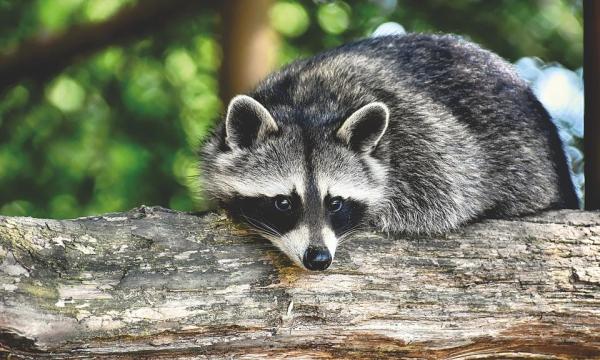
This world is made up of a variety of animals, each with incredibly unique characteristics. There are, however, many animal species that resemble each other and are easily confused. The raccoon, for example, is among the animal species that are often confused with their ‘‘distant cousins.’’
For more about raccoon-like animals and the raccoon family tree, keep reading here at AnimalWised. In addition to general raccoon facts, we’ll also be discovering raccoon characteristics and more!
Raccoon family
Raccoons, sometimes spelled racoon, are native to the Americas, although some populations live in Europe and Asia as an invasive species. These incredibly adaptable animals inhabit forests close to rivers and/or suburban and urban areas with abundant food. Raccoons are omnivorous animals, and a raccoon's diet generally consists of frogs, fruits, plants, insects, and the eggs of birds and crocodiles. Their sensitive front paws help them handle food and explore objects, while their strong climbing ability allows them to move through trees with ease.
As for appearance, the raccoon measures roughly 60 cm in height and weighs between 15 and 20 kg. Its coat is silver on almost all of its body, except for its tail. The characteristic raccoon tail is unique for the black rings that circle it. A raccoon’s face has black mantle spots around each eye, giving it a ‘Zoro-like’ mask appearance.
Raccoon characteristics
Raccoons are solitary and nocturnal animals. Females seek mates only during mating season. The gestation period for raccoons is roughly 73 days, and a female can give birth to up to four cubs. Their nighttime activity helps them avoid some daytime disturbances, and they often use their dexterous paws to search for food.
Raccoon fun fact: the raccoon family and bear family are closely related.
Despite a raccoon’s tender appearance and quiet behavior, raccoons are not pets. For more, we recommend reading our article where we discuss raccoons as pets: guidelines and tips.
Types of raccoons
There are three species of raccoon and several raccoon subspecies, each recognized for its own individual characteristics. The three main raccoon species include the common raccoon (P. lotor), the tropical crab-eating raccoon (P. cancrivorus), and the less common Cozumel raccoon (P. pygmaeus).
Keep reading to discover more about the Procyonidae of the order Carnivora, that is, the raccoon family. Its members include several different mammals, and they can vary in size, diet, and behavior.
Crab-eating raccoon
The crab-eating raccoon, also known as the South American raccoon (Procyon cancrivorus), is a species native to the jungle environments of Costa Rica, Brazil, Argentina, Paraguay, and Uruguay. This raccoon type measures roughly 70 cm in length and can weigh up to 15 kg. This solitary animal is a great climber that feeds on crabs, shrimp, and fish. These raccoons prefer to inhabit refuges in tree hollows, cracks in rocks, and/or abandoned buildings. They may forage near water, where crustaceans and other small prey are easier to find.

Common raccoon
The common raccoon, also spelled racoon, (Procyon lotor) can be found in Panama, the United States, and Canada. This raccoon type can live up to 20 years in captivity and an average of 12 years in its natural habitat. One of the main threats to the common raccoon is indiscriminate hunting. In addition, because this raccoon species ventures from its natural habitat into areas populated by humans, it is often killed in road accidents. Its adaptability can bring it into close contact with people, especially where food or shelter is readily available.

Guadalupe raccoon
The Guadeloupe raccoon (Procyon lotor minor) is endemic to the Lesser Antilles of the Caribbean Sea. According to the International Union for the Conservation of Nature (IUCN), this species is in danger of extinction and is currently classified as "Endangered". Its main threats are hunting and the deterioration of its habitat. Its limited island range makes the preservation of suitable habitat particularly important.

Tres Marias raccoon
The Tres Marias raccoon (Procyon lotor insularis) is native to the archipelago of the Islas Marías, located in the Pacific Ocean. This raccoon subspecies is characterized by its brown coat, which contrasts with the typical gray raccoon.

Cozumel raccoon
The Cozumel raccoon (Procyon pygmaeus) is endemic to the island of Cozumel, off the Yucatan Peninsula (Mexico). This specimen differs a bit from other raccoon species. First of all, it is much smaller than other raccoon species, weighing only 4 kg. Additionally, the Cozumel raccoon has a black band running from each cheek to each eye, as well as a unique golden tail. According to the IUCN, this species is classified as "Critically Endangered." Because it is found only on one island, changes to its habitat can have a significant effect on its population.

Animals that look like raccoons
Despite not being related, there are also some animals that greatly resemble raccoons. For more about raccoon look alike animals, keep reading below:
South American Coati
The coati (Nasua nasua) is an omnivorous mammal native to South America, including Argentina and Paraguay. The South American coati can reach roughly 140 cm in length, and its long tail is often the same length as its body. Its extremities are short, except for its elongated snout and large eyes.
These social animals, unlike the solitary raccoon, live in communities of between 5 and 20 individuals. Their long snouts help them search for food among leaves and soil.
For more, we recommend reading our article where we discuss everything you need to know about coatis as pets.

Red Panda
The red panda (Ailurus fulgens), native to southwestern China and the eastern Himalayas, measures roughly 60 cm in length and weighs a scant 5 kg. This raccoon-like animal feeds mainly on bamboo, plants, fruits, eggs, birds, and lizards. Its reddish-brown body is soft to the touch, and it’s easily recognizable by the white spots on its face. Despite its name and appearance, the red panda is not a raccoon and belongs to its own distinct family.
Because of habitat loss, the disappearance of food sources, indiscriminate hunting, and deforestation, this species is currently classified as "Vulnerable" according to the IUCN Red List.

Kinkajou
The kinkajou (Potos flavus) is a mammal native to the jungles of Central and South America. This tropical rainforest mammal stands out for its prominent tail, which it uses to climb and swing on tree branches. Its elongated and muscular body reaches 58 cm in length. Its dense and short fur can vary in color; chestnut and yellow are the most common. Kinkajous feed on flowers, herbs, bird eggs, insects, and honey. Their tail also helps them balance as they move through the canopy.

Ring-tailed cat
The ringtail (Bassariscus astutus) is a mammal native to rocky or wooded areas of North America. This member of the raccoon family generally reaches 40 cm in length and weighs only 1.5 kg. Its fur color can vary from yellowish-gray to dark brown; however, its tail is always ringed.
This nocturnal and solitary species feeds mainly on fruits, plants, insects, lizards, and small birds. Its long tail helps it balance as it moves across rocky terrain and through trees.

Olinguito
The olinguito (Bassaricyon neblina) lives in the humid regions of Colombia and Ecuador. This raccoon lookalike feeds on insects, fruits, and plants and is characterized by its dark brown and black coloring. This solitary, tree-dwelling species generally measures 35 cm in length and weighs 900 grams. It spends much of its time in the forest canopy, where its small size helps it move among the branches.

If you want to read similar articles to Raccoon-like Animals - Names and Examples, we recommend you visit our Facts about the animal kingdom category.
- Procyon lotor (Animal Diversity Web, University of Michigan)
- Coati (San Diego Zoo Wildlife Alliance)
- Amazing Species: Pygmy Raccoon (International Union for Conservation of Nature)
- Reid, F., Helgen, K. & González-Maya, J.F. 2016. Procyon cancrivorus. The IUCN Red List of Threatened Species 2016: e.T41685A45216426. http://dx.doi.org/10.2305/IUCN.UK.2016-1.RLTS.T41685A45216426.en. Downloaded on 12 July 2019.
- Timm, R., Cuarón, A.D., Reid, F., Helgen, K. & González-Maya, J.F. 2016. Procyon lotor. The IUCN Red List of Threatened Species 2016: e.T41686A45216638. http://dx.doi.org/10.2305/IUCN.UK.2016-1.RLTS.T41686A45216638.en. Downloaded on 12 July 2019.
- Emmons, L. & Helgen, K. 2016. Nasua nasua. The IUCN Red List of Threatened Species 2016: e.T41684A45216227. http://dx.doi.org/10.2305/IUCN.UK.2016-1.RLTS.T41684A45216227.en. Downloaded on 12 July 2019.
- Glatston, A., Wei, F., Than Zaw & Sherpa, A. 2015. Ailurus fulgens (errata version published in 2017). The IUCN Red List of Threatened Species 2015: e.T714A110023718. http://dx.doi.org/10.2305/IUCN.UK.2015-4.RLTS.T714A45195924.en. Downloaded on 12 July 2019.
- Helgen, K., Kays, R. & Schipper, J. 2016. Potos flavus. The IUCN Red List of Threatened Species 2016: e.T41679A45215631. http://dx.doi.org/10.2305/IUCN.UK.2016-1.RLTS.T41679A45215631.en. Downloaded on 12 July 2019.
- Helgen, K., Kays, R., Pinto, C., Schipper, J. & González-Maya, J.F. 2016. Bassaricyon neblina. The IUCN Red List of Threatened Species 2016: e.T48637280A48637420. http://dx.doi.org/10.2305/IUCN.UK.2016-1.RLTS.T48637280A48637420.en. Downloaded on 12 July 2019.