We associate the Mediterranean Sea with some of the most beautiful, accessible, and safe beaches in the world. We don't always associate it with sharks. While it is true many shark species live in tropical regions and coral reefs, they can also live in environments as far-reaching as the Arctic. With such a wide habitat distribution, it shouldn't be a surprise that we can find sharks in the Mediterranean Sea. Which shark species we are likely to find will vary since sharks can migrate depending on the time of year and temperature.
At AnimalWised, we provide a list of sharks in the Mediterranean Sea. We look at 20 Mediterranean shark species and discover more detail about their characteristics and behaviors. We also show you photos of these sharks so you can see what they look like.
Are there sharks in the Mediterranean?
Sharks are a type of fish that is located in the chondrichthyan class, meaning that all sharks are cartilaginous fish. This is because their skeletal system is mainly made up of cartilage. As we have stated in the introduction, there are indeed sharks to be found in the Mediterranean Sea. Not only can we find sharks in the Mediterranean, but you may be surprised at the diversity of shark species found in these waters.
It is common for many people to fear sharks. As many are equipped with razor-sharp teeth and are extremely agile in the water, we should certainly be careful if we approach one in the waters. However, sharks do not usually consider humans a food source. Most shark attacks occur either because the fish was provoked or because they mistook a person for their usual prey.
Some sharks are very docile. Although they are the largest fish species on the planet, the whale shark poses no danger to humans. They will often even let them be towed along through the water, although we don't encourage this practice in the wild.
Unfortunately, many sharks are currently included on the International Union for the Conservation of Nature (IUCN) Red List of Threatened Species. This is in most cases due to human interference in natural habitats such as overfishing, pollution, and climate change. Unfortunately, some are so vulnerable, we may not see these sharks in the Mediterranean Sea for much longer. Additionally, the ecosystem's balance is threatened, as sharks play a crucial role in maintaining the health of marine environments by controlling the population of other species.
Where are there sharks in the Mediterranean?
Sharks are animals with a wide habitat distribution, although how wide depends on the shark species and other factors. Many have such large distribution ranges that they are considered cosmopolitan animal species. These animals commonly remain in a state of constant mobilization, with migratory behaviors that result in traveling long distances. Learn more about migration with our list of animals with migratory habits.
Although we can find sharks in the Mediterranean Sea, most of them usually move through different regions which border this body of water before doing so. It is not common for them to remain in only one area. For this reason, we can find different shark species all over the Mediterranean Sea. Mediterranean countries which have reported the presence of sharks include:
- Spain
- Italy
- Tunisia
- Greece
- Egypt
- Malta
- Morocco
These countries offer a range of habitats that accommodate the various needs of different shark species, from coastal areas to the open sea. It should be noted that these regions are not only home to sharks but also to various other marine species that contribute to the Mediterranean's rich biodiversity. The interaction between these species creates a complex ecosystem that supports life in these waters.

Sharks in the Mediterranean Sea
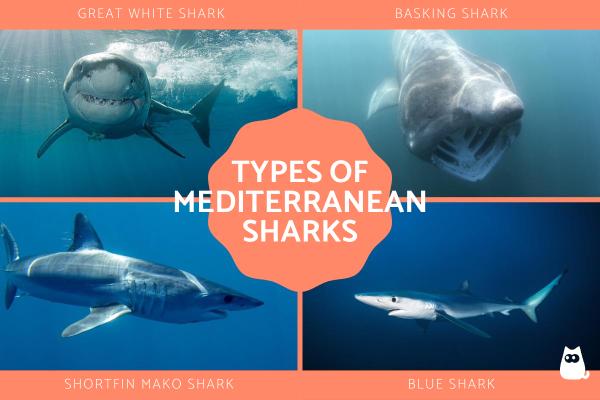
Now that we know sharks can indeed be found in the Mediterranean Sea, you are likely wondering what types may be present. As there is such diversity within sharks which can appear in the Mediterranean, we look at the different Mediterranean shark species in more detail:
Blue shark (Prionace glauca)
This shark species has a wide distribution, but has had reported sightings in the Mediterranean Sea. They usually weigh up to 400 lb in females, although males are considerably smaller. They develop in both coastal and open waters, in temperatures generally between 12-20 ºC/53-68 ºF. It is classified as near threatened. Their adaptability to varying temperatures and habitats is a testament to their resilience as a species.
Basking shark (Cetorhinus maximus)
The basking shark is distributed at different depths with a varied distribution, but they generally seek cold waters of between 8-14 ºC/46-64 ºF. They are one of the largest sharks to be found in the Mediterranean with a weight of over 3.9 tons and measuring up to 11 m/36'. It is considered in danger of extinction. Their filter-feeding behavior is unique among large sharks, as they primarily consume plankton.
Learn more about big fish with our article on the largest sharks in the world.
Bigeye thresher (Alopias superciliosus)
Although they can live in warm waters, they tend to move towards colder waters. They stay on the continental shelf or up to 20 miles from the coast. They measure 1.6 m (5') on average and weigh about 750 lb. It is classified as vulnerable. Their distinctive long tail is not just for show; it is used to stun prey, making them efficient hunters.
Shortfin mako shark (Isurus oxyrinchus)
The shortfin mako shark is a species of shark from the Mediterranean, but can inhabit many other regions. They have high mobilization and mainly pelagic habits. This means they are generally found in open waters with depths that can reach up to 900 m/3000'. The average weight is about 11 kg/24 lb and the length is 3.5 m/11.5'. It is classified in the endangered category. Known for their speed, these sharks are among the fastest in the ocean, reaching speeds up to 45 miles per hour.
Small-spotted catshark (Scyliorhinus canicula)
Also known as the sandy dogfish, this species lives on the continental shelf on muddy or rocky bottoms. These can reach depths of over 400 m/1300'. It is a small shark, compared to the previous Mediterranean shark species, weighing around 2 kg/4.5 lb and measuring 1 m/3.2'. It is considered to be of least concern. They are primarily nocturnal creatures, often hiding during the day and becoming more active at night.
School shark (Galeorhinus galeus)
This species is also cosmopolitan and located in temperate, cold, and warm waters. It is one of the most common types of Mediterranean sharks where it is popular as seafood, particularly in Andalusian cuisine. It grows up to 2 m /6.4' in length and is distributed from coastal waters to about 800 m/2600' deep. However, it commonly lives in depths of around 200 m/650'. It is classified as critically endangered. Their declining population is a concern for both marine biologists and fisheries.
Great white shark (Carcharodon carcharias)
You may be surprised to hear there are great white sharks in the Mediterranean, but it is true. They can be found in temperate and tropical waters, but prefer the former. They can be found both in coastal regions and the high seas, but most commonly prefer deep waters of around 1800 m/5900'. Although believed to be once very common in Mediterranean waters, their sightings are now rare. These apex predators play a vital role in the marine food chain, keeping the ecosystem balanced.
Learn more about his Mediterranean shark species with our article on the world's strongest animals.
Spiny dogfish (Squalus acanthias)
The spiny dogfish lives in temperate waters, including areas of the Mediterranean Sea. The spiny dogfish can be found in some coastal, estuarine, and offshore areas up to about 2,000 m/6500' deep, although most are located less than 600 m/2000'. The maximum sizes do not usually exceed 2 m/6.4' in length and the weight can range from 3-9 kg/6.6-20 lb. It is classified as vulnerable. Known for their longevity, some individuals can live up to 100 years.
Sharpnose sevengill shark (Heptranchias perlo)
This shark has a global, but a patchy distribution. Despite being one of the sharks that inhabit the Mediterranean, large population declines have been reported. They can be found in warm and temperate waters, generally at depths between 30-700 m/100-2300'. Their unique seven gill slits, as opposed to the usual five, make them an intriguing subject of study.
Velvet-bellied lanternshark (Etmopterus spinax)
They generally develop on the continental or insular platform, on muddy or clayey bottoms, at depths ranging from 200-500 m/650-1600'. It is a small shark species that does not usually exceed 45 cm/18' in length, although it can reach up to 60 cm/23.5'. It is classified in the vulnerable category. Their bioluminescent properties allow them to glow in the dark, a fascinating adaptation that aids in survival.
Other Mediterranean sharks
In addition to the above Mediterranean shark species, we can sometimes find the following in the Mediterranean Sea:
- Angel shark (Squatina squatina)
- Tiger shark (Galeocerdo cuvier)
- Portuguese dogfish (Centroscymnus coelolepis)
- Gulper shark (Centrophorus granulosus)
- Small-toothed sand tiger (Odontaspis ferox)
- Bignose shark (Carcharhinus altimus)
- Copper shark (Carcharhinus brachyurus)
- Spinner shark (Carcharhinus brevipinna)
- Sandbar shark (Carcharhinus plumbeus)
- Atlantic sawtail catshark (Galeus atlanticus)
Now that you know the types of Mediterranean sharks, keep expanding your shark knowledge with our article on how sharks reproduce. Sharks' reproductive strategies are just as diverse as their species, contributing to their incredible adaptability and resilience in various marine environments.
If you want to read similar articles to Sharks in the Mediterranean Sea, we recommend you visit our Facts about the animal kingdom category.
- Animal Diversity Web. (2020). Retrieved from: https://www.animaldiversity.org
- Carrasco-Puig P., & Barria C. (2021). Sharks and rays, endangered species that must be protected. 1.- Sharks of our Mediterranean. Association for the study of elasmobranchs and their Ecosystems. Catsharks. Retrieved from: https://www.catsharks.org/2021/08/25/tiburones-de-nuestro-mediterraneo
- IUCN. (2022). The Red List of Threatened Species. Retrieved from: https://www.iucnredlist.org