Spiders (Araneae) are one of the most diverse orders within the animal kingdom, with more than 42,000 species known to us. They are related to mites, scorpions, and opilions, among other groups.
Spiders are distributed throughout the world and have adapted to living in very different habitats. As a result, their diet is diverse and dependent on where they live.
In this AnimalWised article we're going to classify the types of spiders and describe their diet, for example, you'll learn what common house spiders eat. Continue reading to learn more!
Types of spiders
The classification of spiders is fundamentally based on the arrangement of chelicerae. These are some mouthparts that present a nail with which they inject venom. Before knowing what they eat, we must know what type of spider they are.
Currently, three types of spiders are distinguished:
- Araneomorphs (suborder Araneomorphae): this group includes most of the spider families that exist. The main common feature of all of them is the presence of labidognate chelicera, that is, they move at right angles to the axis of the body. Some examples are: Entelegynae, Theridiidae, Araneidae, etc.
- Migalomorphs (suborder Mygalomorphae): is the group of tarantulas, trapdoor spiders and other close relatives. These arachnids have orthognate chelicera, that is, they move parallel to the body. They are known for their robust bodies and longer lifespans compared to other spiders.
- Mesotelos (suborder Mesothelae): only includes one living family: the lifistids (Liphistidae). These are the most primitive spiders, which do not have venom, although they do possess orthognate chelicerae that can produce a strong bite. Their evolutionary traits offer insights into the early adaptation mechanisms of spiders.
What are common house spiders?
Common house spiders is a generic term for spiders that can commonly be found in our homes. These can be the following:
- Yellow sac spider (Chiracanthium inclusum): a common house spider worldwide. It is known for its pale yellow color and preference for building silk sacs in hidden areas.
- Black house spider (Badumna Insignis): an Australian spider also found in New Zealand. They are known for their messy webs and preference for secluded corners.
- Brown house spider (Steatoda grossa): a spider with cosmopolitan distribution. Often mistaken for the black widow due to its similar appearance.
- American house spider (Parasteatoda tepidariorum): a cobweb spider that thrives in both urban and rural settings.
- Common cellar spider, of the family Pholcidae: also known as daddy long-legs in North America. Their long legs and preference for damp areas make them easily recognizable.
- Domestic house spider (Tegenaria domestica): also known as barn weaver in North America. Known for their funnel-shaped webs.
- Giant house spider (Eratigena atrica): formerly Tegenaria gigantea. They are one of the largest house spiders and are often found in basements and attics.
- Hobo spider (Eratigena agrestis): sometimes called aggressive house spider. Despite its name, it is not aggressive to humans.
- House button spider (Latrodectus Geometricus): more commonly known as the brown widow. Its venom is less potent than that of the black widow.
- Southern house spider (Kukulcania hibernalis): Known for their preference for warm climates and their dark, velvety appearance.
- Tiny house spider (Oonops domesticus): They are small and often go unnoticed in households.

Spider diet
Many people wonder, if chelicerae are used to bite and inject venom, are spiders carnivorous? The answer is yes, most spiders are carnivorous. However, there is only one known exception, a herbivorous spider called Bagheera kiplingi. We'll talk about them in another section.
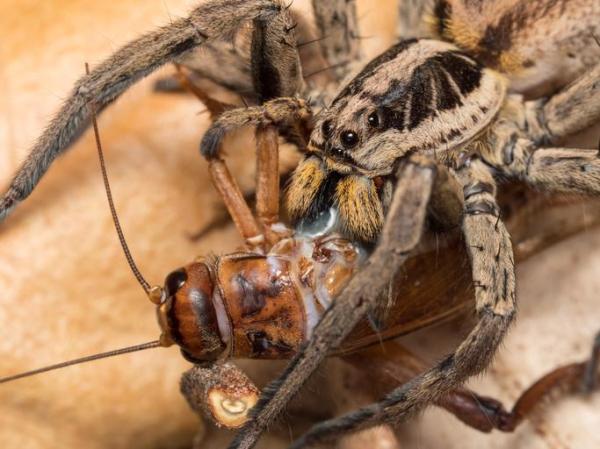
Spiders are predatory animals that capture other arthropods and inject venom to paralyze or kill them before eating them. In reality, most spiders do not eat their prey, but rather absorb their internal fluids until they are completely dry.
The feeding of spiders is based on insects, although they can also feed on other arachnids. Larger spiders, such as the giant tarantula (Theraphosa blondi), can eat mice and lizards. Some species have even been observed preying on small birds and amphibians.
Although considered carnivorous, many spider species consume small amounts of plant matter, such as flower nectar. This behavior has been recorded in many species of the Salticidae family. As we've previously mentioned, there is one spider (Bagheera kiplingi) whose diet is based on plants, making them herbivorous.
Interestingly, some spiders have evolved to include small amounts of plant matter in their diets, like pollen and leaf sap, which they might encounter in their habitats.
What do common house spiders eat?
Common house spiders eat common indoor insects, such as: mosquitos, roaches, flies, earwigs, and moths. They are carnivorous, as we've mentioned before, so they will capture and eat other insects. Providing us with an effective home pest control.
In addition to these typical insects, house spiders may also consume silverfish, ants, and even other spiders if they cross their path. This opportunistic feeding behavior helps control a wide range of pests in domestic environments, ensuring a balanced ecosystem within our homes.
What can I feed a house spider?
Some people make friends with their house spider. As long as they stay in their corner and don't bother the household, many people prefer to keep them as they get rid of indoor pests for them. A common question is what to feed a house spider.
Although these spiders are very independent, if you've noticed that they haven't caught anything in weeks and you want to feed them, you can feed them insects. It's best if the insect is freshly caught as spiders cannot feed off insects that have been killed a while ago.
Crickets and small mealworms can be good options for feeding house spiders. These can be purchased from pet stores and are generally more nutritious than wild-caught insects. Additionally, you can introduce tiny flies or gnats to their environment, which are typically easy for them to catch.
How long can house spiders survive without food?
Another common question is how long can house spiders survive without food? Spiders are very intelligent animals built to survive through hardships. Spiders will commonly have a reserve of food for these desperate days. However, if they've already fed off their reserves, they will survive an average of four-eight weeks.
If you've seen that they haven't eaten for a month and wish to feed them, remember to make sure the insect is fresh. You'll also want to make sure they know an insect is caught in their web, if not they won't go get it. Drop the insect into the spiderweb. This way, the spider will sense movement in their web and go see if it's their dinner.
It's fascinating to note that some spider species can lower their metabolic rate significantly when food is scarce, allowing them to survive even longer periods without sustenance. This adaptation is crucial for their survival in environments where food availability can be unpredictable.
How long do house spiders live in your house?
House spiders will often find a little corner in someone's home and catch any insects that pass by. These house spiders have a lifespan of up to two years. Although it's common for outdoor spiders to live for various years, house spiders don't live as long as them.
Environmental factors such as temperature, humidity, and availability of food can significantly influence their lifespan. In optimal conditions, some spiders might live slightly longer, continuing to help control pest populations in our homes.

Is it safe to have house spiders?
Yes, it's perfectly safe. House spiders are not generally dangerous to humans. They simply want to set up a web to catch insects to eat. These spiders also keep to themselves and are completely independent. In fact, they even help us maintain our house free of pests as they feed off them. These spiders will not move from their web unless they're starving and need to relocate to find food. They live for up to two years and do not attack you. They will most likely try to run away from danger instead of attacking.
Spiders do not watch you or recognize you as they have very basic eyesight. Instead, they sense movement. This helps them sense any movement happening on their web. In other words, spiders will keep to themselves and are safe to have at home. However, if you do not feel comfortable having them, we encourage you to trap them and take them outside so they can find another home.
Moreover, house spiders can act as a natural pest control solution, reducing the need for chemical insecticides that might harm the environment or other non-target species. Their presence can thus contribute to a more sustainable and eco-friendly home.
If you enjoyed this article and wish to learn more, we invite you to watch this Youtube video by Birdy Official. In this video they talk about what different types of spiders eat.
If you want to read similar articles to What Do House Spiders Eat?, we recommend you visit our Healthy diets category.
- Coddington, JA and HW Levi. (1991). Systematics and evolution of spiders (Araneae) . Annual Review of Ecology and Systematics 22: 565-592.
- Rainer, FF ( 2011 ): Biology of Spiders . Cambridge University Press.
- Willis, JG & Norman IP (1975). A revision of the trapdoor spider genus Cyclocosmia (Araneae, Ctenizidae) . American Museum Novitates , 2580: 1-36.
- Jackson, RR & Whitehouse, MEA (1986). The biology of New Zealand and Queensland pirate spiders (Araneae, Mimetidae): aggressive mimicry, araneophagy and prey specialization. Journal of Zoology 210 (2): 279-303
- Valdez-Mondragón, A. et al. (2014). First record of the mygalomorph spider family Paratropididae (Arachnida, Araneae) in North America with the description of a new species of Paratropis Simon from Mexico, and with new ultramorphological data for the family . ZooKeys, (416), 1-21.
- Richman, David B .; Jackson, Robert R. (1992). A review of the ethology of jumping spiders (Araneae, Salticidae) . Bull. Br. Arachnol. Soc. 9 (2): 33-37.
- Meehan, CJ, Olson, EJ, Reudink, MW, Kyser, TK, & Curry, RL (2009). Herbivory in a spider through exploitation of an ant – plant mutualism . Current biology, 19 (19), R892-R893.