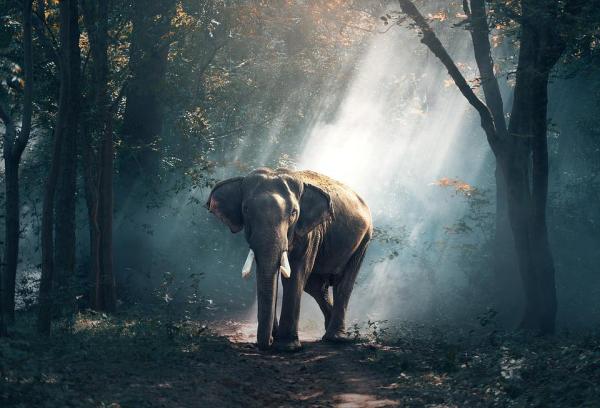
Elephants are among the largest animals in the world. Tall, heavy, majestic, and with huge ears, these animals carry imposing tusks, making it difficult for them to go unnoticed. But, have you ever wondered where elephants live?
Learn a little more about these magnificent mammals, their distribution, what they feed on, and the main reasons driving them towards extinction. For more, keep reading with us here at AnimalWised.
Elephant facts
Take a look at these amazing elephant facts:
- Elephants are mammals from the taxonomic order Proboscidea and the family Elephantidae.
- The elephant’s main prehistoric ancestor was the giant mammoth.
- Elephants have a life expectancy of 70 years, although there are records of some elephants living up to 90 years of age.
- Elephants are one of the top 10 largest animals in the world.
- Elephants are the largest land animals on the planet.
- Their trunks are not only useful for breathing, but they also: accumulate water, help the animal pick up objects, and aid them in distinguishing different textures.
- Elephants cannot jump.
- Elephants have incredible long-term memory.
- They communicate through a variety of vocalizations and subsonic rumbles that can be detected over long distances.
- Elephants play a crucial role in their ecosystems, aiding in seed dispersal and creating pathways in dense forests for other animals.
Where do African elephants live?
There are two species of African elephants: the African bush elephant (Loxodonta africana) and the African forest elephant (Loxodonta cyclotis). Although both live in Africa, they are distributed in different areas:
- African bush elephant: This elephant can reach up to 4 meters in height and weigh up to 6 tons. The African bush elephant inhabits desert areas covering the African continent, such as the sub-Saharan region.
- African forest elephant: This elephant is smaller than the African bush elephant. The African forest elephant measures only about 2.5 meters in height and weighs around 2.7 tons. They live in humid regions of forests and jungles. Such areas include Cameroon, Gabon, Congo, Guinea, and countries within the Central African zone. The forest elephants are particularly crucial for their habitat as they help to maintain the forest ecosystem by spreading seeds and creating clearings that promote plant growth.

Where do Asian elephants live?
There is only one species of Asian elephant (Elephas maximus) which is made up of three subspecies: the Sri Lankan elephant (Elephas maximus maximus), the Sumatran elephant (Elephas maximus sumatranus), and the Indian elephant (Elephas maximus indicus).
These species measure up to 3 meters in height, weighing up to 5 tons. They are considered to be incredibly peaceful and sociable animals. In addition, they are considered incredibly sacred animals in India. Asian elephants are distributed in several countries over the relevant continent, such as Sri Lanka and Sumatra: hence their given names. They are also distributed over Nepal, India, Indochina, Borneo, and Thailand. They prefer to live in areas covered with tropical forests, where it is easier for them to camouflage themselves within the surrounding vegetation. Asian elephants play a significant ecological role by maintaining the forest habitat, which is critical for other wildlife species.

Where do elephant seals live?
Although popularly known as an elephant, the truth is that this marine species does not bear any relationship to the aforementioned terrestrial mammal. The genus Mirounga includes two species: the northern elephant seal (Mirounga angustirostris) and the southern elephant seal (Mirounga leonina).
Elephant seals first inhabited the colder areas of North America, specifically, the surrounding Alaskan waters. The southern elephant seal, however, is distributed among the Patagonian coasts, which includes Australia, the Maldives, and Argentina.
This species has been dubbed with its ‘elephant’ name, due to its appearance. They, like elephants, have thick gray skin and can weigh up to a ton. Due to their large size, elephant seals have few predators, but at times, females and babies fall victim to sharks. Like other saltwater animals, elephant seals spend most of their lives in water. However, during their breeding season, they prefer to relocate to coasts, where they are able to mate and care for the young. Additionally, elephant seals are known for their long migrations, which are among the longest of any mammal species. They travel thousands of kilometers to forage and return to their breeding grounds each year.

What do elephants eat?
Terrestrial elephants, such as the African and Asian elephant, are herbivores. This means that they live on leaves, herbs, bark, and stems. An adult elephant needs to consume a large amount of food daily in order to survive. Adult elephants can ingest up to 200 kilograms of plant material daily. These elephants also choose to live in areas where water is easily accessible, for both drinking and bathing purposes. Elephants can consume up to 200 liters of water a day.
Sea elephants feed on fish, crustaceans, and other types of sea animals, such as squid, sharks, and rays. Elephant seals have adapted to dive deep into the ocean, reaching depths of over 1,000 meters in search of food. Their diet and foraging habits are crucial for the marine ecosystem, as they help regulate the population of their prey species.
Why are elephants in danger of extinction?
Many people are often confused as to how such a large animal can be in danger of extinction. The truth is that elephants are endangered as a consequence of human action, as one of the main threats to elephants is illegal hunting.
For centuries, ivory (which forms elephant tusks) has been considered a material of great value. Poachers are therefore predominantly responsible for elephant assassination, as they kill these animals in the name of money-driven profit. Unethical hunting also comes in the form of excursions, where the only objective is to hunt elephants for 'fun' or as a sport. Such practices have had a major impact on elephant extinction, where sadly now there are less than 1 million elephant species left in the world.
While there are sanctuaries created to protect these mammals, the lack of conscience when it comes to their general safety by others holds responsibility for the reduction in their numbers.
In addition to illegal hunting, we can include the destruction of their habitat. Due to this destruction, we (humans) force elephants to migrate un-instinctively. This is a process in which not all members of the herd survive, since food and water become scarce. Furthermore, climate change is exacerbating these challenges by altering habitats and making it harder for elephants to find the resources they need. Conservation efforts are critical, focusing on anti-poaching measures, habitat restoration, and sustainable coexistence strategies with humans.

If you want to read similar articles to Where Do Elephants Live?, we recommend you visit our Facts about the animal kingdom category.