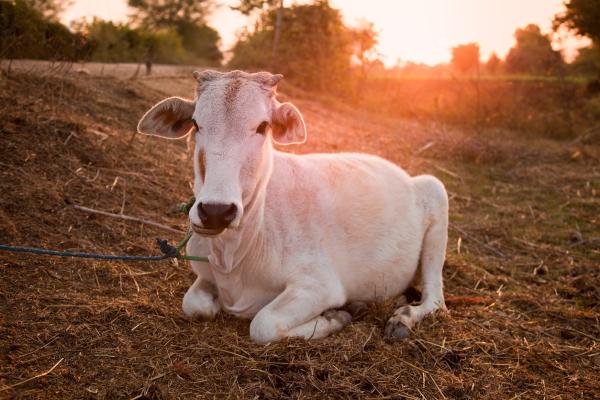
Hindus all over the world revere and worship cows. In fact, in India, cows are considered to be a manifestation of the Mother Goddess and a sacred animal that provides life-sustaining milk, considered the divine prasadam or holy offering.
In India, the cow is a holy, maternal figure revered as a symbol of the divine bounty of the earth. Do you want to learn more? Stay with us at AnimalWised and discover why are cows sacred in India.
Lord Krishna: Friend and protector of cows
Lord Krishna, one of the most revered Hindu deities, was a cowherd. This may account for the mythological significance and historical importance attached to cows in India. He is often depicted playing his flute, surrounded by dancing Gopis - or milk maidens - and cows.
Some of the other names for Lord Krishna are "Govinda" and "Gopala", which stand for “protector and friend of cows”. Feeding a cow in India is therefore considered highly auspicious for a devotee of Lord Krishna.
It should be noted that the bond between Krishna and cattle goes beyond mere symbolism; it represents an ideal of harmony and balance with nature, where humans and animals coexist peacefully. This connection reflects a broader perspective within Hinduism that emphasizes respect for all living beings.

Vedic scriptures and the Holy Cow
The holy Hindu scriptures, the Vedas, also contain verses which stress that it is a sin to kill cows and eat their meat. The Vedas also emphasize that cows should be offered protection and even today, many Indian states prohibit the slaughter of cows.
Additionally, these ancient texts highlight the cow as a symbol of abundance and fertility. They often refer to cows as the mothers of prosperity, underscoring their role in sustaining human life. The sanctity attributed to cows in the Vedas is deeply ingrained in the cultural and spiritual fabric of Indian society.
The cow in India: Harbinger of divine products
Sattvic or divine products of milk and dairy have a social and religious significance in India. This is because these products such as buttermilk, organic milk, and yogurt provide strength and nourishment to the body.
Even Lord Shiva's trusted steed is Nandi; not a horse, the sacred bull.
Furthermore, the consumption of cow's milk and its derivatives is believed to purify the mind and body, promoting spiritual growth and enlightenment. These products are integral to various rituals and ceremonies, further cementing the cow's status as a provider of essential and divine sustenance.
The cow in India: A source of fuel
Cow dung is also used as fuel in India. Rich in methane, it generates heat and electricity. Many rural homes in India are plastered with cow dung to protect the walls from extreme temperatures. Cow dung is also the perfect fertilizer which has jumpstarted the organic farming movement in India.
In addition to being an eco-friendly fuel source, cow dung is utilized in making traditional medicinal remedies and in pest control solutions. Its versatility in various applications highlights the cow's multifaceted contributions to sustainable living and environmental conservation.

Cows and Yagnas
In a land of spiritual mysticism like India, religious ceremonies called yagnas or fire ceremonies to thank the gods involve the cow. The ritual of burning cow dung as a sacred fire purifies the air too besides eliminating pollution and harmful radiation. Whether you opt for science or spirituality, there are good reasons why the cow is considered sacred in India.
These rituals are not merely symbolic but are seen as vital to maintaining cosmic balance, playing a crucial role in Hindu cosmology. The inclusion of cow products in such ceremonies signifies their importance in sustaining both spiritual and ecological harmony.
The Holy Cow and the Panchamrit
Ayurveda, an India holistic system of medicine and healing holds that the sacred cow provides the Panchamrit or sacred ambrosia that is the nectar of Gods made from cow products like milk, yogurt, and ghee.
Drinking this sweet prasadam or divine offering, one can initiate positive energy, according to Ayurveda. Cow rituals are performed in states of India such as Rajasthan.
Moreover, the Panchamrit is often used in religious rituals and offerings, symbolizing purity and sanctity. It serves as a reminder of the cow's central role in nurturing and supporting life, both physically and spiritually.

Ancient holy texts of Hinduism and the Sacred Cow
In the Mahabharata, an ancient mythological epic of the Hindus, the Pandava king Bhishma says that cows represent sacrifice because they are pure and holy, and they feed and nourish humans through milk and other products. Therefore, cows are sacred in Hinduism. Bhishma also says that cows act as a mother providing milk to human beings. The Puranas, ancient Hindu texts, say that nothing is more pious than the gift of cows.
Lord Krishna in the Bhagvad Gita - a scripture that is also a part of the Mahabharata - states: “Dhenunam asmi kamadhuk", which means "Among the cows, I am the wish-fulfilling cow". The wish-fulfilling cow is Kamadhenu, considered the mother of all cows and thus an originator of life. You can learn the fascinating story of the Kamadhenu cow here at AnimalWised.
Surabhi or Nandini is another holy name for the Sacred Cow. Even divine Hindu sages such as Chaitanya Mahaprabhu have revered the Holy Cow. Small wonder that India still regards the cow as a sacred animal!
In addition, the cow is often associated with the concept of dharma, or righteous duty, in Hindu philosophy. It embodies the virtues of patience, forbearance, and generosity, serving as a living example of the moral and ethical ideals upheld in Hindu culture.
Now that you know why is the cow a sacred animal in Hinduism, don't forget to share the article and spread the word!

If you want to read similar articles to Why are Cows Sacred in India?, we recommend you visit our Facts about the animal kingdom category.