Types of Martens - All Marten Species

 Add us on Google
The marten is a type of mustelid within the family Mustelidae, a classification which also includes weasels, minks, ferrets, badgers, and otters, among other animals. Mustelids have a very wide distribution, with populations on almost every continent, with Antarctica being the most notable exception. Different species live in different habitats, with some having more aquatic behaviors than others. Martens are mustelids which comprise the genus Martes. They are terrestrial animals with elongated bodies, soft fur, scent glands, and carnivorous habits. Mustelids are one of the most diverse animal types within their order.
At AnimalWised, we present the different types of martens. We provide all marten species with photos, information about their behaviors, and fun facts.
How is the marten classified?
As we have stated in the introduction, we know that the marten is a type of mustelid animal. This is a taxonomic classification which helps us to know how they are related to other living beings. We provide the full taxonomic classification of martens below:
- Kingdom: Animalia
- Phylum: Chordata
- Class: Mammalia
- Order: Carnivora
- Family: Mustelidae
- Subfamily: Guloninae
- Genus: Martes
Within the genus Martes, we can find 8 species of marten. These species are further divided into numerous subspecies, with around 61 currently reported. It is important to note that new subspecies may be discovered in the future, as taxonomy is a dynamic field of study.
Characteristics of martens
Despite their diversity, all mustelids have certain characteristics which set them apart from other types of mammals. These include having fur and scent glands on their body, as well as a mainly carnivorous diet. Each type of mustelid also exhibits its own specific characteristics, which include the following:
- They have thin and elongated bodies that resemble weasels and ferrets.
- Males usually measure between 18 to 24" (45 to 60 cm), while females measure 12 to 16" (30 to 40 cm), although exceptions do occur.
- The weight of males ranges between 1.1-14 lb (0.5-6 kg) and that of females between 0.4-11 lb (0.2-5 kg).
- The colorations and combinations of the fur vary depending on the species. They may be yellowish, brown, black, gray, or whitish, with various combinations thereof.
- In summer, the coat is shorter and less dense than in winter, enabling temperature regulation.
- Typically, martens are solitary animals and only form pairs during the reproductive season.
- Males often have intense confrontations to mate with females, showcasing their competitive nature.
- Courtship rituals include playful interactions between mating pairs, reinforcing bonds.
- Most species reproduce between June and August, aligning with favorable environmental conditions.
- The gestation period is highly variable depending on the species. Some experience a delay in embryo implantation, prolonging the process for more than 200 days, while in others, it lasts only a month.
- Although males and females maintain separate territories, these may overlap.
- Some species exhibit arboreal habits, while others are strictly terrestrial.
- Martens possess well-developed senses, which make them effective hunters.
- All species are omnivorous, with diets including hares, birds, reptiles, mice, fish, frogs, eggs, fruits, and berries.
- With the exception of the Nilgiri marten (M. gwatkinsii), classified as 'vulnerable', all other types of martens are considered in the 'least concern' category in terms of conservation status.
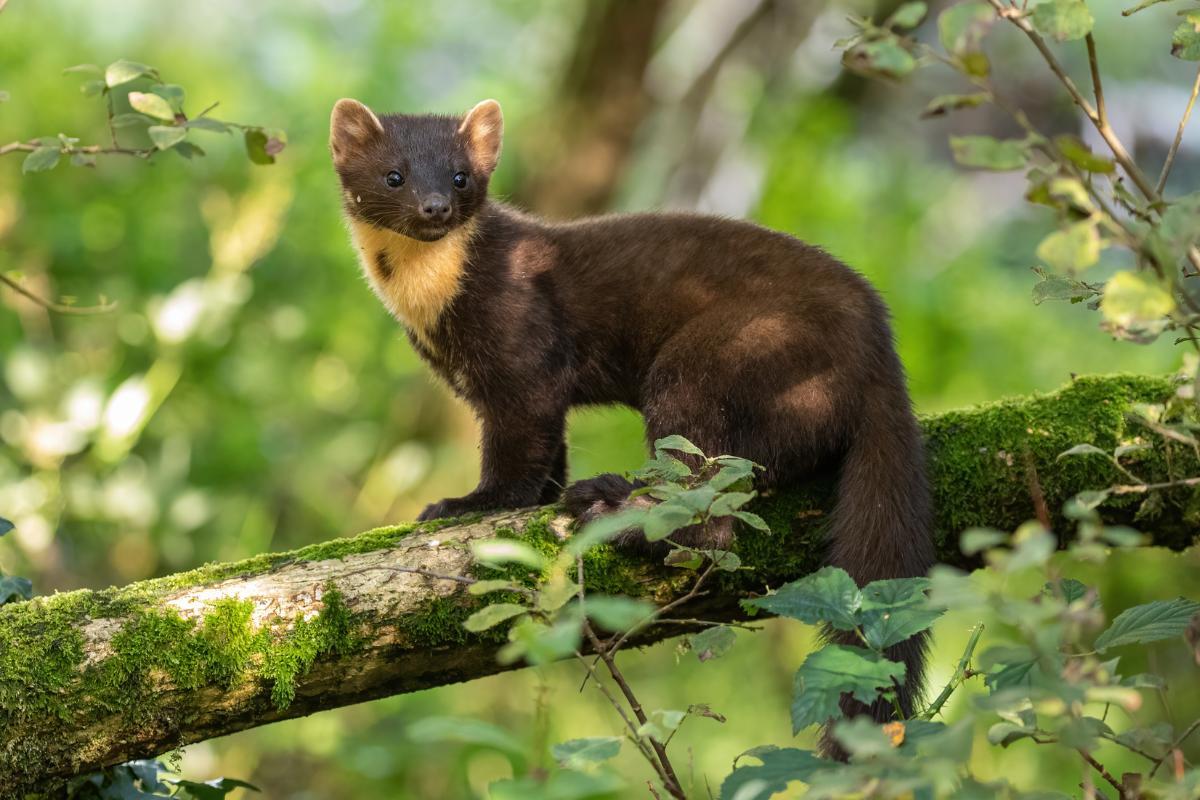
The image below shows a European pine marten with its distinctive yellow chest markings. Discover more facts about mustelids with our article explaining the different types of otter species.

Types of martens
In total, there are eight well-differentiated species of martens. They share the general characteristics explained above but also have traits unique to their own species. Below, we present the different types of martens found in the wild, highlighting certain individual characteristics in terms of behavior, habitat, and more:
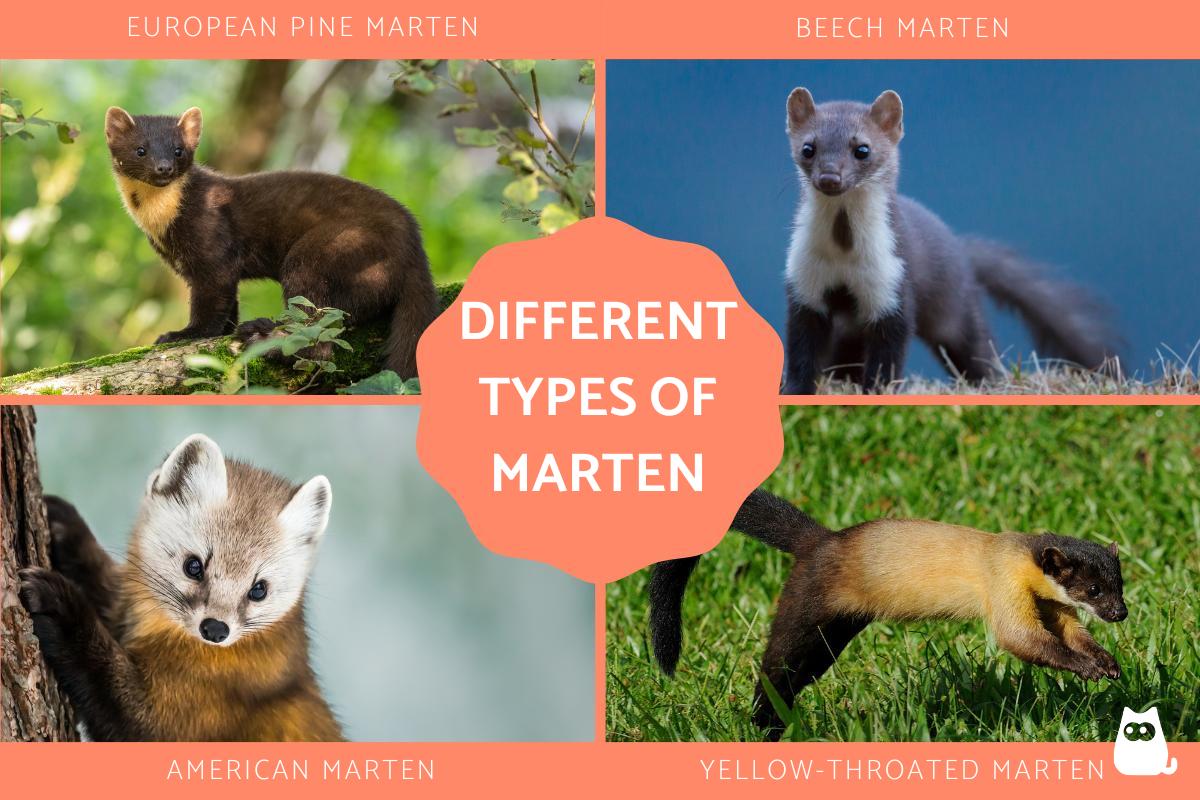
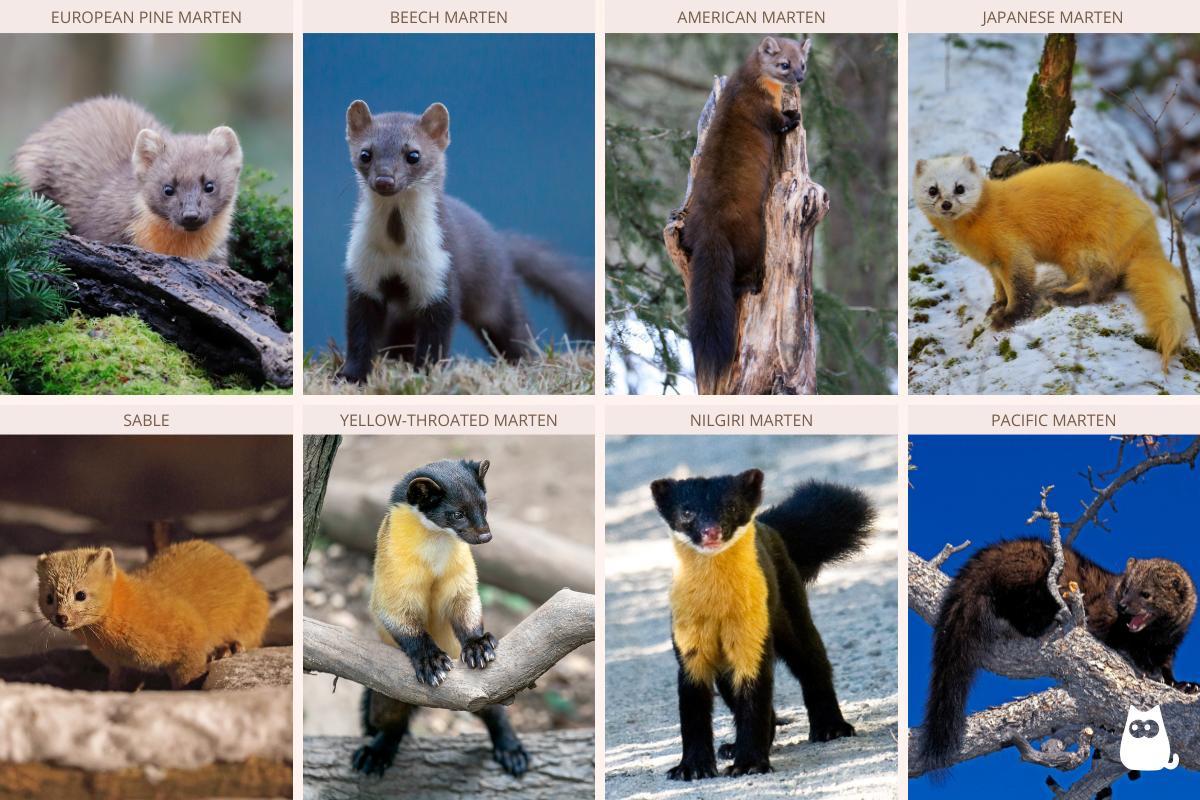
- European pine marten (Martes martes): native to much of Europe, Asia Minor, and Asian Russia, among other surrounding areas. It thrives in various forest types and is an excellent climber, measuring between 24-32" (60-80 cm) and weighing 1.1-4 lb (0.5-1.8 kg). It exhibits an intense brown color with a whitish orange spot on the throat.
- Beech marten (Martes foina): distributed throughout much of Europe and Central Asia. This marten species prefers more open spaces, such as deciduous forests, forest edges, rocky slopes, and urban areas. It is dark brown or grayish brown, with a light stripe under the chin. Its weight ranges between 2.2-5 lb (1-2.3 kg), and its size ranges from 16-21" (40-54 cm).
- American marten (Martes americana): native to Canada and the United States, also known as the American pine marten, it inhabits coniferous forests. It weighs between 0.55-3 lb (0.25-1.3 kg) and measures 12.6-18" (32-45 cm). Notably, it has a grayish head, dark brown legs and tail, cream chest, and brown back. They are sensitive to environmental changes, particularly weather and light, adapting their behaviors accordingly.
- Japanese marten (Martes melampus): endemic to Japan, with two subspecies identified, it thrives in forests and suburban areas. Its weight ranges between 1.1-3.8 lb (0.5-1.7 kg), and its length varies from 18.5-21" (47-54 cm). Its coloration ranges from yellowish brown to dark, with a light spot on the neck.
- Sable (Martes zibellina): native to China, Japan, Kazakhstan, Korea, Mongolia, and Russia, inhabiting various habitats such as boreal or coniferous forests, deciduous forests, and plains or mountains. It measures 13.8-22" (35-56 cm) and weighs 1.5-4 lb (0.7-1.8 kg). Their fur varies depending on the subspecies, from light to dark brown, being lighter on the ventral area than on the back and legs. Historically, it has been used in the fur trade, although less so than in the past.
- Yellow-throated marten (Martes flavigula): widely distributed throughout Asia, it inhabits boreal, equatorial, and many other forest types, from sea level to about 4,000 meters above sea level. Its size ranges from 19.7-28" (50-72 cm), and its weight from 2.7-12.6 lb (1.2-5.7 kg). It features a dark head, bright yellow chest and throat, and a dark tail. The coloration pattern varies depending on the subspecies.
- Nilgiri marten (Martes gwatkinsii): native to India, it inhabits various forest types such as evergreen, mosaic forests, grasslands, and humid forests. It has an average weight of 4.6 lb (2.1 kg) and a length that ranges between 21.7-25.6" (55-65 cm). It is dark brown in color, with a yellow or orange throat that can extend towards the forelimbs.
- Pacific marten (Martes caurina): native to Canada and the United States, it inhabits coniferous, mixed, and deciduous forests in both highlands and lowlands. It can weigh from 4.4-11 lb (2-5 kg), and its size is between 29.5-47" (75-120 cm). It presents shades of brown with silver or grayish areas on the body, and in some individuals, there may be a cream patch on the chest.
You can see the different marten species photos below. If you would like to learn more about a certain type of marten, take a look at our related article on what do pine martens eat?

If you want to read similar articles to Types of Martens - All Marten Species, we recommend you visit our Facts about the animal kingdom category.
- Dubberley, L. (2022). Tuesday (Online), Animal Diversity Web. Retrieved from: https://animaldiversity.org/accounts/Martes/
- Myers, P., Espinosa, R., Parr, C. S., Jones, T., Hammond, G. S., & Dewey, T. A. (2024). Taxon Information. The Animal Diversity Web. Retrieved from: https://animaldiversity.org/search/?q=martes&feature=INFORMATION
- IUCN (2024). IUCN Red List of Threatened Species. Version 2023-1. Retrieved from: https://www.iucnredlist.org/search?query=Martes&searchType=species