What Are Abyssal Fish?

Fish are the most diverse vertebrates when it comes to aquatic environments. In fact, there are about 28,000 species of fish around the world. They have a large number of anatomical and physiological adaptations that have allowed them to evolve successfully over the years.
In this AnimalWised article, we're going to discover what abyssal fish are and their characteristics. We'll also provide examples with photos. Discover more about these deep-sea fish and their fascinating anatomy in this article!
What are abyssal fish?
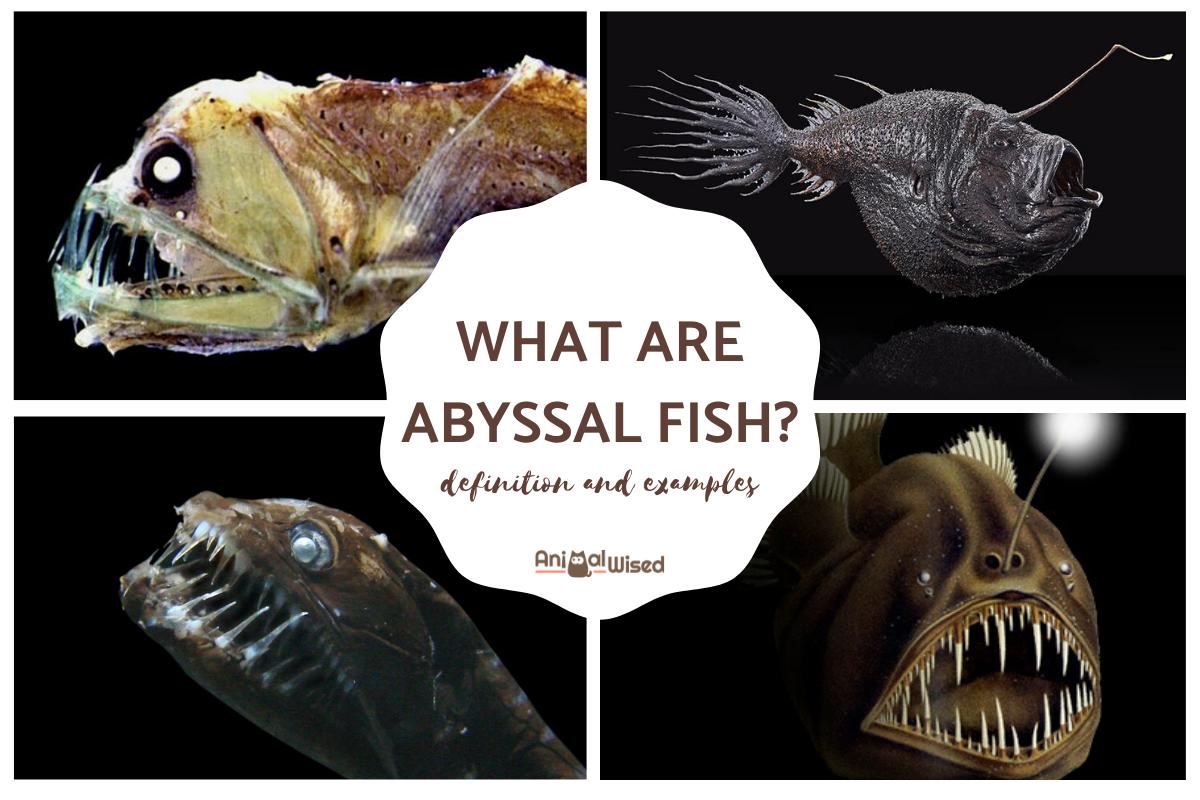
Abyssal fish are a group of species that have the ability to live in the abyssal zone. That is, a portion of the ocean deeper than 2,000m (6,600 feet). This zone is characterised by its extreme environmental conditions. This includes deep seas, extreme water temperatures between 0º-4ºC (32º-39ºF), high concentration of nutritional salts, as well as a major pressure increase and lack of oxygen.
The abyssal zone, or abyssopelagic zone, also makes up more than 83% of the ocean and covers around 60% of the earth. And yet, it is the zone we know least about. At its depths, this zone remains in perpetual darkness.
The fish that have the correct characteristics to live in these extreme conditions are called abyssal fish. They have a series of characteristics that allow them to survive in such deep oceans. In the following section, we will go through their characteristics.
Abyssal fish characteristics
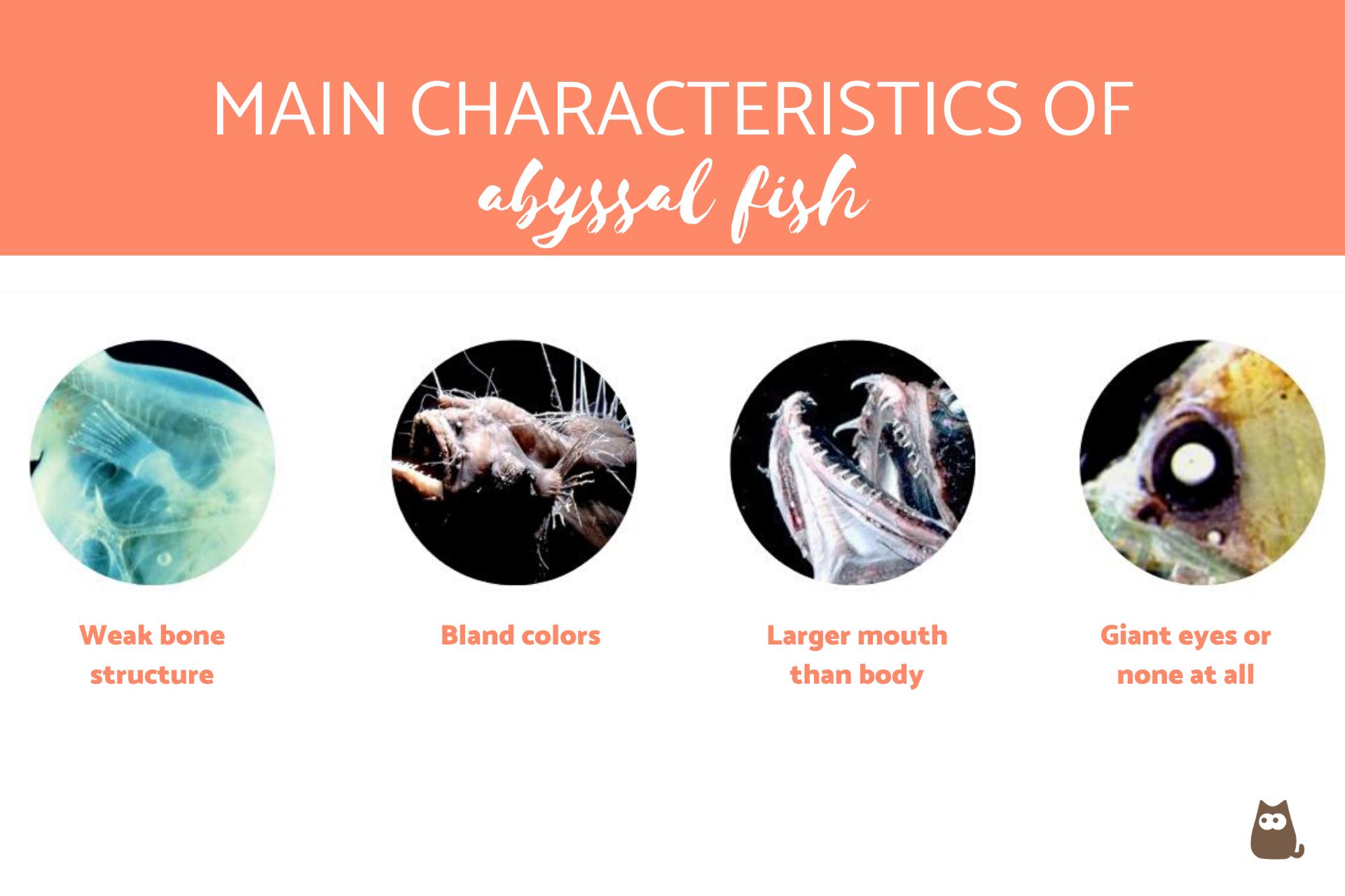
As previously mentioned, these fish share certain characteristics that allow them to survive in the extreme conditions of the abyssal zone. They are the following:
- Skeleton: Abyssal fish have weak bones as they have no need for stronger bones. This is because there are only weak currents in the abyss zone. Another reason for their weak bones is the fact that they cannot receive the nutrients and minerals, such as vitamin D or calcium, due to the lack of sun and the specific water components. Additionally, their skeletal structure is adapted to withstand the immense pressure found at such depths.
- Body: These fish don't have bright or flashy colors; many lack any color and seem to be transparent. This helps them blend into their environment, which is in perpetual darkness. Many abyssal fish have bioluminescence, allowing them to produce light from their bodies. This adaptation is crucial for communication and luring prey. These fish also have a very soft and flexible body that allows them to float around the deep sea.
- Mouth: Many abyssal fish species have extremely large mouths in comparison to their bodies. In fact, many have larger mouths than their bodies. This is an adaptation to the lack of food sources. The development of their mouths and stomachs allows them to feed on larger prey. In fact, sometimes their prey are larger than themselves. Some species seem to be made up of merely a head and a large jaw. Others have huge sharp teeth that don't fit in their mouth when closed. This adaptation is essential for maximizing their feeding opportunities in the scarce environment.
- Eyes: Some abyssal species have enormous eyes, while others don't have eyes at all. Abyssal fish with no eyes will need to rely on other senses in order to locate prey, mate, and avoid predators. When it comes to fish that do have eyes, their eyesight is extremely sensitive. In fact, they are 100 times more sensitive to light than the human eye. This sensitivity allows them to detect the faintest glimmers of bioluminescence in the dark depths.
In addition to these adaptations, some species have developed unique sensory organs that help them navigate and hunt in the dark. If you're enjoying this article, we encourage you to also read our article on animals without a brain.

What fish live in the abyssal zone?
Among the types of abyssal fish, some of the most notable are:
Angler fish (Ceratias holboelli)
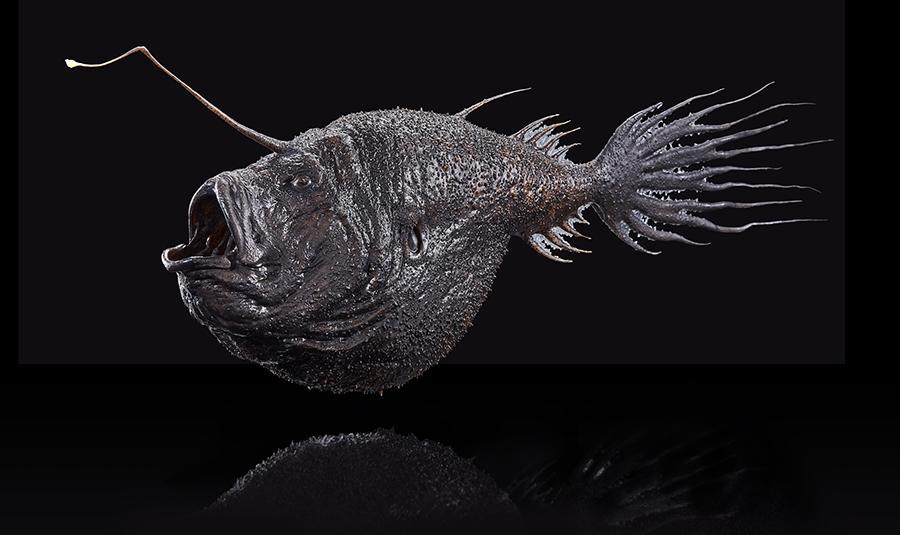
This fish (order Lophiiformes) inhabits the depths of all the oceans on our planet. It is a species of great size, being able to reach more than a meter in length. It has a certain strategy to prey on other fish that consists of using a filament that comes out of the upper part of its body.
The filament is made up of the first three vertebrae of its skeleton. The first of the filaments is the longest and is used to “fish”, since it is mobile and illuminates thanks to bioluminescent bacteria with which it performs a symbiosis. This way, the light emitted by the filament is used as a decoy to attract its prey, making it a master of deception in the deep sea.

Nether Anglerfish (Melanocetus johnsonii)
Another example of abyssal fish of the order Lophiiformes that lives in the abyssal zone is the Nether Anglerfish. This species has a very unique reproduction process and exhibits an extreme case of sexual dimorphism.
While the female is large, measuring up to a meter in length, the male is a parasite ten times smaller. The male, who doesn't even have a digestive system, attaches itself to the female's body. That's where he feeds off her nutrients and produces sperm. Males are able to find a female thanks to their highly developed sense of smell that can locate a female's pheromones. This unique adaptation ensures the continuation of the species in such an inhospitable environment.

Viper fish (Chauliodus sloani)
This abyssal fish belongs to the order Stomiiformes and is distributed in warm and temperate deep waters. They are found in depths of about 5,000 meters.
It has an elongated body similar to a snake (hence its name) with about 35 cm in length. In this species, the male is larger than the female. Its jaw is so large that in order to swallow its prey, it must dislocate them. In addition, it also has enormous and sharp teeth. These adaptations make the viper fish a formidable predator despite the scarcity of prey in its environment.

Whipfish (Saccopharynx ampullaceus)
This species is of the order Saccopharyngiformes and lives in 3,000 meters deep waters, distributed throughout the Atlantic Ocean. It reaches more than 1.5 meters in length and its body is dark brown, being almost black near the head.
It has an extremely long and thin tail that can reach four times the length of the body. In addition, adults suffer from reduced jaw. Nevertheless, they can capture larger prey than themselves thanks to their expanded stomach and great sense of smell. This remarkable adaptation allows whipfish to thrive in the nutrient-poor deep sea.

Pelican fish (Eurypharynx pelecanoides)
This species is of the order Saccopharyngiformes. It is distributed in temperate areas of all oceans. It measures about 60 cm and its shape is reminiscent of an eel. That's why they are also called “voracious eel”.
What stands out in a very striking way is the size of their mouth, which becomes larger than their body. Its name is due to the fact that its lower jaw opens reminiscent of a pelican's gular pouch, allowing them to swallow huge prey. Its body ends in a long, thin tail that ends in a bioluminescent organ that it uses to attract prey. This combination of features makes the pelican fish a cunning hunter in the depths.

Other deep sea fish that live in the abyssal zone
Other deep-sea fish that live in the abyssal zone are:
- Spiny fish (Himantolophus appelii).
- Dragon fish (Stomias boa).
- Leptostomy fish (Leptostomias gladiator).
- Toothed firefly (Gonostoma elongatum).
- Ax fish (Argyropelecus aculeatus).
- Spiny frogfish (Caulophryne jordani).
- Square-nosed helm (Scopelogadus beanii).
- White Nether Cerato (Haplophryne mollis).
- Red velvet whale fish (Barbourisia rufa).
- Crop fish (Saccopharynx lavenbergi).
These species, each with their own unique adaptations, contribute to the rich diversity of life in the abyssal zone. Want to learn more? Watch this Youtube video by the Scientific Magazine about the abyssal Anglerfish.

If you want to read similar articles to What Are Abyssal Fish?, we recommend you visit our Facts about the animal kingdom category.
- Hernández-Urcera, J. & Guerra, Á. (2014). Life in great depths . Medical dendra. Humanities magazine, 13 (1), 34-48.
- Nielsen, JG, Bertelsen, E. & Jespersen, Å. (1989). The biology of Eurypharynx pelecanoides (Pisces, Eurypharyngidae) . Acta Zoologica, 70 (3), 187-197.