Living and Extinct Prehistoric Birds - Evolution of Birds

Birds are warm-blooded vertebrates that walk, hop, or stand only on their hind legs, while their front legs have evolved into wings, which enable them to fly in most cases, although not all of them do. Birds are descended from bipedal, carnivorous Jurassic dinosaurs that lived 150 to 200 million years ago. In fact, they are the only dinosaurs that survived the mass extinction at the end of the Mesozoic Era.
In this AnimalWised article, we talk about living and extinct prehistoric birds, their relationship to dinosaurs, and show specific examples.
How did birds evolve?
Birds are the last surviving lineage of dinosaurs. Their evolution can be broadly classified into prehistoric birds and modern birds. Prehistoric birds evolved in the Jurassic period, 200 to 150 million years ago, from theropods, a group of bipedal carnivores that included the colossal Tyrannosaurus rex and the graceful Velociraptor.
These prehistoric birds almost all still had teeth and claws on their wings, but otherwise outwardly resembled modern birds. Their classic small, light, feathered, and winged physique developed gradually over tens of millions of years of evolution rather than in a single burst of innovation.
Early birds diversified during the Jurassic and Cretaceous periods and evolved into capable flyers with superior growth rates, but were decimated during the extinction at the end of the Cretaceous along with their close relatives, the dinosaurs. After the mass extinction, there was an explosive diversification of modern birds (members of the crown group of birds), culminating in more than 10,000 species now distributed worldwide.
The emergence of ducks, cuckoos, hummingbirds, and other modern forms of birds seemed a classic case of evolutionary radiation in response to the displacement of ecological niches by an extinction event. In this case, the niches had previously been occupied by dinosaurs, pterosaurs (flying reptiles), and archaeal birds. It is believed that birds were able to survive this catastrophic event primarily because they were smaller than dinosaurs, because their diet was more diverse and therefore more adaptable, and because they could fly.
New techniques of paleontological analysis have made it possible to reconstruct the evolution of the birds' distinctive anatomy. The results suggest that bird features evolved gradually over several million years, albeit for very different purposes than they do today.
Birds have characteristics that distinguish them from other vertebrates. In addition to the characteristics that enable them to fly, their metabolism allows them to grow very quickly and their large brains give them high intelligence and good senses. They are so different that their origin has long aroused the curiosity of naturalists.
Research has also shown that the colors and patterns of their feathers have played a significant role in their evolution, serving purposes in mating rituals and camouflage. These adaptations highlight the complex interplay between environment and evolutionary biology in shaping the incredible diversity seen in modern birds.
If you want to learn more about birds, do not miss this other article where we talk about birds that do not fly.
Are prehistoric birds related to dinosaurs?
Numerous fossils of feathered dinosaurs have been found, demonstrating the drastic transformation of these terrestrial giants into graceful birds of flight that we know today.
As mentioned earlier, birds have evolved from dinosaurs and are therefore dinosaurs, just as man is a kind of mammal. Specifically, birds evolved from a group of carnivorous dinosaurs called theropods, the same group to which Tyrannosaurus rex belonged.
The first birds were in fact more like small dinosaurs than they were like any bird today. Their mouths still contained sharp teeth. But over time, the birds lost their teeth and developed beaks. Although their ancestors were carnivores, they later diversified their diet to omnivores or herbivores.
When comparing theropod bones, it can generally be said that the first birds reduced their size over a period of about 50 million years. They also developed larger breasts and stronger feathering, which allowed them to grow wings.
These prehistoric birds developed the same flight strategy as modern birds. Many small modern species can fly by flapping their wings continuously and following a straight trajectory. However, if they want to optimize their flight efficiency, whether to increase speed or fly long distances, they have to change their strategy. They did this by alternating periods of wing flapping with others in which the wings fold with the body.
Another fascinating aspect is the development of various flight techniques. Some birds became adept at soaring, utilizing thermal air currents to glide effortlessly, while others developed rapid, powerful wing strokes for agile maneuvering in dense forests. These adaptations allowed birds to occupy a wide array of ecological niches, from the skies above open plains to the dense canopy of jungles.
If you want to learn more about birds, do not miss this other article, where we discuss the different types of bird feet and their functions.
Examples of extinct prehistoric birds
Now that we know that present-day and extinct prehistoric birds are indeed descended from dinosaurs, let us get to know some species of these extinct species a little better:
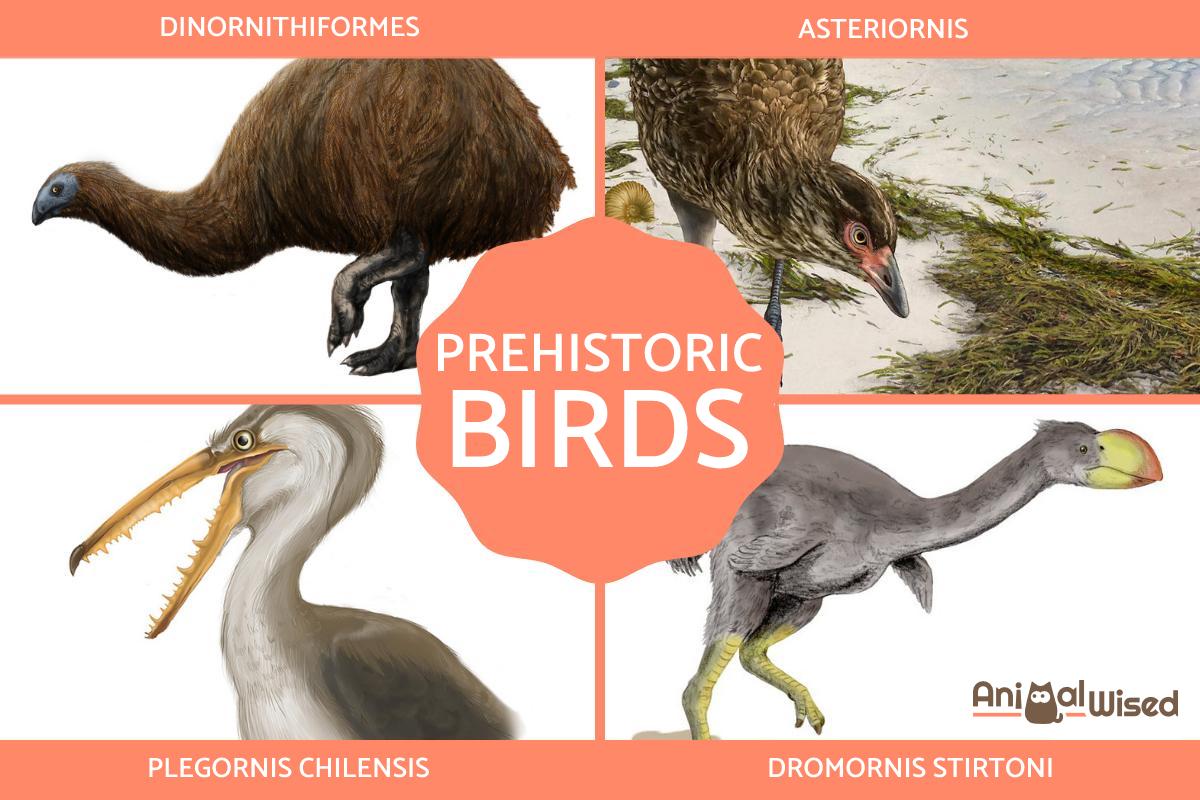
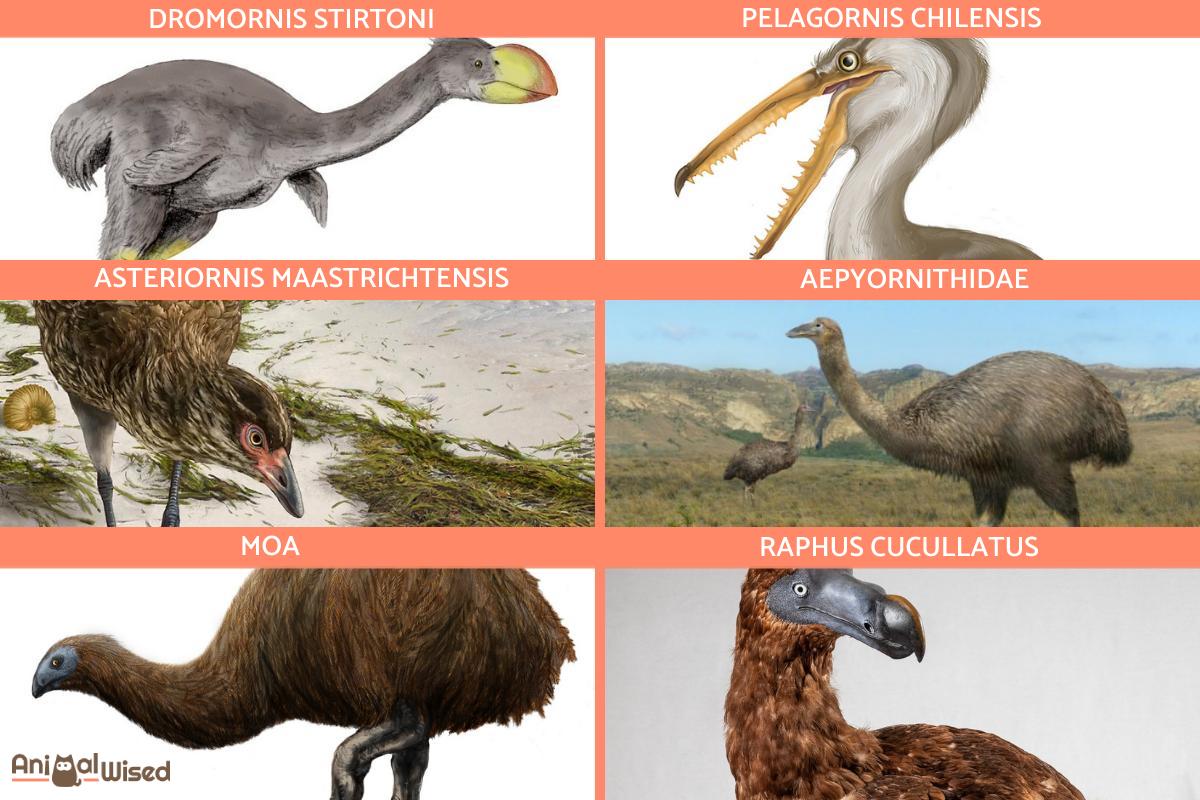
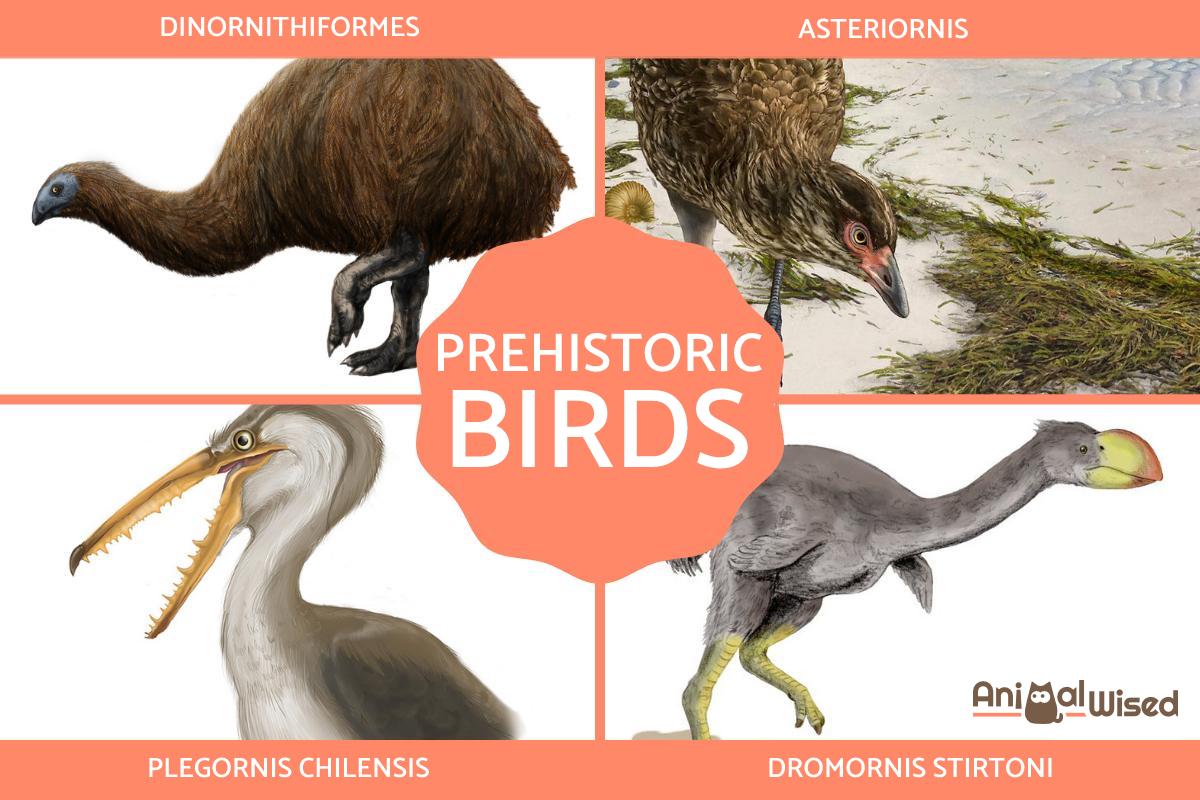
Stirton's thunderbird (Dromornis stirtoni)
This was a flightless bird, endemic to Australia, that lived thousands of years ago. It is considered one of the largest birds that ever existed, weighed between 450 and 600 kg and its head was more than half a meter long. Despite these features, he had a tiny brain, compared to the size of domestic chickens or sparrows.
Interestingly, Stirton's thunderbird was part of a unique ecosystem where it played a crucial role as both a browser and seed disperser, which would have significantly influenced the vegetation patterns of its habitat.
Pelagornis chilensis
This species corresponded to one of the largest flying prehistoric birds that ever existed. Its remains were found in Chile and allowed to describe that the animal had a wingspan between 5.25 and 6.10 meters.
It lived about 7 million years ago. In addition to its size, the presence of bony projections on the beak, simulating teeth, stands out. On the other hand, its pelican-like appearance is described.
The enormous wingspan of Pelagornis chilensis would have made it an exceptional glider, capable of covering vast distances over oceans in search of food, similar to modern albatrosses.
Asteria bird (Asteriornis maastrichtensis)
This prehistoric bird is related to the ancestor of both ducks and roosters. It lived in Europe about 66.7 million years ago, about the time when dinosaurs existed. It is believed that he could fly and his habitat was coastal areas. His contribution to science was very valuable because he provides information about the first modern birds that lived at that time.
Moreover, the discovery of Asteriornis fossils helps bridge the gap in our understanding of avian evolution, offering insights into how early birds adapted to a rapidly changing environment at the end of the Cretaceous period.
Elephant birds (Aepyornithidae)
On Madagascar there was a group of birds that appeared about 85 million years ago and became extinct due to human pressure around the 18th century. Their name refers to their main characteristic, the enormous size they could reach, up to 3 meters high and about 650 kg.
These birds were part of a unique island ecosystem, and their extinction likely led to significant changes in the ecological balance of Madagascar, affecting everything from plant life to other animal species.
Moas (Dinornithiformes)
There was a group of atypical birds that included a variety of species that differed in size but had one common feature in their evolutionary process: the absence of wings. They lived in New Zealand and, depending on the species, they could be the size of a modern chicken or grow 3 meters tall. They appeared about 90 million years ago and became extinct around 1400 due to human activities. Among their living relatives we find the kiwis.
The extinction of Moas due to overhunting by humans had profound impacts on New Zealand's ecosystems, highlighting the delicate balance between species and their environments.

Examples of current prehistoric birds
In some cases, extinct birds are closely related to species living today. Let us know some examples of living prehistoric birds:
Family Struthionidae
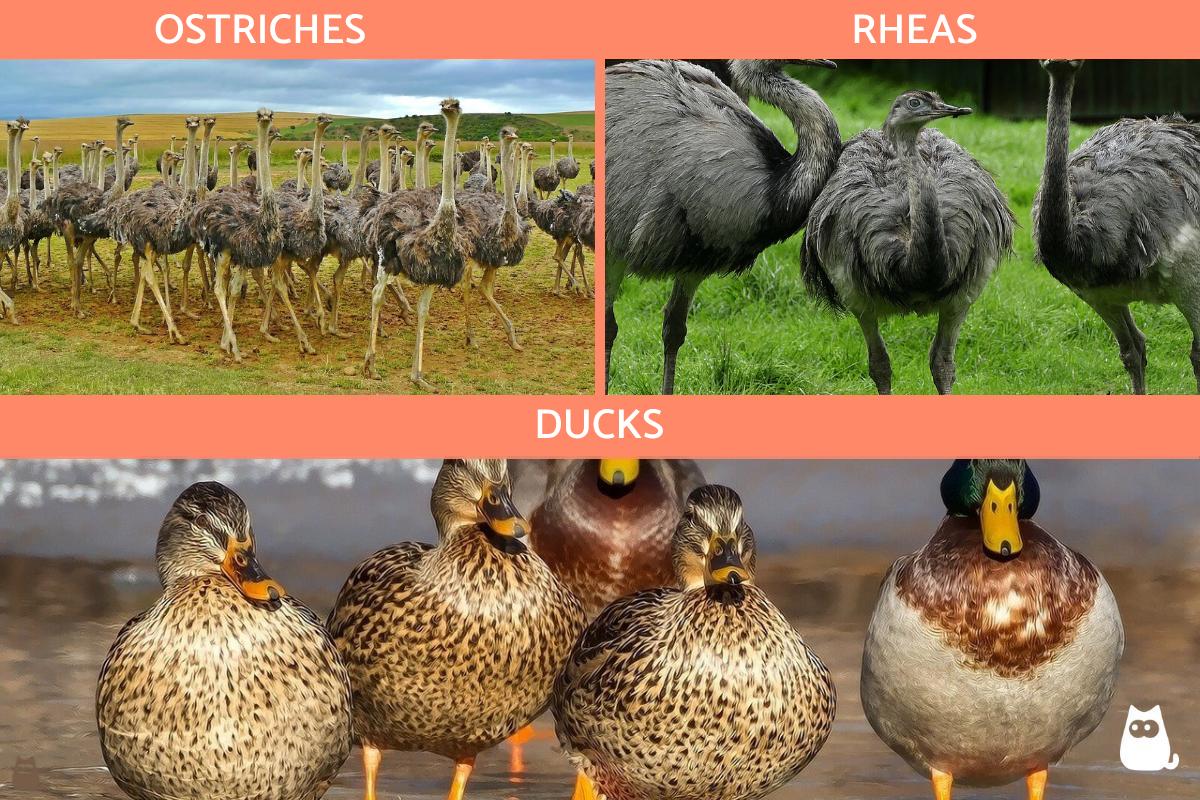
This is a family of flightless birds that emerged in the Eocene, a period that lasted roughly between 56 and 34 million years ago. Currently, the only living genus is Struthio, which includes the peculiar ostriches.
Ostriches have adapted remarkably well to arid environments, utilizing their long legs to cover great distances in search of food and water, demonstrating the enduring adaptability of ancient avian lineages.
Family Rheidae
This family belongs to the group of ratites, which are flightless birds and have a long evolutionary history. There are several already extinct species in this family. Currently, only three species commonly known as Rheas are still alive.
Rheas are known for their complex social behaviors and communal nesting habits, which reflect sophisticated survival strategies developed over millions of years of evolution.
Galloanserae Group
This group, traditionally called, contains two subgroups within which there are numerous species with a long history of domestication by humans, namely:
- Galliformes: Mainly terrestrial species.
- Anseriformes: corresponds to species with aquatic habits.
The ancestors of this group lived with the dinosaurs, but they became extinct. However, the Galloanserae were able to continue their evolutionary path and today have representatives such as chickens and ducks.
The domestication and widespread distribution of Galloanserae species have made them integral to human culture and agriculture, showcasing the deep connections between humans and avian species throughout history.

If you want to read similar articles to Living and Extinct Prehistoric Birds - Evolution of Birds, we recommend you visit our Facts about the animal kingdom category.
- Tambussi, C. (2006). Evolution of Modern Birds . Available in: Museum Magazine. Available at: http://sedici.unlp.edu.ar/bitstream/handle/10915/47242/Documento_completo__.pdf?sequence=1&isAllowed=y
- Braun, EL; Kimball, R.T. (2021). Data types and the phylogeny of Neoaves . birds. Available at: https://www.mdpi.com/2673-6004/2/1/1
- Borenstein, S. (2014). Study traces dinosaur evolution into early birds . Available at: https://web.archive.org/web/20140808042331/http://apnews.excite.com/article/20140731/us-sci-shrinking-dinosaurs-a5c053f221.html
- Lingenhöhl, D. (2021). The giant bird with the brain of a sparrow . Available at: https://www.investigacionyciencia.es/noticias/el-ave-gigante-con-cerebro-de-gorrin-19740
- National Museum of Natural History of Chile (). Pelagornis chilensis – The world's largest prehistoric bird . Available at: https://www.mnhn.gob.cl/colecciones/pelagornis-chilensis-el-ave-prehistorica-mas-grande-del-mundo
- Pickrell, J. (2020). Remains of oldest documented modern bird discovered to date . Available at: https://www.nationalgeographic.es/animales/2020/03/descubren-restos-ave-moderna-mas-antigua-documentada