Types of Toucans - Different Toucan Species

 Add us on Google
Along with barbets, toucans make up the birds found in the Ramphastidae family, itself belonging to the order Piciformes. Toucans are arboreal and inhabit the forests of the Americas with a habitat ranging from Mexico to Argentina. Toucans are very intelligent birds, but they are particularly noted for their physical appearance. This is due to their vibrant plumage colorations and characteristically long beaks.
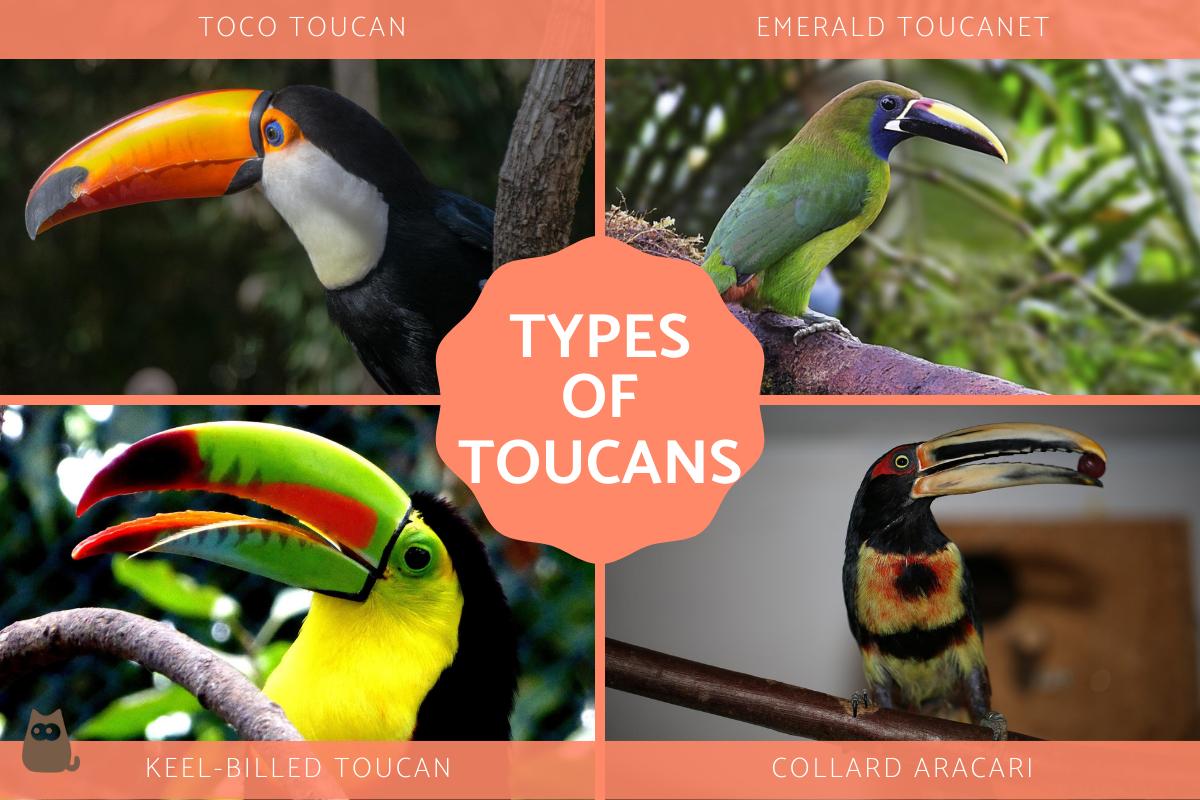
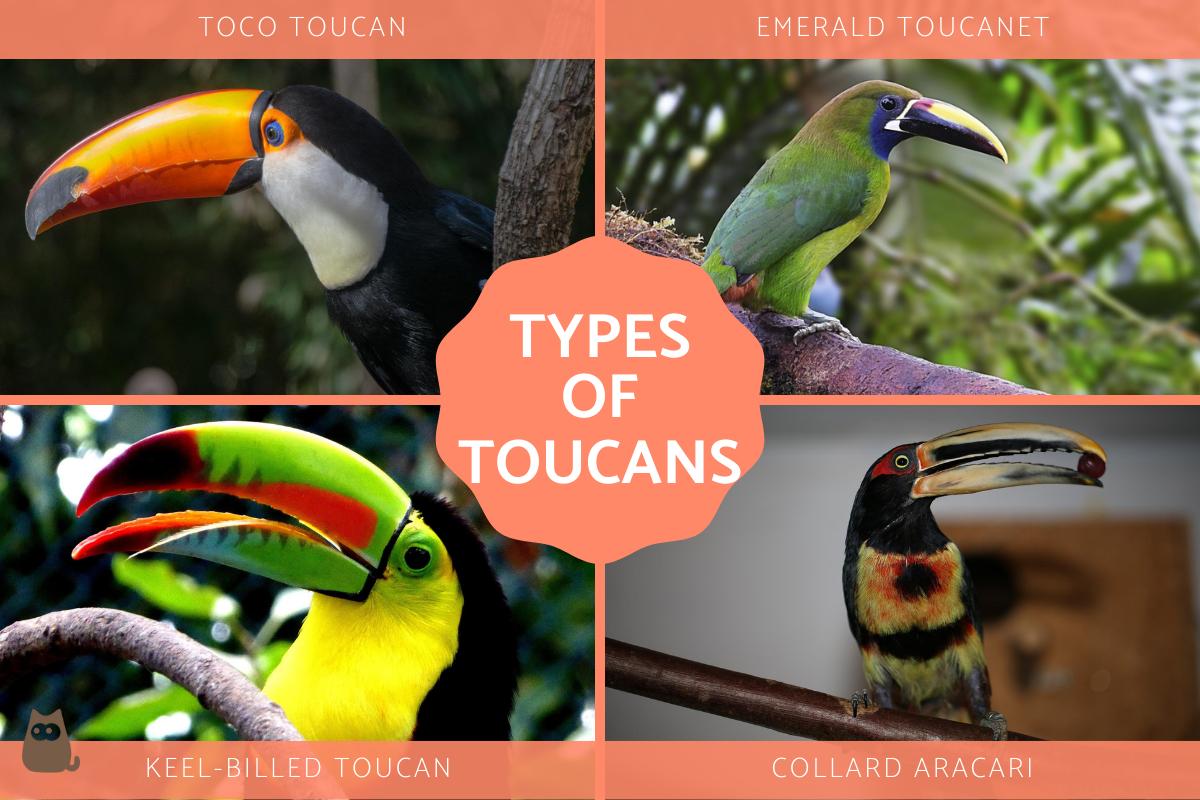
The best known toucan is the largest, a bird known as the toco toucan (Ramphasto toco). However, there are more than 40 species of Toucan to be found. In this AnimalWised article on types of toucans, we reveal what are the different toucan species, as well as their characteristics and photos of what they look like.
Characteristics of different types of toucans
All types of toucans that exist have a series of characteristics that allows their grouping within the same taxonomic group. The common characteristics of toucans include the following:
- Beak: all toucans have a long, wide and downward curved beak. It can be of various colors, including black and white or yellow. Its edges are serrated and sharp, with air chambers to make it lighter and reduce strain on their head. In addition to eating, they use their beaks to eliminate heat and regulate their temperature.
- Plumage: the color of their plumage varies greatly between the different types of toucans that exist, although black, green, blue, white and yellow colors usually dominate. A peculiar characteristic is that the orbital zone around the eye is usually of a different color. This feature adds to their striking appearance, making them easily distinguishable.
- Wings: their wings are short and rounded, meaning they are best adapted to short flights. This adaptation helps them navigate through dense forest canopies where they primarily reside.
- Habitat: toucans are arboreal and inhabit the canopy of forests. They are generally quite sedentary, although they can make regional migrations looking for seasonal fruit. Their habitat preference emphasizes the importance of forest conservation for their survival.
- Food: most toucans are types of frugivorous animals, i.e. they mainly feed on fruit. However, the diet of the toucan may also include seeds, leaves, eggs, insects and small vertebrates, such as lizards. Their diverse diet reflects their adaptability to different environmental conditions.
- Social behavior: they are monogamous animals and live with the same partner all their lives. In addition, many form family groups of more than 4 individuals. This social structure aids in protection and resource sharing within groups.
- Reproduction: after a mating ritual in which the male feeds the female, both mates build a nest in the hollow of a tree. Afterwards, the females lay their eggs and both parents take care of both incubation and rearing. This cooperative parenting ensures a higher survival rate for the offspring.
- Threats: the toucan family is considered vulnerable due to the destruction of habitat as a result of deforestation. According to the IUCN, although none of the types of toucans that exist are in danger of extinction, the number of their populations is in constant decline. Conservation efforts are crucial to protect these unique birds and their habitat.
Toucans are not the only bird with an elongated beak. Take a look at our related article to find out the different types of birds with long beaks.

Types of toucans
As with many types of birds, different toucan species are grouped into categories depending on certain factors. With the toucan, they are usually differentiated by size. Toucans are grouped into three categories according to size:
- Toucans: the largest type of toucan, known for their impressive size and vibrant appearance.
- Aracaris: medium-sized toucans that are agile and quick, often seen in lively groups.
- Toucanets: small toucans, known for their charming demeanor and varied color patterns.
This size grouping is loose and does not affect their taxonomic ordering. According to modern classification, there are five genera of toucan:
- Green toucanets (Aulacorhynchus)
- Dichromatic toucanets (Selenidera)
- Mountain toucans (Andigena)
- Aracari (Pteroglossus)
- Toucans (Ramphastos)
Within these different genera of toucans, we can find various types of toucan species. We look at some of these different toucan species in more detail below.
Green toucanets (Aulacorhynchus)
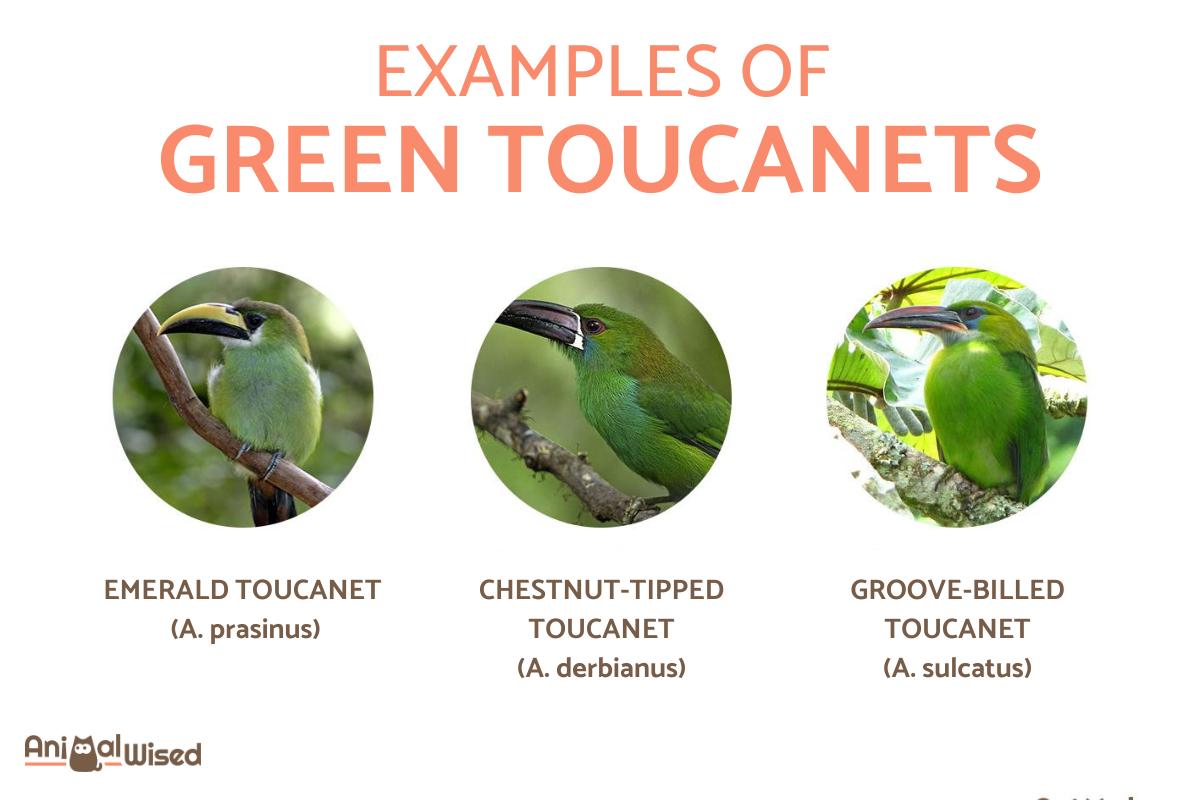
Green toucanets (Aulacorhynchus) are distributed throughout the humid forests of the Neotropics, from southern Mexico to Bolivia. They are small, green types of toucans that are between 30 and 40 cm long and have a long, stepped tail. Their bill is usually black, white, yellow or reddish, adding to their distinctive look.
Examples of green toucanets
The different species of toucanets present variations in color, size, bill shape, and vocalizations. The following are some examples:
- Emerald toucanet (A. prasinus) - Known for its vibrant green plumage and melodic calls, this species is often found in pairs or small groups.
- Chestnut-tipped toucanet (A. derbianus) - This species has a unique chestnut color on the tips of its feathers, making it easily recognizable.
- Groove-billed toucanet (A. sulcatus) - Characterized by the grooves on its bill, this species is adapted to a variety of forest environments.
These toucanets play an important role in their ecosystems, particularly in seed dispersal, which aids in forest regeneration.

Dichromatic toucanets (Selenidera)
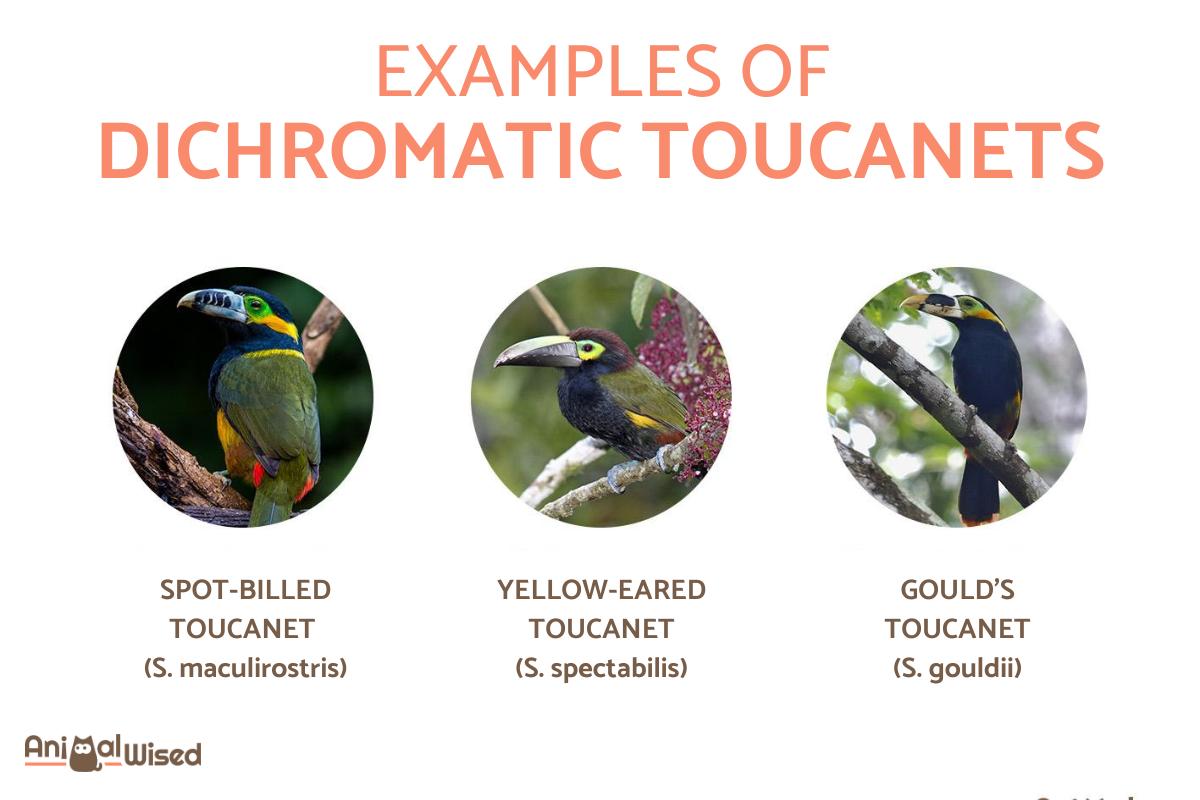
Dichromatic toucanets (Selenidera) inhabit the forests of the northern half of South America. They are characterized by having a dark black beak with white or, sometimes, gray tones. As in the previous group, their size is between 30 and 40 cm, making them part of the small toucanet group.
These jungle animals are markedly sexually dimorphic animals. Males have a black throat and chest, while females have a brown chest and a slightly shorter bill. In some species, males have a red and yellow stripe that starts from the orbital area, while the females do not have this feature. This sexual dimorphism is a fascinating aspect of their biology and plays a role in mate selection.
Examples of dichromatic toucanets
Among the species of dichromatic toucanets, we find the following:
- Spot-billed toucanet (S. maculirostris) - Known for the distinctive spots on its beak, this species is quite vocal and social.
- Yellow-eared toucanet (S. spectabilis) - With its striking yellow ear patch, this toucanet is a sight to behold in the dense forest canopy.
- Gould's toucanet (S. gouldii) - This species is notable for its rich coloration and its preference for lower forest levels.
Their presence in diverse habitats highlights the adaptability and ecological significance of these toucanets.

Mountain toucans (Andigena)
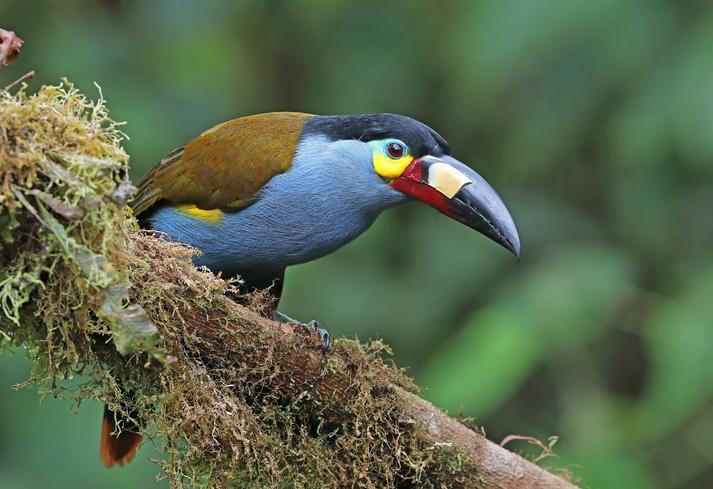
As their name suggests, mountain toucans (Andigena) are distributed in the humid forests of mountain ranges. Specifically, they are found in the Andes mountain range of western South America. They are characterized by having very striking and varied colors, both in their plumage and on the beak. They measure between 40 and 55 cm in length.
Examples of mountain toucans
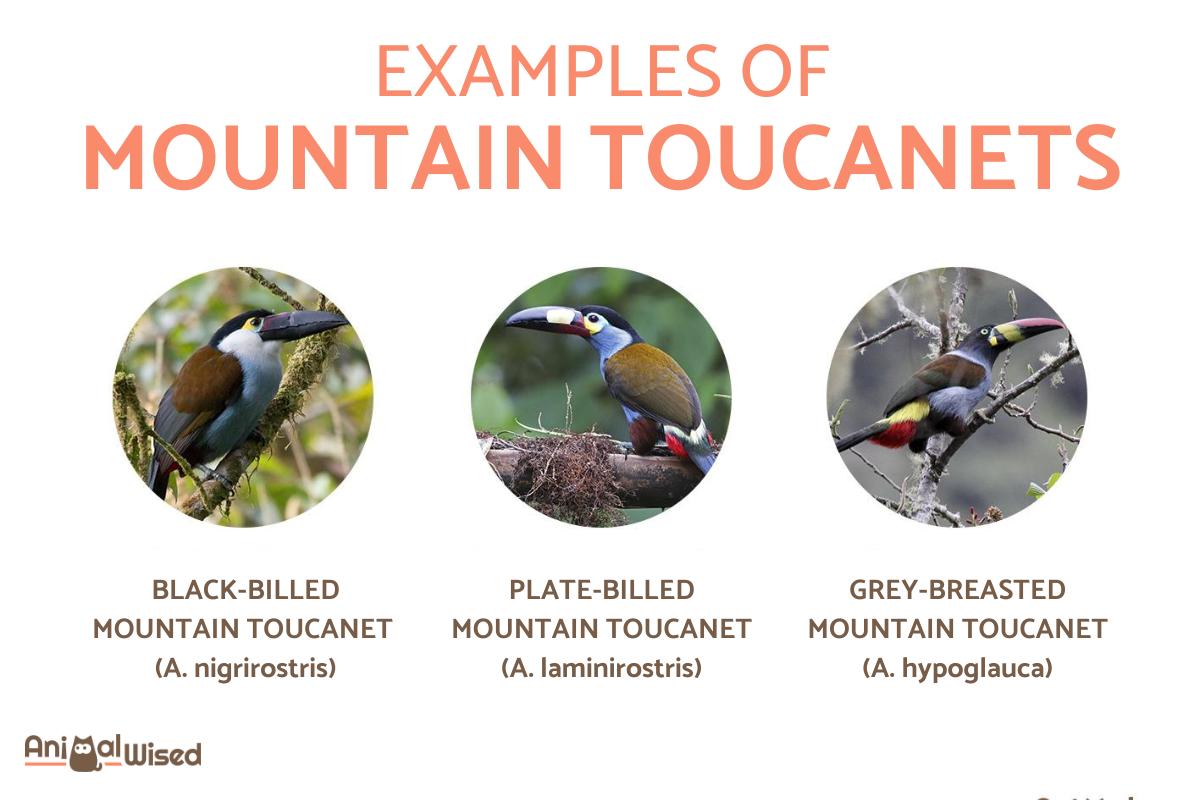
These are some examples of mountain toucans:
- Black-billed mountain toucan (A. nigrirostris) - This species is distinguished by its glossy black bill and vibrant plumage. It can often be seen foraging in pairs or small groups.
- Plate-billed mountain toucan (A. laminirostris) - Known for its unique plate-like bill, this toucan is often found in high-altitude cloud forests.
- Grey-breasted mountain toucan (A. hypoglauca) - With its subtle grey breast and colorful beak, this toucan adds beauty to the Andean landscapes.
And if these toucans seem striking to you, we encourage you to read this other article about the most exotic animals in the world. These mountain toucans contribute significantly to the biodiversity and ecological balance of their mountainous habitats.

Aracari (Pteroglossus)
Aracari (Pteroglossus) live in the forests of the Neotropics or tropical zone of America. They mainly inhabit the basins of the Amazon and Orinoco rivers. Known for their social behavior, these birds are often seen in flocks, which helps in locating food sources.
The size of these Amazon animals is around 40 cm in length. With the exception of the saffron toucanet (P. bailloni), they have black or dark back plumage, while the belly is colorful and often covered with horizontal stripes. The beak measures around 10 cm in length and is usually yellow and black. Their striking appearance makes them a favorite among bird watchers and nature enthusiasts.
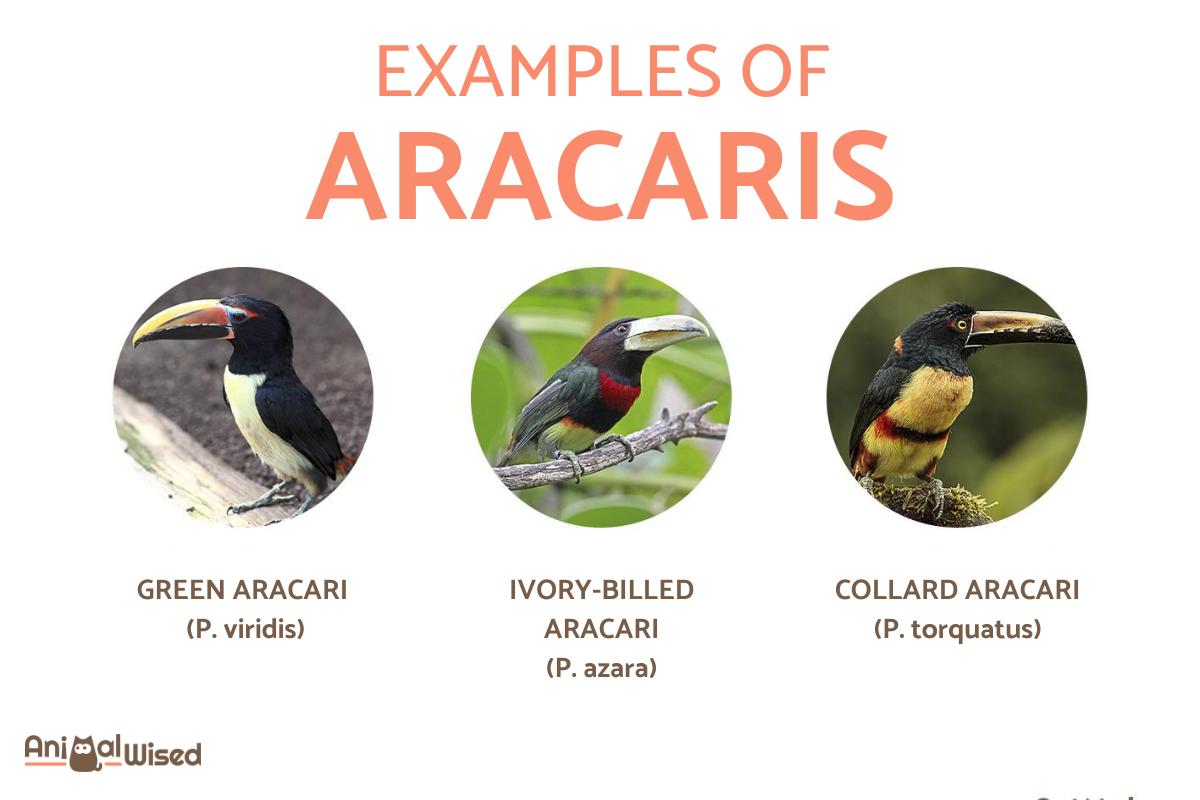
Examples of aracari
- Green aracari (P. viridis) - This species is the smallest of the aracaris and is known for its emerald green plumage.
- Ivory-billed aracari (P. azara) - Named for its ivory-colored bill, this aracari is a regular inhabitant of the Amazon rainforest.
- Collared aracari (P. torquatus) - With its distinctive collar marking, this species is often seen in mixed-species flocks.
Their presence in the dense Amazonian forests underscores the rich biodiversity of this crucial ecosystem.

Toucans (Ramphastos)
Birds of the genus Ramphastos are the best known toucans and they bear the mononym of toucan. Of all the types of toucan that exist, these are the largest and have the most striking beaks. Their large size and vibrant coloration make them iconic symbols of the Neotropical forests. They also have a very wide distribution, from Mexico to Argentina.
These jungle animals measure between 45 and 65 cm in length and their beak can reach 20 cm. As for its plumage, it is very varied in coloration, although the back and wings are usually dark, while the belly is lighter or brighter. This contrast in colors is not only visually stunning but also serves as a form of communication among toucans.
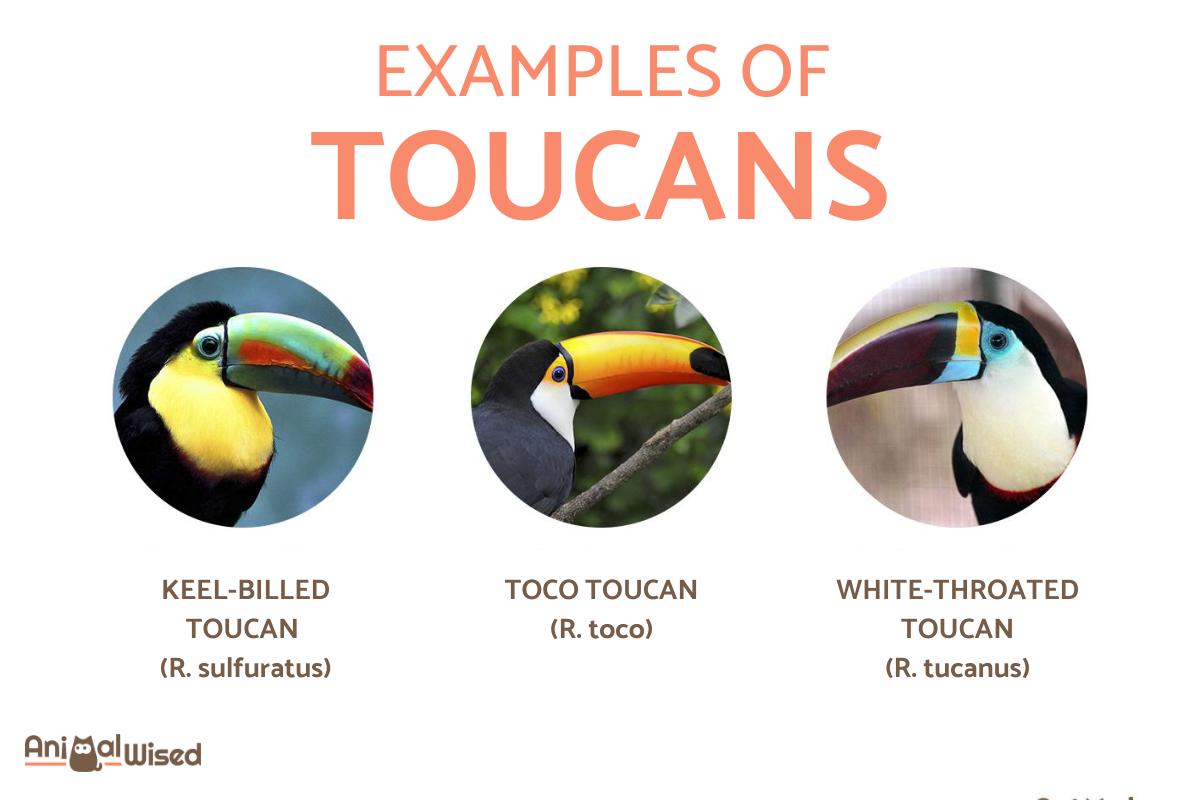
Examples of toucans
Here are some examples of toucans:
- Keel-billed toucan (R. sulfuratus) - Known for its rainbow-colored bill, this toucan is often seen in the forest canopy, feeding on fruits.
- Toco toucan (R. toco) - The largest of all toucans, it is easily recognized by its massive orange beak and striking black and white plumage.
- White-throated toucan (R. tucanus) - This species has a distinctive white throat patch and is often heard calling loudly in the forest.
Now we know the different types of toucan species, we might want to know about other groups of birds. Take a look at our article on the different types of water birds to learn more. These toucans play a vital role in their ecosystems, particularly in seed dispersal and forest regeneration.

If you want to read similar articles to Types of Toucans - Different Toucan Species, we recommend you visit our Facts about the animal kingdom category.
- Short, L., & Horne, J. (2001): Toucans, Barbets & Honeyguides. Oxford University Press.
- Puebla-Olivares, F., et al. (2008). Speciation in the Emerald Toucanet (Aulacorhynchus Prasinus) Complex, The Auk, 125(1), 39–50.
- Sandoval, R., & Rodriguez, A. (2018). Observations at a yellow-eared toucanet (Selenidera spectabilis). Neotropical Ornithology, 29, 175–178.
- Hilty, S. L., & Brown, W. L. (2001). Guide to the Birds of Colombia. Princeton University Press, NJ. 1030p.